Tesco Steel & Engineering forges ASTM A350 LF2 blind flanges — low temperature carbon steel, the cold-weather twin of A105 — to ASME B16.5 Class 150–2500 from ½″ to 24″ NB and to ASME B16.47 up to 60″. Same strength group as A105, one decisive addition: every heat is heat treated and Charpy impact tested at -46 °C — certified proof the blind stays tough through blowdown chills, depressurisation and cold climates where plain carbon steel risks brittle fracture. Facings follow the mating flange: BLRF, BLFF or BLRTJ — and LF2 lives happily in the RTJ wellhead world, with NACE MR0175 compliance to order. Every lot with EN 10204 3.1/3.2 MTC. ISO 9001:2015, made in Mumbai, India — exported to 50+ countries.
ASTM A350 LF2 Cl.1 · ASME SA-350Charpy Tested at -46 °CASME B16.5 ½″–24″ · Class 150–2500ASME B16.47 to 60″RF · FF · RTJ FacingsNACE MR0175 to OrderEN 10204 3.1 / 3.2 · ISO 9001:2015
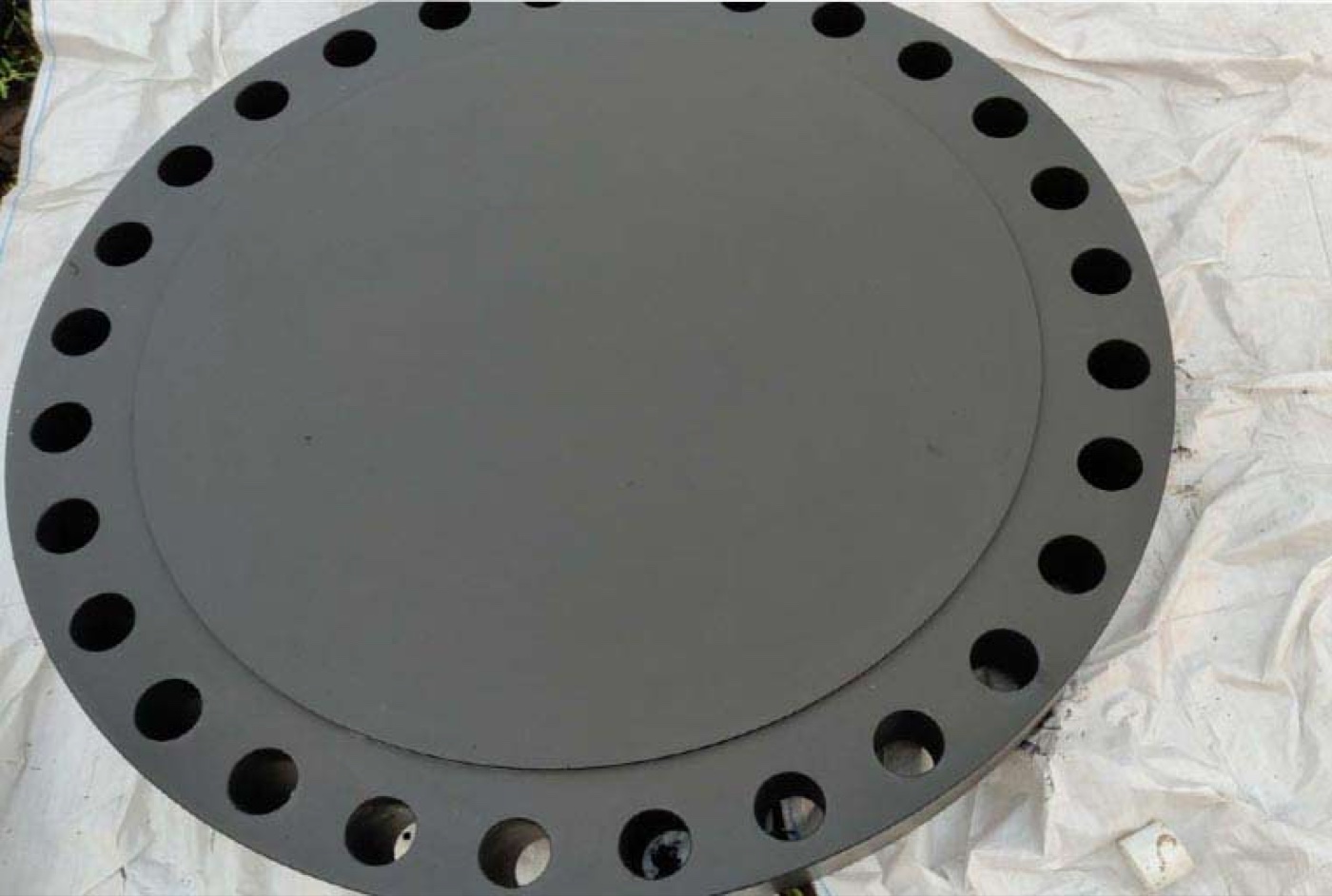
Large LTCS Blind Flange — Black-Coated Raised Face, at Our Works
What is an ASTM A350 LF2 Blind Flange?
The blind that carries a cold certificate. A solid forged disc of low temperature carbon steel with no bore, closing pipes, valves and nozzles exactly as an A105 blind does — but heat treated and Charpy V-notch tested at -46 °C, so its toughness in the cold is proven, not assumed. Same B16.5 group 1.1 ratings as A105, tensile 485–655 MPa. The closure of gas plants, blowdown systems and cold climates, per ASME B16.5 / B16.47 in RF, FF and RTJ facings.
Also searched as: LF2 blind flange, LTCS blind flange, SA-350 LF2 blind (the ASME boiler-code twin), A350-LF2 Cl.1 blind, low temp carbon steel blind — all refer to the product on this page. See also the A105 blind flanges (the warmer twin), the LTCS hub, and the facing pages BLRF / BLFF / BLRTJ.
485–655 MPa (max capped — strength traded for toughness)
Pressure Ratings
Identical — both in ASME B16.5 material group 1.1
Appearance
Identical — only marking and certificate distinguish them
The point in one line: LF2 costs a little more and gives up nothing — what you are buying is the proof on paper that the blind will bend, not shatter, on the coldest day the process can produce.
Why the Charpy Test Matters on a Blind
Brittle Fracture Is the Enemy
Carbon steel below its transition range can fail instantaneously — no bulge, no weep, no warning. A blind is a plate carrying full line pressure in bending; it is precisely the component you do not want brittle.
The Test That Rules It Out
Charpy V-notch specimens from every heat are broken at -46 °C and must absorb the specified energy. The values print on the certificate — toughness measured, not assumed.
Cold Comes From the Process, Not Just the Weather
Depressurisation chills steel far below ambient — the Joule-Thomson effect of gas letting down can take a Middle East gas plant's piping below -46 °C. The blowdown case, not the map, usually decides LTCS.
Each rung is bought with a certificate. LF2 is the workhorse rung — the one that covers nearly all real-world "low temperature" piping without leaving carbon-steel economics.
LF2 Chemistry & Mechanical Properties
Element
C
Mn
Si
P
S
Weight %
≤0.30
0.60–1.35
0.15–0.30
≤0.035
≤0.040
Property
ASTM A350 LF2 Requirement
Tensile Strength
485–655 MPa (70–95 ksi) — maximum capped
Yield Strength (0.2%)
≥ 250 MPa (36 ksi)
Elongation
≥ 22% (basic, in 2 in.)
Hardness
≤ 197 HB
Impact (Class 1)
Charpy V-notch at -46 °C, specified minimum average — every heat
Slightly less carbon and more manganese than A105 — the recipe leans toward toughness — and the capped tensile maximum is deliberate: over-strong carbon steel tends to be under-tough, so the specification refuses the trade.
Strong in LF2 — wellheads & gas plants run RTJ from Class 600 up
Cold, sour and high-pressure often arrive together — which is why the LF2 RTJ blind is a signature gas-industry part. The mating flange governs the facing; for RTJ the ring number follows from size and class.
ASTM A350 LF2 Blind Flange Specifications
ASTM A350 LF2 Blind Flanges are available in the following specifications:
Material Grade
ASTM A350 LF2 Class 1 (default) / Class 2; ASME SA-350 dual-certifiable
Impact Testing
Charpy V-notch at -46 °C (Class 1), values stated on certificate; heat treatment mandatory
Size
1/2"NB to 24"NB per ASME B16.5; 26"–60" per ASME B16.47 Series A & B; EN 1092-1 Type 05 to order
Class
150#, 300#, 400#, 600#, 900#, 1500#, 2500#
Facings
Raised Face (BLRF), Flat Face (BLFF), Ring Type Joint (BLRTJ) with groove per B16.20
Sour Service
NACE MR0175 / ISO 15156 compliance on request — hardness within the 197 HB cap
Surface Protection
Black anti-rust paint / oil standard; yellow zinc-chromate, galvanizing, VCI to order
Modifications
NPT-tapped centre (hydrotest / vent / drain / gauge), lifting provisions — to order
Certification
EN 10204 3.1 (standard) / 3.2 witnessed — impact values, heat treatment and class stated
Why LF2 Blind Flanges Are Specified
Proven Toughness, on Paper
The -46 °C Charpy certificate is the whole point: when the auditor, the code or the incident investigator asks whether the closure could go brittle, the answer is a test result, not an assumption.
A105 Economics, Cold-Rated
Same strength group, same dimensions, same look — LTCS stays within carbon-steel pricing while covering design temperatures A105 legally cannot.
The Blowdown Insurance
Lines that run warm can still chill below -29 °C in seconds when gas depressurises. Specifying LF2 blinds across a gas plant removes the coldest-case question closure by closure.
Sour-Ready
NACE MR0175 compliance sits comfortably inside LF2's mandatory heat treatment and hardness cap — the natural blind for sour gas processing and wellhead isolation.
Three details buyers miss.The blinds look identical: nothing visually separates LF2 from A105 — segregate stock by marking and heat number, and never let an uncertified blind onto an LTCS line. Class 1 unless stated: LF2 Class 2 is impact tested at only -18 °C; if your minimum design metal temperature is -46 °C, the certificate must say Class 1. Match the test blind too: hydrotest and blowdown closures see the same cold cases as the line — an A105 test blind on an LTCS system is a specification break that audits do catch.
How Our LF2 Blind Flanges Are Manufactured
1
Forging — cut billet of the spectro-verified LF2 heat is hot-forged into the solid disc blank, keeping full heat traceability from melt to marking.
2
Mandatory heat treatment — normalized, normalized and tempered, or quenched and tempered per the specification; furnace charts retained against the heat number.
3
Impact testing — Charpy V-notch specimens broken at -46 °C for every heat; recorded values go onto the certificate — the step that makes LF2, LF2.
4
Machining & facing — faces, OD and drilling to ASME B16.5 / B16.47; RF serrations, full flat face or RTJ groove gauged per B16.20; NPT taps machined where ordered.
5
Testing & marking — tension test, chemistry and hardness against the heat (UT, MPI and NACE testing where specified), then permanent marking including grade, class and heat number.
6
Protection & packing — black anti-rust coating or the ordered finish, gasket faces protected, EN 10204 3.1 MTC issued; palletised or crated sea-worthy as pictured on this page.
Where LF2 Blind Flanges Are Used
Wherever the metal can get cold: gas processing and LPG plants, ethylene and ammonia units, compressor and pipeline stations with depressurisation cases, offshore platforms, and cold-climate projects generally — as line closures, maintenance isolations and tapped hydrotest blinds matched to the system's LTCS rating. Stock and packing below:
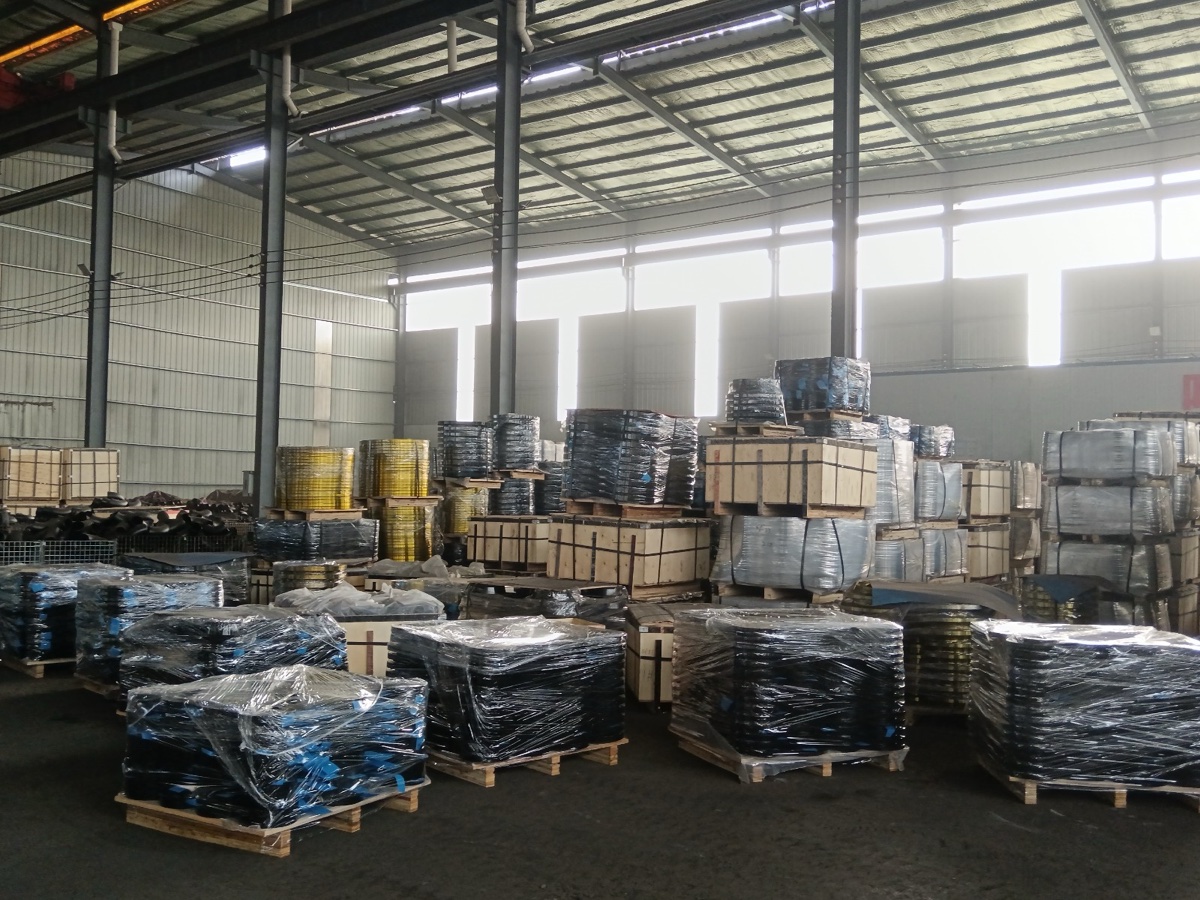
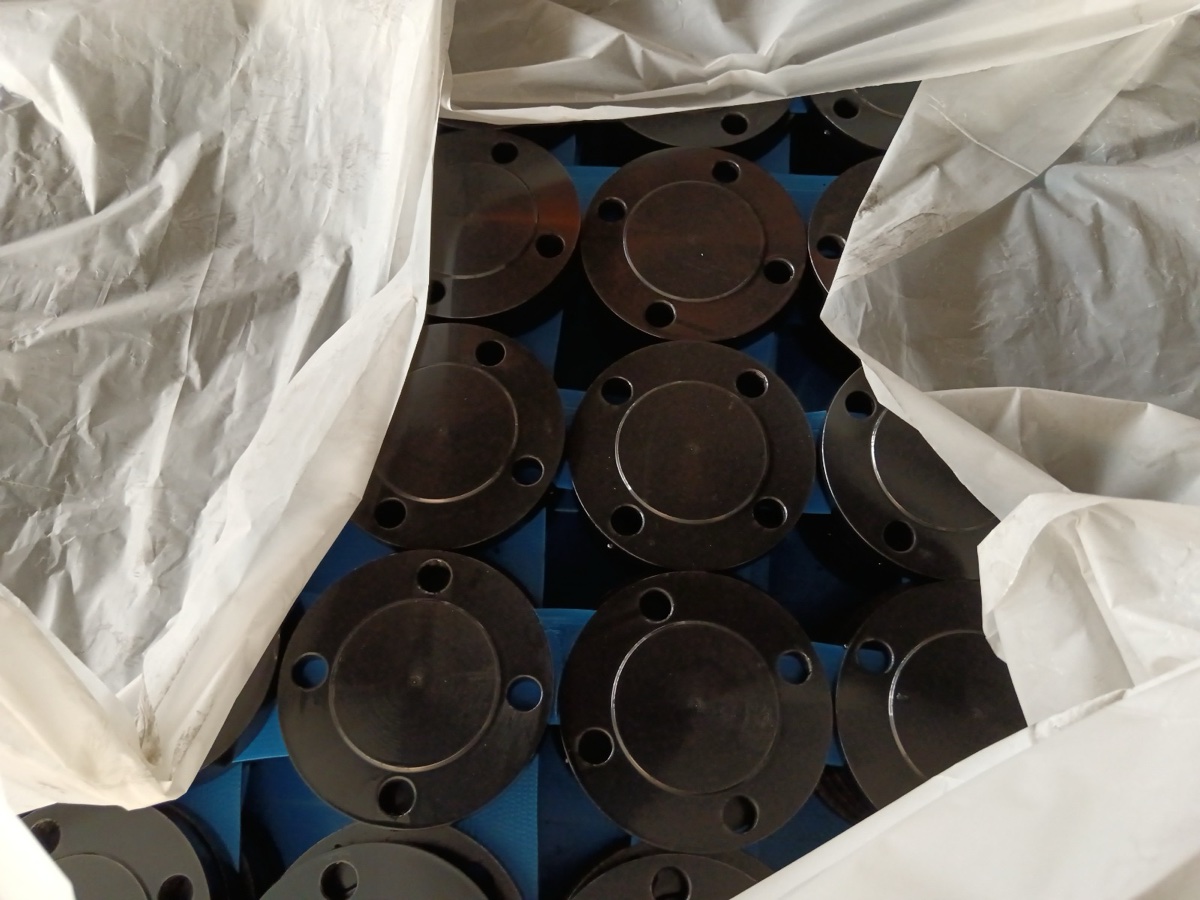
Palletised Flange Stock — Wrapped for Export at Our WarehouseBlack-Coated RF Blind Flanges — Packed in Lined Crate
LF2 Blind Flange Dimensions
Blind dimensions are class-governed — identical for LF2 and A105. Full charts:
An ASTM A350 LF2 blind flange is a solid forged disc of low-temperature carbon steel (LTCS), drilled to the standard bolt pattern with no bore, used to close pipes, valves and vessel nozzles where the design temperature falls below what ordinary A105 covers. LF2 is chemically close to A105 but supplied heat-treated and Charpy impact tested at -46°C — proof, on the certificate, that the steel stays tough in the cold. Dimensions follow ASME B16.5 from ½ inch to 24 inch and ASME B16.47 beyond, in raised face, flat face and ring joint facings.
What kind of steel is A350 LF2?
A forged low-temperature carbon steel — ASTM A350 covers carbon and low-alloy forgings requiring notch toughness testing, and LF2 is its workhorse grade. Chemistry sits close to A105 (carbon 0.30% max, manganese 0.60-1.35%), but heat treatment is mandatory — normalized, normalized and tempered, or quenched and tempered — and every heat must pass a Charpy V-notch impact test. The result is a grade that matches A105 in strength and appearance while carrying certified toughness down to -46°C.
What is the difference between A105 and A350 LF2?
Strength-wise, almost nothing — the two share ASME B16.5 material group 1.1, so pressure-temperature ratings match. The difference is proven toughness: A105 carries no impact-test requirement and the codes stop assuming its toughness below -29°C; LF2 is mandatorily heat treated and Charpy tested at -46°C. The flanges look identical on a pallet — only the marking and the certificate distinguish them — which is exactly why the certificate matters. Our A105 blind flange page covers the warmer twin; below -29°C, the blind must be LF2.
What does the Charpy impact test prove?
That the steel absorbs energy instead of shattering when it is cold. Carbon steel loses toughness as temperature falls — below its transition range it can fracture in a brittle, instantaneous way rather than bending and leaking a warning. The Charpy V-notch test breaks notched specimens at -46°C and measures the energy absorbed; LF2 must meet the specified minimum average. For a blind flange — a plate holding full line pressure in bending — brittle fracture is the failure mode you buy LF2 specifically to rule out.
What temperature range does an LF2 blind flange cover?
From -46°C, the impact-test temperature, up through the same moderate-temperature territory as A105 — LF2 shares B16.5 material group 1.1 ratings. In practice LF2 is specified for the cold end: minimum design metal temperatures between -29°C and -46°C, and any line whose blowdown or depressurisation case dips below -29°C. Colder still, the handoff continues: A350 LF3 (3.5% nickel) reaches -101°C, and austenitic stainless blinds carry cryogenic duty beyond.
What is the difference between LF2 Class 1 and Class 2?
The impact-test temperature. Class 1 — the default, and what 'LF2' means unless stated otherwise — is Charpy tested at -46°C. Class 2 is tested at only -18°C, trading toughness margin for slightly relaxed requirements, and is rarely specified. Unless your specification explicitly says Class 2, order and expect Class 1; our certificates state the class and the actual impact values recorded.
When is A350 LF3 needed instead of LF2?
Below -46°C. LF3 adds about 3.5% nickel, which keeps the steel tough down to -101°C — the grade of colder gas-processing and refrigerated-storage duty. Below that, ferritic steels give way entirely and cryogenic service (LNG at -162°C, liquid nitrogen at -196°C) moves to austenitic stainless, which has no ductile-brittle transition at all. The ladder is: A105 to -29°C, LF2 to -46°C, LF3 to -101°C, stainless beyond — each step bought with the certificate that proves it.
What are the mechanical properties of LF2 blind flanges?
Tensile strength 485-655 MPa (70-95 ksi) — note the specification caps the maximum, since over-strong carbon steel tends to be under-tough — yield strength 250 MPa (36 ksi) minimum, elongation 22% minimum, hardness 197 HB maximum, plus the mandatory Charpy impact values at -46°C. Mandatory heat treatment underwrites all of it. Every heat is tension-tested, impact-tested and chemistry-verified, with results on the EN 10204 3.1 certificate.
What facings are LF2 blind flanges made with?
All three: raised face (BLRF), flat face (BLFF) and ring type joint (BLRTJ) — each facing has its own page on this site. The RTJ share is notably higher in LF2 than in most grades: low-temperature carbon steel is a wellhead and gas-plant material, and that world runs ring joints from Class 600 upward. The LF2 forging is common to all three facings; the mating flange governs the choice, and for RTJ the ring number follows from size and class.
What sizes and classes are LF2 blind flanges available in?
From ½" to 24" NB per ASME B16.5 in Classes 150 through 2500, and from 26" to 60" per ASME B16.47 Series A and B. Common sizes and classes are stocked; larger and higher-class blinds are forged against the order with full impact-test certification. EN 1092-1 Type 05 blinds in the PN series are produced to order in the same grade — with the low-temperature toughness certified to EN or ASTM requirements as the project specifies.
Can LF2 blind flanges be tapped for testing or instruments?
Yes — the NPT-tapped centre modification applies to LF2 exactly as to any blind: fill, vent, drain, gauge and injection connections for hydrotest and operational duty. It is a common order in LF2 because gas plants hydrotest and depressurise constantly, and the test closure must match the line's low-temperature rating — an A105 test blind on an LTCS system is a specification break. The tap is machined and certified with the flange; state the NPT size on the enquiry.
Where are LF2 blind flanges used?
Wherever the metal can get cold: gas processing and LPG plants, ethylene and ammonia units, pipeline and compressor stations subject to depressurisation (the Joule-Thomson chill of gas letting down to atmosphere), offshore platforms, and simply cold climates — Canadian, Siberian and Central Asian projects specify LTCS as a matter of course. On those sites the LF2 blind is the standard closure for isolations, future connections and hydrotest work, in the same duties its A105 twin performs everywhere else.
Is LF2 suitable for sour service?
Yes, commonly — LF2 with NACE MR0175 / ISO 15156 compliance is a staple of sour gas processing and wellhead work. The requirements are chiefly hardness control (comfortably within LF2's 197 HB cap when processed correctly) and appropriate heat treatment, both of which we certify. State the NACE requirement on the enquiry so testing and certification are aligned from the start; sour, cold and high-pressure often arrive together, and LF2 RTJ blinds serve exactly that intersection.
Which standards cover LF2 blind flanges?
The material standard is ASTM A350 (grade LF2, Class 1 or 2), with ASME SA-350 as its boiler-code twin; dimensions follow ASME B16.5 for ½"-24", ASME B16.47 for 26"-60", or EN 1092-1 for PN-series blinds. Pressure-temperature ratings come from B16.5 material group 1.1, shared with A105. A complete specification reads: 'Blind Flange, RF, 8", ASME B16.5 Class 300, ASTM A350 LF2 Cl.1' — and our EN 10204 certificates state dimension standard, grade, class and impact results together.
Who manufactures ASTM A350 LF2 blind flanges in India?
Tesco Steel & Engineering is an ISO 9001:2015 certified flange manufacturer based in Mumbai, India, forging ASTM A350 LF2 blind flanges from ½" to 24" NB per ASME B16.5 in Classes 150-2500 and to 60" per ASME B16.47 — heat treated, Charpy impact tested at -46°C and certified to EN 10204 3.1/3.2 on every lot — in raised face, flat face and ring joint facings, with NPT-tapped test blinds and NACE MR0175 compliance to order, alongside the full A105, stainless and alloy blind range. Exported to more than 50 countries.