Inconel 600 Long Weld Neck Flanges — UNS N06600 Nickel-Chromium LWN Manufacturer
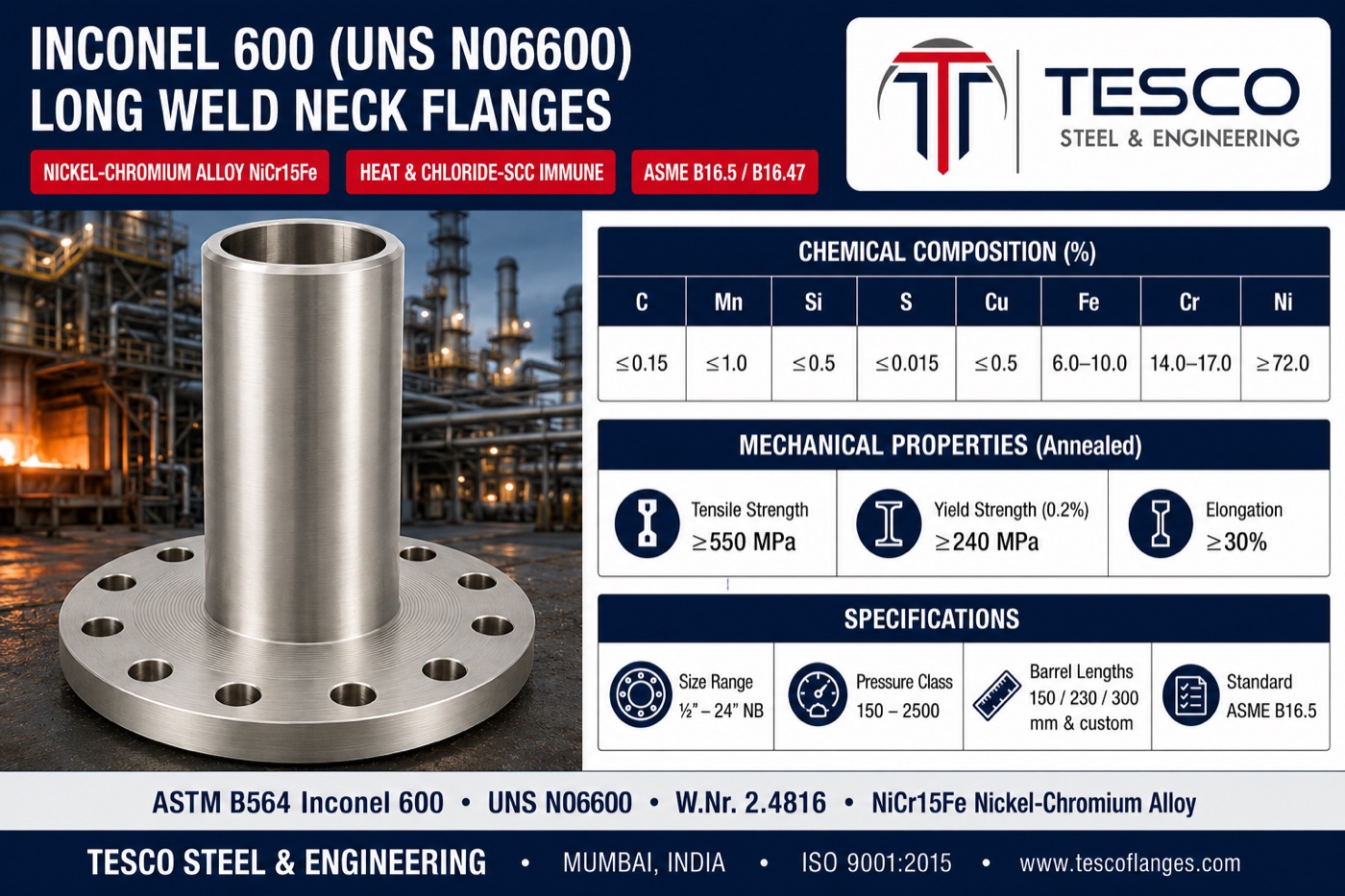
Tesco Steel & Engineering manufactures Inconel 600 long weld neck flanges — the Inconel bench opens: ASTM B564, UNS N06600, W.Nr. 2.4816, NiCr15Fe — with ASME B16.5 flange ends in Classes 150–2500 and the barrel made to order. The recipe is stainless run in reverse: nearly three-quarters nickel with 14–17% chromium as the film-former — the nickel family's chemistry wearing the chromium film's heat standing. The franchises follow: useful strength deep into red heat with an oxidation film to ~1090 °C, chloride-SCC immunity that hot brines cannot touch, dry halogens at temperature, and the caustic credential with its honest subtlety — the hottest pure alkali stays with Nickel 200/201, because the chromium leaches. The biography is told straight: the nuclear steam-generator chapter and the PWSCC lesson that sent primary circuits to Alloy 690. Hand-offs stay honest too — 310S below on economics, 625 above on strength and acid, Incoloy 800 across for code creep. One forging, one closing weld with ERNiCr-3 — the great dissimilar-joint filler. Facings: RF / FF / RTJ; small bore on the Inconel 600 socketweld. Every lot with EN 10204 3.1/3.2 MTC. ISO 9001:2015, made in Mumbai, India — exported to 50+ countries.
ASTM B564 · UNS N06600 · W.Nr. 2.4816NiCr15Fe — Stainless Run in ReverseStrength Deep Into Red Heat · ~1090 °C FilmChloride-SCC Immune · Dry HalogensERNiCr-3 — The Dissimilar-Joint Filler550 / 240 MPa AnnealedB16.5 Flange Ends · Class 150–2500EN 10204 3.1 / 3.2 · ISO 9001:2015
Inconel 600 Long Weld Neck Flanges — Specifications at a Glance
What is an Inconel 600 Long Weld Neck Flange?
The nickel-chromium original, in the nozzle pattern. An Inconel 600 flange (UNS N06600, ASTM B564) whose neck continues as a long, heavy-walled straight barrel — the nozzle itself — bevelled for one closing butt weld at the furnace, heater or vessel shell. Stainless run in reverse: ≥72% nickel with 14–17% chromium as the film-former — strength deep into red heat, chloride-SCC immunity, dry halogens, the caustic credential. Welds with ERNiCr-3, no PWHT. Supplied annealed — 550/240/30. Hand-offs honest: 310S below, 625 above, 800H for code creep, the pure metals for the hottest alkali. Flange ends per ASME B16.5, Classes 150–2500; barrel length and bore stated by you. EN 10204 3.1 on every lot.
The rule of the original:600 is the default where heat meets nickel chemistry — oxidation alone reads the stainless ladder, strength and acid read 625, code creep reads 800H, and the hottest pure caustic stays with the pure metals.
What the Reversed Recipe Buys
Strength Where Certificates Go Nominal
Useful strength deep into red heat with no phase change and no sigma — structure stable through the thermal cycling that embrittles iron-based grades, film serviceable to ~1090 °C.
Chloride SCC, Off the Table
At 72% nickel the cracking mechanism has no grip — hot brines and condensing chloride duty that crack 316-class stainless in weeks leave 600 untouched.
The Halogen Inheritance
Dry chlorine and HCl gas at temperature — the pure-nickel family's franchise carried into the heat, serving chlorination plants by name.
The Dissimilar-Joint Filler
ERNiCr-3 — celebrated far beyond this alloy as the wire that joins nickel alloys, stainless and carbon steel across the boiler world; here it simply welds like-to-like, no PWHT.
Specification Notes — Getting Inconel 600 Long Weld Necks Right
Three honest notes.Not a code-creep alloy: 600 holds strength at red heat, but rated creep duty on pressure parts belongs to Incoloy 800H's certificates — and where oxidation alone is the duty, the stainless scaling ladder serves at a fraction of the price. Sulphidising gas is the nickel family's enemy: reducing sulphur-bearing atmospheres attack high-nickel alloys through the nickel-sulphur eutectic — the same warning the 310S page carries in reverse; name the atmosphere on every hot enquiry. And the nuclear history means what it says: primary-water service reads Alloy 690 now — the PWSCC chapter is told in the FAQ, and industrial service is untouched by it.
How Our Inconel 600 LWN Flanges Are Manufactured
1
Forging — each piece individually forged from certified N06600 heats kept segregated on the nickel shelf, with the barrel integral — no welded build-ups.
2
Annealing — softened and homogenised, the single-phase structure set for service; records retained against the heat number.
3
Verification — chemistry per heat with the 72% nickel floor and chromium window certified; mechanicals per heat at the 550/240 line.
4
Machining — flange end to ASME B16.5; barrel turned to pattern (standard / HB / equal) and bored to the ordered schedule or drawing; RF serrations, flat face or RTJ groove per B16.20; weld end bevelled 37.5°.
5
Testing & marking — PMI reads the nickel-chromium signature on every piece — 600 must mix with neither the stainless shelf nor its 625 and Incoloy neighbours; marked with grade, size, schedule and heat number.
6
Certification & packing — EN 10204 3.1 MTC (3.2 witnessed on request); WPS guidance naming the ERNiCr-3 filler; faces and bevels protected, packed sea-worthy.
Where Inconel 600 LWN Flanges Are Used
Where heat meets nickel chemistry: furnace and heat-treatment systems — muffle, retort and radiant-tube connections, sight ports and instrument nozzles — hot chlorination and chloride-chemistry plants, dry chlorine and HCl gas systems at temperature, caustic and alkali service short of the fusion crown, thermal and petrochemical cracking hardware, and the vessel nozzles, standpipes and level-bridle connections riding on all of them — from cryogenic duty to red heat on one certificate. One forging, one closing weld. Production and supply below:
Long Weld Necks — Machined at Our WorksLong Weld Neck — Heavy Barrel, Bevelled Weld EndDN600 RF Long Weld Neck — Large Diameter, B16.5 Drilling
Inconel 600 LWN Flange Dimensions
Flange-end dimensions are class-governed per ASME B16.5 (ratings per the alloy's tables — checked at service temperature); barrel length and bore per order. Full class-by-class charts:
Seven elements — temperature, chemistry and atmosphere pick the bench:
1
Size & standard — e.g. 6″ NB ASME B16.5.
2
Pressure class & facing — 150#–2500#, checked against the derating tables at service temperature; RF, FF or RTJ with ring number.
3
Barrel length — overall, face to weld end: 150 / 230 / 300 mm stock or any stated length.
4
Barrel bore & pattern — pipe schedule to match or finished bore in mm; standard, heavy barrel or equal barrel; weld-end prep if non-standard.
5
Grade line & service — ASTM B564 Inconel 600 (UNS N06600) — with the service named fully: temperature, chemistry, atmosphere (sulphur-bearing gas especially) — checking 310S economics below, 625 / 800H above, and the pure-nickel caustic crown.
6
Certification — EN 10204 3.1 (our standard) / 3.2 witnessed.
Example: “LWN Flange RF, 4″ NB, ASME B16.5 Class 300, barrel 230 mm, Sch 80 bore, standard pattern, ASTM B564 Inconel 600 UNS N06600, chlorination reactor nozzles — dry Cl2 at 350 °C, EN 10204 3.1 — 6 pcs.” Quotations normally within 24 hours with price, unit weight and delivery.
An Inconel 600 long weld neck flange is a forged nickel-chromium alloy flange — UNS N06600, W.Nr. 2.4816, NiCr15Fe, supplied to ASTM B564 — whose neck continues as a long, heavy-walled straight barrel that is itself the nozzle, bevelled at its far end for one closing butt weld made out at the furnace, heater or vessel shell. Inconel 600 is the Inconel bench's original: the 1930s recipe that runs stainless in reverse — nearly three-quarters nickel with 14-17% chromium as the film-former — holding useful strength deep into red heat, immune to chloride stress corrosion cracking, and carrying the caustic and dry-halogen credentials of the nickel family. Flange ends follow ASME B16.5 in Classes 150 to 2500; the barrel is machined to the ordered length and bore. Supplied annealed at 550/240 MPa with EN 10204 3.1/3.2 certification.
How does a long weld neck differ from a standard weld neck flange?
Geometry and mission. A standard weld neck's hub tapers quickly down to the pipe's outside diameter and wall, ending in a weld bevel a few centimetres from the flange face — it is built to butt-weld to pipe and continue as a piping run. A long weld neck keeps a full-section straight barrel for its entire length: no taper to pipe dimensions, wall far heavier than the matching schedule, length made to order. The mission follows the shape — the LWN is not a fitting on a pipe run but a nozzle in its own right, projecting through insulation, vessel walls or exchanger channels, with the butt weld relocated to the shell side where the fabricator wants it. In one certified forging it replaces the weld neck flange, the pipe nipple and one whole circumferential weld.
Why is Inconel 600 called stainless run in reverse?
Because the two recipes are mirror images. Stainless steel is iron given a chromium film and helped by nickel; Inconel 600 — the 1930s original of the whole Inconel family — is nickel given a chromium film and helped by iron: at least 72% nickel as the backbone every property stands on, 14-17% chromium as the film-former, and a deliberate 6-10% iron that cheapens the melt and toughens the matrix without costing the chemistry anything that matters. The inversion is the point. Iron-based austenitics carry their nickel in percentages; here the nickel is the metal, so everything the nickel bench promises — chloride-SCC immunity, caustic standing, cryogenic toughness, structural stability at red heat with no sigma phase and no embrittling transformations — comes built into the base, while the chromium adds the oxidation film that pure nickel lacks. One alloy, two inheritances: the nickel family's chemistry and the chromium film's heat standing, which is exactly the combination the rest of this page trades on.
What is the heat franchise — strength deep into red heat?
The property that built the Inconel name. Inconel 600 holds useful strength and complete structural stability far past the temperatures where ferritic steels have long surrendered and iron-based austenitics are trading on their last margins: no phase change from cryogenic to near the melting point, no sigma-phase embrittlement in long service, and an oxidation film serviceable to roughly 1090°C in continuous duty. That is why the alloy owns furnace and heat-treatment hardware — muffles, retorts, radiant tube supports, fixtures — and the nozzles, sight ports and instrument connections on them that this page forges. Two honest boundaries frame the franchise: 600 is not a creep-rated pressure alloy in the code sense — sustained load-bearing at extreme temperature is engineered around the application, with Incoloy 800H holding the code-creep franchise — and reducing sulphidising gas attacks high-nickel alloys, the same nickel-sulphur eutectic warning the 310S page carries, so sulphur-bearing atmospheres need naming on the enquiry.
What do chloride-SCC immunity and the caustic credential mean on this page?
They are the nickel backbone's gifts, each with its own nuance. Chloride stress corrosion cracking — the mechanism that stalks every iron-based austenitic and caps the stainless bench's hot-chloride service — has no grip at 72% nickel: hot brines, chloride-laden process streams and condensing chloride duty that would crack 316 in weeks leave 600 untouched, which is why hot chlorination and chloride-chemistry plants specify it by name; dry chlorine and hydrogen chloride gas at temperature are part of the same franchise, inherited from the pure-nickel side of the family. The caustic credential carries a subtlety worth knowing: 600 serves hot concentrated caustic nearly as well as pure nickel and better where the alkali is oxidising — but in the very hottest caustic, the chromium that buys the heat film becomes a liability, leaching selectively into the melt, which is why the caustic crown itself stays with Nickel 200 and 201 as their pages tell it. The rule: chloride heat reads 600; the hottest pure alkali reads the pure metals.
What is the chemical composition of Inconel 600 (UNS N06600)?
Nickel 72.0% minimum, chromium 14.0-17.0%, iron 6.0-10.0%, manganese ≤1.0%, carbon ≤0.15%, silicon ≤0.5%, sulphur ≤0.015%, copper ≤0.5%. Three readings matter. The nickel is a floor — nearly three-quarters of the metal, the backbone every property stands on. The chromium is the film-former, dosed at the modest level the 1930s recipe set and never needed to change for its core duties. And the iron is a deliberate range, not an impurity — it cheapens the melt and toughens the matrix without costing the chemistry anything that matters. Note what is absent: no molybdenum and no niobium — those are the additions that make 625 the stronger, acid-capable descendant, and their absence keeps 600 the simple, stable, economical original. Chemistry is verified per heat, PMI-confirmed on the nickel-chromium signature, and travels on the EN 10204 3.1 MTC.
What are the mechanical properties of Inconel 600 long weld neck flanges?
Annealed to ASTM B564: tensile strength 550 MPa (80 ksi) minimum, yield strength 240 MPa (35 ksi) minimum, elongation 30% minimum — a solid nickel-alloy certificate at room temperature, with no ductile-brittle transition down to cryogenic service. The number that sells the alloy, though, is what remains at temperature: 600 retains useful strength deep into red heat, where the stainless bench's certificates have become largely nominal, and its structure stays single-phase and stable through thermal cycling that embrittles iron-based grades. For nozzle duty the frame is the bench's usual one: flange geometry is class-governed, ratings follow B16.5's tables for the alloy — checked at the service temperature, where the derating curves matter as much as they did on the pure-nickel pages — and the 30% elongation absorbs forging, machining and the closing weld. Where code-rated creep strength is the actual requirement, the honest hand-off is Incoloy 800H, whose page carries that franchise.
What is the ASTM B564 specification for Inconel 600 flanges?
The nickel bench's shared forging standard, in the chapter that carries the Inconel family's original. ASTM B564 (ASME SB-564) spans the family from pure nickel through Monel, the Inconels and the Incoloys — one standard, many UNS numbers — and its N06600 chapter covers the forged flanges this page describes. Around it sit the product-form siblings: B166 for bar and rod, B167 for seamless pipe and tube, B168 for plate, sheet and strip, all to the same chemistry. Nothing changes at the flange end: dimensions, drilling and facings follow ASME B16.5, with pressure-temperature ratings from its tables for the alloy — read at the service temperature, which for this grade's habitat is the number that actually governs. The order line reads 'ASTM B564 Inconel 600 (UNS N06600)', with the EN designation NiCr15Fe / 2.4816 on the same certificate for European drawings.
What is the nuclear heritage — and the PWSCC honesty?
The most famous chapter in the alloy's biography, told honestly. Alloy 600 was the material of the pressurised-water reactor's steam generator tubing for a generation — chosen for exactly the virtues this page lists — and for decades it served; then primary-water stress corrosion cracking, a slow intergranular mechanism specific to high-temperature primary-circuit water, emerged across the fleet, and the industry replaced 600 with Alloy 690, its 30%-chromium descendant, in new and retubed plant. The honest lessons: PWSCC is a nuclear-primary-water phenomenon, not a general-service defect — none of the furnace, chlorination or caustic franchises are touched by it; but the history is why nuclear-adjacent specifications now write 690, and why an enquiry naming primary-circuit service gets pointed there rather than sold this page. Industrial 600 remains exactly what it was: the stable, weldable, heat-standing original, with eight decades of service behind every certificate.
When does Inconel 600 hand off — down, up and across the benches?
Down by economics: where the duty is oxidation-resistance alone at moderate stress, the stainless scaling ladder — 309, 310S — serves at carbon-steel-adjacent prices, and 600 earns its premium only when chloride immunity, structural stability through cycling, or nickel-family chemistry ride along; the 310S page's ~1100°C ceiling and this alloy's meet at nearly the same thermometer reading, with the difference written in strength, stability and price. Up by strength and acid: Inconel 625 adds molybdenum and niobium for a far stronger certificate and reducing-acid capability — the descendant for stressed, wet, severe duty. Across by mission: Incoloy 800H holds the code-creep franchise for rated hot pressure parts; the Hastelloy bench takes the reducing acids; and the pure-nickel pair keeps the hottest caustic, as the chromium subtlety explains. The rule of the original: 600 is the default where heat meets nickel chemistry — and the enquiry's temperature, stress and chemistry lines pick the descendant when one is needed.
How is the closing weld on an Inconel 600 LWN made?
With the nickel family's habits and the bench's most famous consumable. The filler of record is ERNiCr-3 — matching 600's chemistry, and celebrated far beyond it as the great dissimilar-joint filler: the wire that joins nickel alloys to stainless and to carbon steel across the world's boiler and heat-exchanger industry, tolerant of dilution from both sides and stable through heat treatment. On this page it simply welds like-to-like: no preheat beyond dryness, no PWHT, nothing to age. The care points are the family's: scrupulous cleanliness — nickel punishes sulphur, paint and shop grime with cracking — and a sluggish weld pool favouring modest heat input and good access, which the LWN's straight barrel provides by design. High-carbon heats can sensitise in some aggressive wet services, so where intergranular-sensitive chemistry is named, procedures keep heat input controlled — the heat franchises are untouched by the issue. The closing weld inherits the plant's qualified procedure, and WPS guidance travels with every supply, filler class stated.
How are the barrel length and bore of a LWN specified?
Two numbers that belong on every enquiry. Length: measured overall from the flange face to the weld end — 150 mm (6"), 230 mm (9") and 300 mm (12") are the common stock lengths, and any length machines to order; state it explicitly, because 'long' is not a dimension. Bore: the barrel is drilled and bored to order — most commonly to match the inside diameter of the connecting pipe schedule, sometimes cylindrical special bores for level bridles, instrument standpipes or restriction work; state the schedule or the finished bore in millimetres. Add the weld-end preparation (standard 37.5° bevel unless told otherwise) and the nozzle is fully defined.
What sizes and pressure classes do Inconel 600 LWN flanges come in?
Flange ends follow ASME B16.5 from ½" to 24" NB in Classes 150, 300, 400, 600, 900, 1500 and 2500 — with the full class-by-class LWN dimension charts on this site — and larger diameters forge to order against B16.47 or drawing dimensions. The order book follows the habitat: furnace, heater and heat-treatment systems concentrate in Classes 150 and 300 — the temperature, not the pressure, is the load — while hot chloride and chlorination process duty specifies per its piping class, sometimes higher. At this grade's temperatures the B16.5 derating curves govern hard, so the class for a hot nozzle is chosen from the tables at temperature, not at ambient — a check our quotation runs as standard. State size, class, barrel length and bore together — the four numbers define the forging — with the service temperature named, and our quotation returns price, unit weight and delivery per class.
What details are needed to get an accurate Inconel 600 LWN flange quotation?
Seven elements plus commercial terms: (1) size and dimensional standard — e.g. 6" NB ASME B16.5; (2) pressure class — 150 to 2500, checked against the derating tables at the service temperature; (3) facing — RF (the default), FF or RTJ with ring number; (4) barrel length overall, face to weld end — 150/230/300 mm stock or any stated length; (5) barrel bore — pipe schedule to be matched or finished bore in millimetres, with pattern (standard, heavy barrel, equal barrel) and weld-end prep if non-standard; (6) the grade line — ASTM B564 Inconel 600, UNS N06600 — with the service named fully: temperature, chemistry and atmosphere (sulphur-bearing gas especially), so the 310S economics below, the 625 and 800H questions above, and the pure-nickel caustic crown are all checked honestly; (7) certification — EN 10204 3.1 (our standard) or 3.2 witnessed. Add quantity and destination; quotations normally within 24 hours, with the alloy-market lead time quoted honestly.
Who manufactures Inconel 600 long weld neck flanges in India?
Tesco Steel & Engineering is an ISO 9001:2015 certified flange manufacturer based in Mumbai, India, producing Inconel 600 long weld neck flanges to ASTM B564 with B16.5 flange ends from ½" to 24" NB (larger to order) in Classes 150-2500, in standard, heavy-barrel and equal-barrel patterns — each forged individually from certified N06600 heats kept segregated on the nickel shelf, annealed, machined with the barrel bored to the ordered schedule or drawing, bevelled for the closing weld, PMI-checked on the nickel-chromium signature on every piece, and marked with grade, size, schedule and heat number. Supplied with EN 10204 3.1/3.2 certification and WPS guidance naming the ERNiCr-3 filler — alongside the Inconel 600 socketweld, weld neck and blind siblings, the 625 and Incoloy descendants, and the complete long weld neck range. Exported to more than 50 countries.