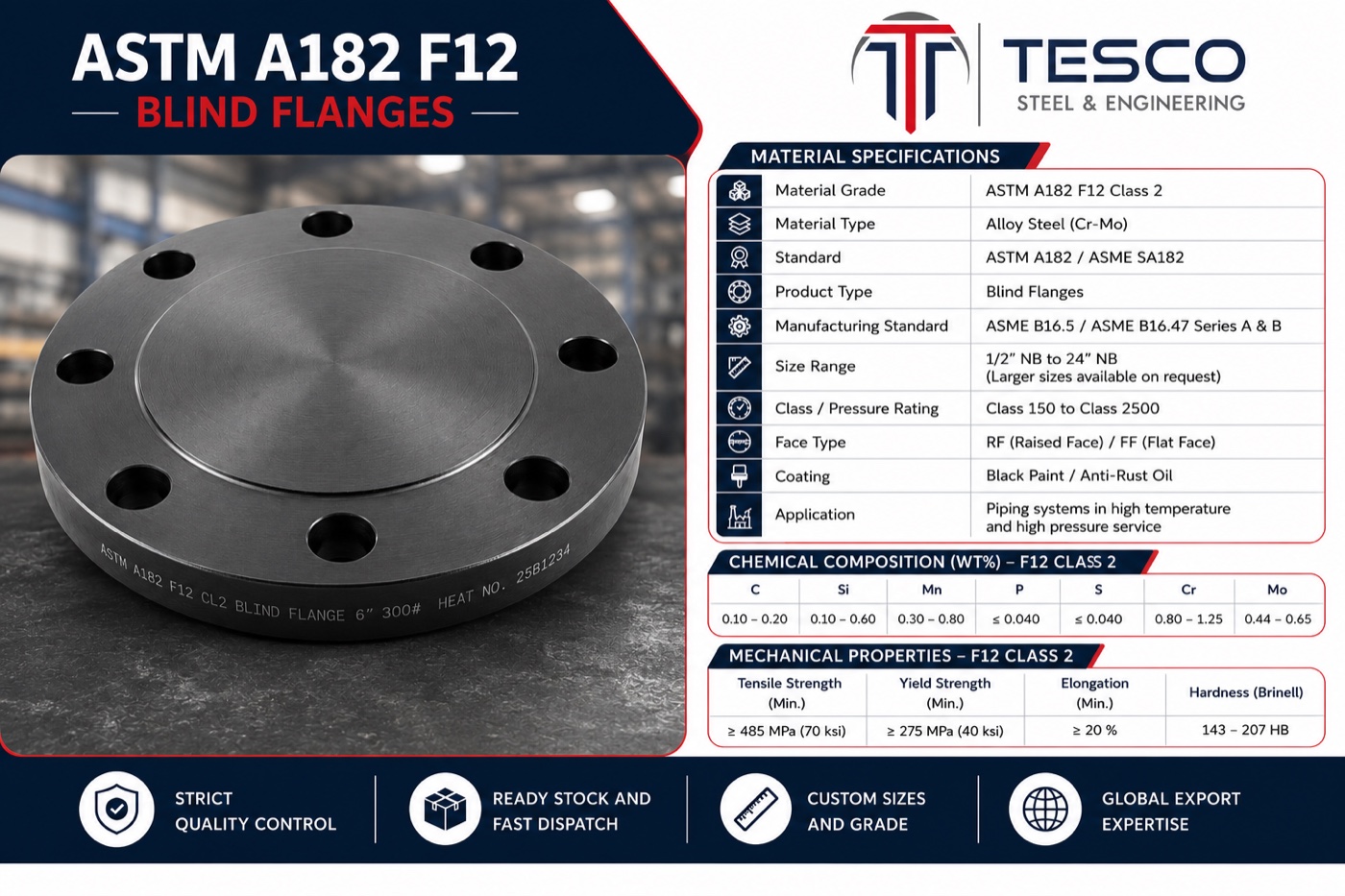
Tesco Steel & Engineering forges ASTM A182 F12 blind flanges — 1Cr-½Mo chrome-moly, the boiler-piping grade — to ASME B16.5 Class 150–2500 from ½″ to 24″ NB and to ASME B16.47 up to 60″. In steam plant the flange follows the pipe: lines run in P12/T12 boiler steel take F12 closures, just as P11 takes F11 — and F12 is the closest ASTM analogue to EN 13CrMo4-5, which is why European-heritage projects specify it. The ½% molybdenum resists creep, the 1% chromium holds oxidation in check, and the blind stays rated where A105 left the tables. Supplied as Class 2 by default; facings BLRF, BLFF or BLRTJ. Every lot with EN 10204 3.1/3.2 MTC. ISO 9001:2015, made in Mumbai, India — exported to 50+ countries.
ASTM A182 F12 Blind Flange — Specifications at a Glance
What is an ASTM A182 F12 Blind Flange?
The boiler-line closure. A solid forged disc of 1Cr-½Mo alloy steel with no bore, closing pipes, valves and nozzles in steam and boiler service. The ½% molybdenum resists creep — the slow stretch that retires carbon steel above ~450 °C — and the 1% chromium adds oxidation resistance. The natural closure of P12/T12 piping and the closest ASTM analogue to EN 13CrMo4-5. Standard flange grade Class 2: tensile ≥485 MPa, hardness 143–207 HB. Dimensions per ASME B16.5 / B16.47 in RF, FF and RTJ facings; EN 10204 3.1 certified.
Also searched as: F12 blind flange, A182-F12 blind, SA-182 F12 blind (the ASME boiler-code twin), F12 Class 2 blind, 1Cr blind flange, 13CrMo4-5 blind flange — all refer to the product on this page. See also the alloy steel hub, the F12 slip on flanges, siblings F11 / F22 / F5 / F9 blind flanges, and the facing pages BLRF / BLFF / BLRTJ.
F12 vs F11 — The Flange Follows the Pipe
A quarter percent of chromium separates the two grades — same molybdenum, same class structure, near-identical service territory. So why do both exist, and how do you choose?
The Pipe Decides
Boiler codes built matched families: P12/T12 pipe and tube take F12 flanges, P11 takes F11. If your line list names the pipe grade, the closure grade is already chosen — certificates must match the family even where the metallurgy nearly overlaps.
The European Connection
F12 is the closest ASTM analogue to EN 13CrMo4-5, the 1Cr-½Mo boiler steel of European practice — which is why EN-heritage plants and licensors specify F12 where ASME flange dimensions apply.
Interchangeable Metallurgy, Not Certificates
Strength classes, heat treatment and service limits are effectively common — but an F11 certificate does not satisfy an F12 line class or vice versa. Order what the specification names; we confirm at enquiry when a drawing is ambiguous.
F12 Class 1 & 2 — Chemistry and Strength
Property
Class 2 (flange default)
Class 1
Carbon
0.10–0.20%
0.05–0.15%
Manganese
0.30–0.80%
0.30–0.60%
Silicon
0.10–0.60%
0.50–1.00%
Chromium
0.80–1.25%
0.80–1.10%
Molybdenum
0.44–0.65%
0.44–0.65%
Tensile Strength
≥485 MPa (70 ksi)
≥415 MPa (60 ksi)
Yield Strength
≥275 MPa (40 ksi)
≥220 MPa (32 ksi)
Hardness
143–207 HB
Per A182, lower window
An unqualified "F12" order receives Class 2 — the flange standard. No F12 class carries a vanadium requirement, and none carries an impact-test requirement: it is a hot-service grade, certified for strength at temperature. Elongation is ≥20%, heat treatment is mandatory, and the certificate states the class explicitly.
Rule of thumb: F12 and F11 are molybdenum-led near-twins — strength at temperature for steam, chosen by pipe family. F5 and F9 are chromium-led — hot sulphur corrosion in refinery streams. F91 is the modern creep-strength-enhanced 9Cr of power-plant main steam.
ASTM A182 F12 Blind Flanges are available in the following specifications:
Material Grade
ASTM A182 F12 Class 2 (default); Class 1 to order; ASME SA-182 dual-certifiable
Heat Treatment
Per A182 — mandatory; hardness verified into the class window; condition stated on certificate
Size
1/2"NB to 24"NB per ASME B16.5; 26"–60" per ASME B16.47; EN 1092-1 in 13CrMo4-5 to order
Class
150#, 300#, 400#, 600#, 900#, 1500#, 2500#
Facings
Raised Face (BLRF), Flat Face (BLFF), Ring Type Joint (BLRTJ) with groove per B16.20
Service
Boiler & steam creep duty; useful allowable stresses into the 550–590 °C region per ASME tables
Modifications
NPT-tapped centre (hydrotest / vent / drain / gauge), lifting provisions — machined & certified at the works
Testing
Tension, chemistry & hardness per heat; PMI routine; UT / MPI where specified
Certification
EN 10204 3.1 (standard) / 3.2 witnessed
Why F12 Blind Flanges Are Specified
The P12 Line's Own Closure
Where the piping is P12/T12, the F12 blind keeps grade family, creep behaviour and certificates uniform across the joint — the specification-clean answer.
Creep-Rated Where Carbon Steel Isn't
The blind stays code-rated on steam lines that left A105's allowable-stress table behind — and holds them shut for the decades boiler plant expects.
The EN-Bridge Grade
13CrMo4-5 systems meeting ASME flange dimensions land on F12 naturally — one grade serving both specification worlds, with the certificate matched to whichever governs.
Bolted, So Fabrication Stays Simple
1Cr wants preheat and PWHT when welded — a bolted blind sidesteps all of it, arriving correctly heat treated from the works.
Know the Siblings
P11 systems: F11. Hotter or hydrogen-heavy: F22. Hot sulphur: F5 / F9. General duty: A105. Facings: BLRF / BLFF / BLRTJ.
Specification Notes — Getting F12 Right
Three details buyers miss.F12 is not F11: the metallurgy nearly overlaps but the certificates don't — order the grade your line class names, matched to the pipe family (P12 → F12, P11 → F11). State the class: "F12" alone gets Class 2, the flange default; Class 1's strength window is lower and the certificate must match. Not a cold-service grade: F12 carries no impact-test requirement — below about -29 °C, closures belong to LF2 or stainless, however hot the line runs in normal operation.
How Our F12 Blind Flanges Are Manufactured
1
Forging — cut billet of the spectro-verified F12 heat is hot-forged into the solid disc blank, keeping full heat traceability from melt to marking.
2
Heat treatment — per A182; hardness verified into the 143–207 HB Class 2 window; furnace charts retained against the heat number.
3
Machining & facing — faces, OD and drilling to ASME B16.5 / B16.47; RF serrations, flat face or RTJ groove gauged per B16.20; NPT taps machined where ordered.
4
Testing — tension test, chemistry and hardness against the heat; PMI routine on every alloy lot — F12 and F11 are indistinguishable by eye, and PMI keeps the families apart; UT and MPI where specified.
5
Marking — permanent marking of standard, grade (F12 and class), size, class and heat number.
6
Certification & packing — EN 10204 3.1 MTC (3.2 witnessed on request); faces protected, palletised or crated sea-worthy.
Where F12 Blind Flanges Are Used
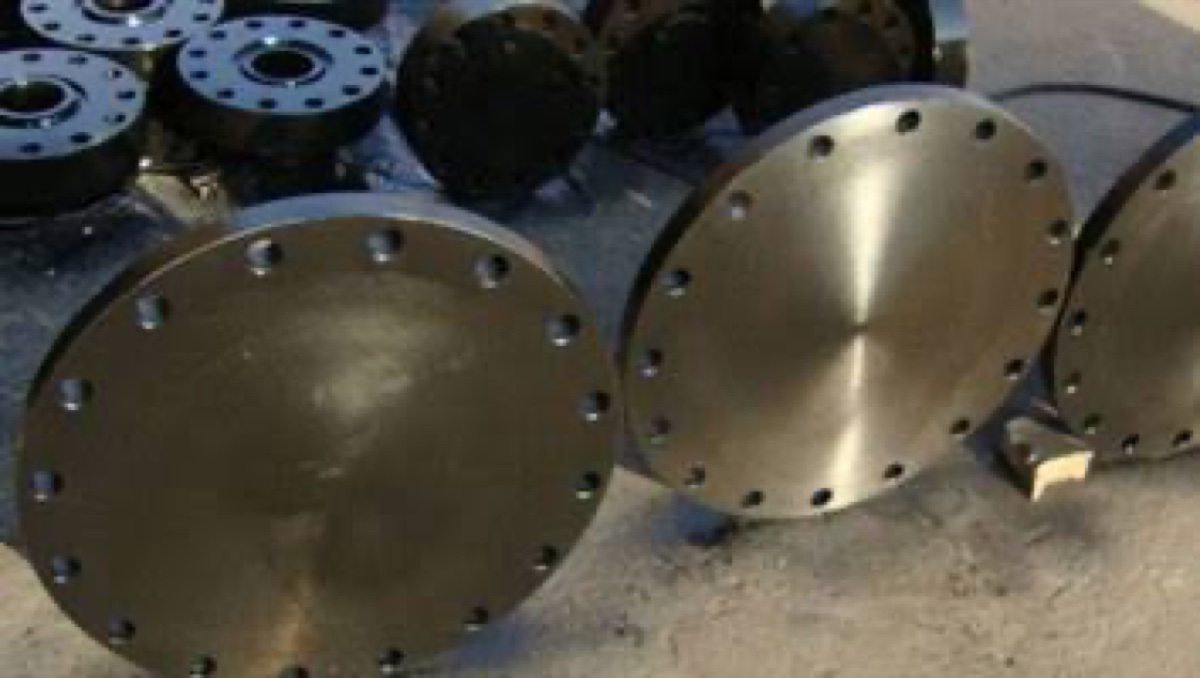
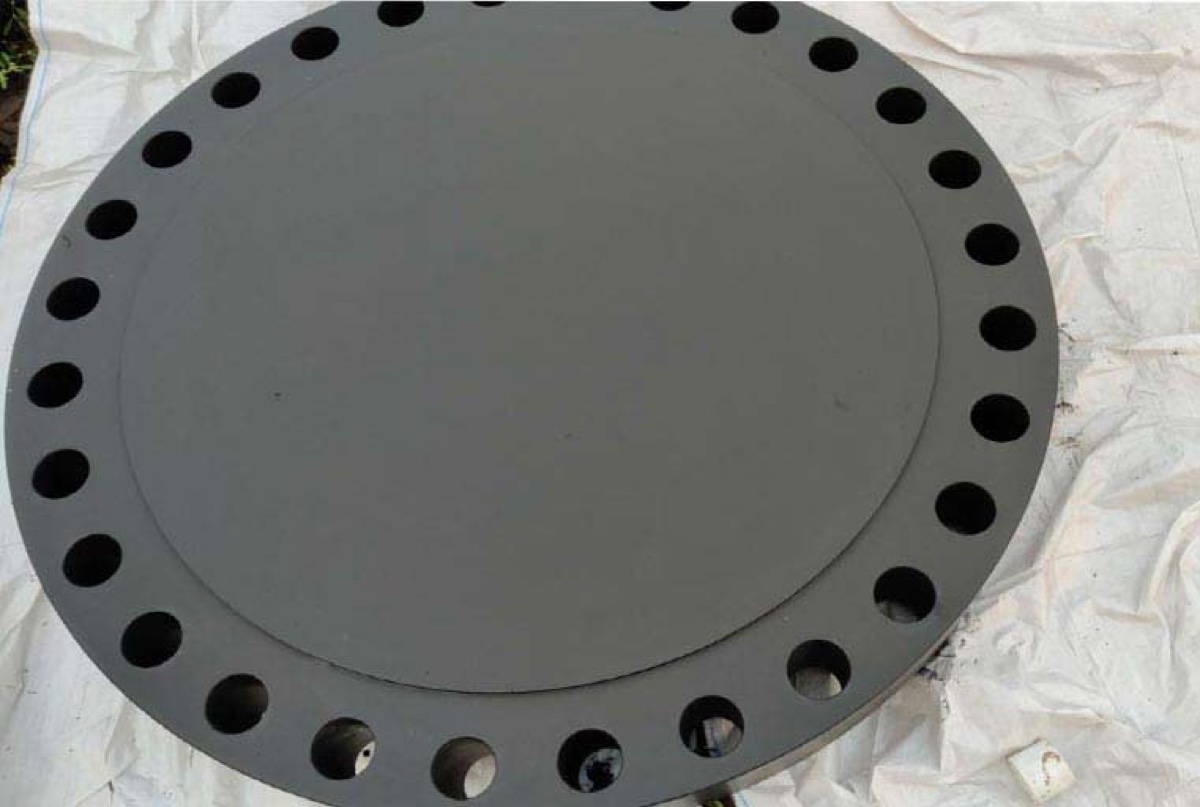
Boiler and steam plant above all: economiser and evaporator circuits, steam headers and drums, HRSGs behind gas turbines, district-heating and industrial steam systems — especially where the piping itself is P12/T12 or 13CrMo4-5 and the closures follow the pipe. Production below:
Forged Blind Flanges — Assorted Sizes at the WorksLarge-Diameter Blind Flange — Coated, Ready for Dispatch
F12 Blind Flange Dimensions
Blind dimensions are class-governed — identical across material grades. Full charts:
An ASTM A182 F12 blind flange is a solid forged disc of 1Cr-½Mo alloy steel, drilled to the standard bolt pattern with no bore, used to close pipes, valves and vessel nozzles in hot steam and boiler service. F12 sits at the light end of the chrome-moly family: the ½% molybdenum carries strength into the creep range where carbon steel quietly stretches, and the 1% chromium adds oxidation resistance. Dimensions follow ASME B16.5 from ½ inch to 24 inch and ASME B16.47 beyond, in raised face, flat face and ring joint facings.
What kind of steel is A182 F12?
A forged 1Cr-½Mo low-alloy steel. In the standard flange grade — F12 Class 2 — the chemistry runs carbon 0.10-0.20%, manganese 0.30-0.80%, silicon 0.10-0.60%, chromium 0.80-1.25% and molybdenum 0.44-0.65%, supplied heat treated. No vanadium or niobium is required in either F12 class, and no impact test either — it is a hot-service grade, certified for strength at temperature. It handles like carbon steel and prices just above it, at the bottom rung of the chrome-moly ladder.
What is the difference between F12 and F11?
A quarter percent of chromium — F11 runs 1.00-1.50%, F12 runs 0.80-1.25% — with the same molybdenum, the same strength classes and near-identical service territory. In practice the choice is made for you: the flange follows the pipe. Lines specified in P12/T12 boiler tube and pipe take F12 flanges; P11 lines take F11. European-heritage projects often land on F12 because it is the closest ASTM analogue to EN 13CrMo4-5. If your line class names one, order that one — the certificates are not interchangeable even where the metallurgy nearly is.
F12 Class 1 or Class 2 — which one?
Class 2 is the flange standard — tensile 485 MPa and yield 275 MPa minimum, hardness 143-207 HB — and is what an unqualified 'F12' order receives. Class 1 is a lower-carbon, lower-strength variant (tensile 415 MPa, yield 220 MPa minimum) occasionally specified for weldability in fittings. The certificate states the class explicitly; if your piping class just says F12, Class 2 is almost certainly what it means, and we confirm at enquiry when in doubt.
What do the chromium and molybdenum do?
The molybdenum resists creep — the slow permanent stretch that retires carbon steel above roughly 450°C — and the chromium resists oxidation and keeps the microstructure stable through decades at temperature. Together they let a bolted closure hold a steam line shut for its design life. F12 carries the lightest chrome-moly loading that buys this behaviour, which is exactly why boiler codes built the P12/T12/F12 family around it.
What are the mechanical properties of F12 blind flanges?
For F12 Class 2 — the flange standard: tensile strength 485 MPa (70 ksi) minimum, yield 275 MPa (40 ksi) minimum, elongation 20% minimum, hardness 143-207 HB, in the mandatory heat-treated condition. Class 1 delivers 415/220 MPa where specified. As with all chrome-moly, the room-temperature numbers understate the point — the grade earns its keep at temperatures where carbon steel has left the allowable-stress tables. Results travel on the EN 10204 3.1 certificate.
What temperature range does an F12 blind flange cover?
Hot service is its home: F12 holds useful allowable stresses into the 550-590°C region of the ASME tables, with everyday steam practice working it below about 540-560°C and stepping to F22 or F91 beyond. It is not a cold-service grade — below about -29°C ferritic steels need impact testing, and cold closures belong to LTCS or stainless. Between those bounds F12 covers boiler, superheater-adjacent and steam-header duty economically.
Is F12 equivalent to EN 13CrMo4-5?
It is the closest ASTM analogue — both are nominally 1Cr-½Mo boiler steels with near-identical chemistry windows and the same job in steam plant. Projects built to EN piping in 13CrMo4-5 (or its older designations 13CrMo44, 15Mo3-adjacent systems) commonly take A182 F12 flanges where ASME dimensional standards apply. The certificates remain distinct — an EN 1092-1 blind certified to 13CrMo4-5 is available to order where the specification demands the EN pedigree end to end; state which world your line class lives in and we match it.
What facings are F12 blind flanges made with?
All three: raised face (BLRF) — with the graphite-filled spiral-wound gaskets typical of steam practice — flat face (BLFF) for utility interfaces, and ring type joint (BLRTJ) for high-class hot circuits, the ring chosen softer than the groove. Each facing has its own page on this site. The forging is common to all three; the mating flange governs the choice, and for RTJ the ring number follows from size and class.
What sizes and classes are F12 blind flanges available in?
From ½" to 24" NB per ASME B16.5 in Classes 150 through 2500, and to 60" per ASME B16.47 where large hot headers need closing. Chrome-moly blinds are generally forged against the order rather than stocked — power and boiler projects specify them by line class, and each lot carries its own heat-treatment record and certification. EN 1092-1 PN-series blinds in 13CrMo4-5 are produced to order for EN-specified systems.
Does welding or air-hardening affect F12 blind flanges?
Mildly — 1Cr steel wants preheat and often post-weld heat treatment when welded, though less critically than the 5Cr and 9Cr grades. A blind flange sidesteps the question: it is bolted, never welded, arriving from the works correctly heat treated and staying that way. The discipline that remains is ours — controlled forging, heat treatment and hardness verification into the 143-207 HB window — and the certificate records it. Taps and modifications belong at the works, not the field.
Can F12 blind flanges be tapped for testing or instruments?
Yes — fill, vent, drain, gauge and injection taps are machined into the centre of the blind at the works and certified with the flange. Tapped F12 blinds are common in boiler practice: hydrotesting economiser, evaporator and steam-header circuits calls for closures that match the line's creep rating, and an NPT-tapped F12 blind is the engineered answer. State the NPT size on the enquiry and the tap arrives ready to plug.
Where are F12 blind flanges used?
Boiler and steam plant above all: economiser and evaporator circuits, steam headers and drums, HRSGs, district-heating and industrial steam systems — especially where the piping itself is P12/T12 or 13CrMo4-5 and the closures follow the pipe. They appear across refinery and petrochemical steam services in the same role. Duties are the usual blind duties: isolations, future connections and tapped hydrotest blinds, in the line's own metal so creep behaviour and certificates stay uniform across the joint.
Which standards cover F12 blind flanges?
The material standard is ASTM A182 grade F12 (Class 1 or 2), with ASME SA-182 as its boiler-code twin; dimensions follow ASME B16.5 for ½"-24" and ASME B16.47 for 26"-60". Pressure-temperature ratings come from the B16.5 tables for the 1Cr material group. A complete specification reads: 'Blind Flange, RF, 6", ASME B16.5 Class 300, ASTM A182 F12 Cl.2' — and our EN 10204 certificates state dimension standard, grade, class, heat treatment and test results together.
Who manufactures ASTM A182 F12 blind flanges in India?
Tesco Steel & Engineering is an ISO 9001:2015 certified flange manufacturer based in Mumbai, India, forging ASTM A182 F12 blind flanges in Classes 1 and 2 from ½" to 24" NB per ASME B16.5 in Classes 150-2500 and to 60" per ASME B16.47 — heat treated, hardness-controlled, PMI-verified and certified to EN 10204 3.1/3.2 on every lot — in raised face, flat face and ring joint facings, with NPT-tapped test blinds to order, alongside F11, F22, F5, F9 and F91 chrome-moly, carbon steel, LTCS, stainless and nickel-alloy blinds. Exported to more than 50 countries.