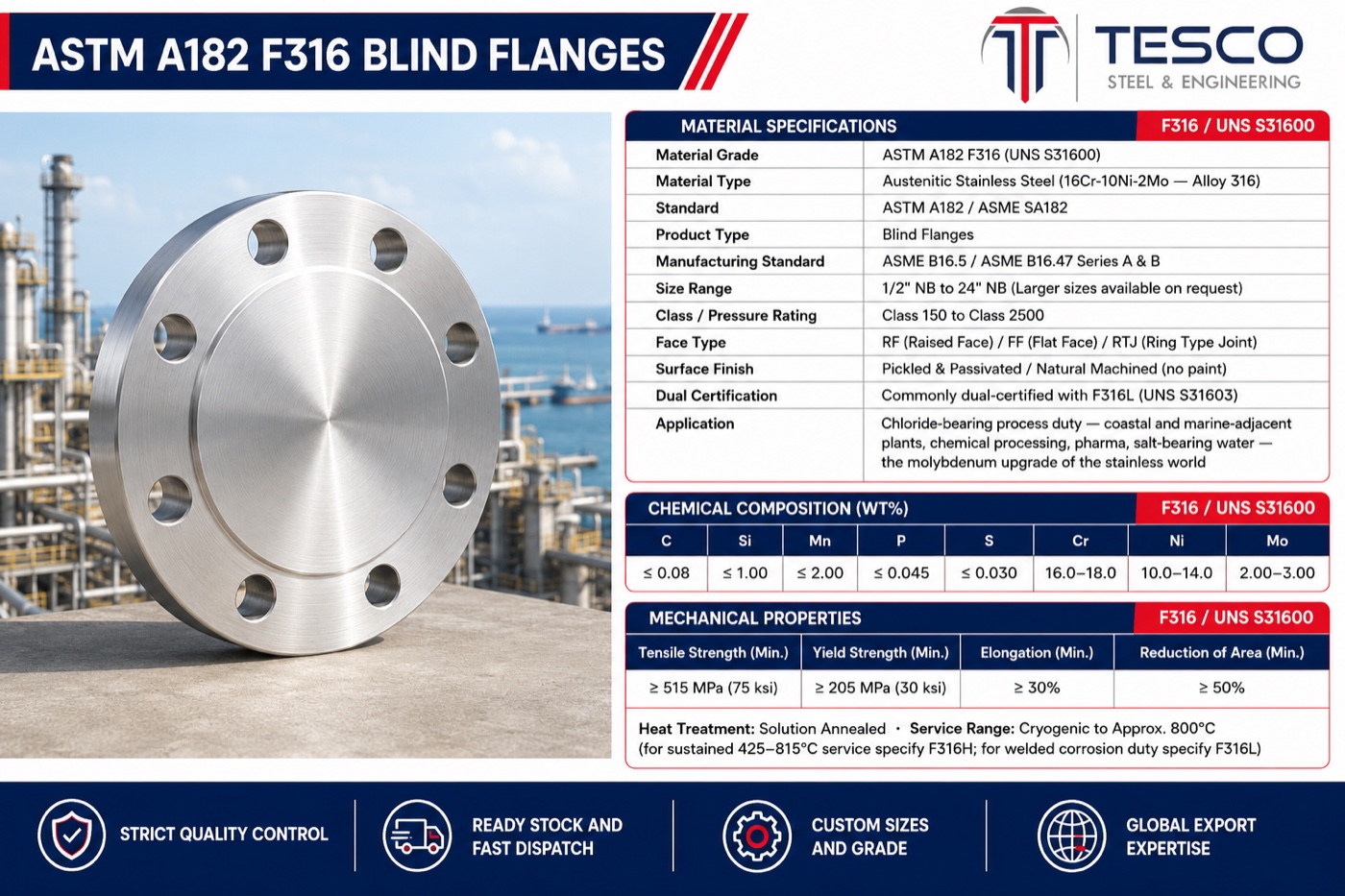
Tesco Steel & Engineering forges ASTM A182 F316 blind flanges — alloy 316, UNS S31600, the molybdenum upgrade of the stainless world — to ASME B16.5 Class 150–2500 from ½″ to 24″ NB and to ASME B16.47 up to 60″. The 2–3% molybdenum defends the passive film where chlorides attack — pitting and crevice resistance that carries stainless into coastal plants, salt-bearing water and process chlorides where 304 stains and pits. Cryogenic capability retained, commonly F316/F316L dual-certified — and honestly bounded: continuous seawater belongs to duplex. Facings: BLRF, BLFF or BLRTJ. Every lot with EN 10204 3.1/3.2 MTC. ISO 9001:2015, made in Mumbai, India — exported to 50+ countries.
ASTM A182 F316 · UNS S31600 · EN 1.440116Cr-10Ni-2Mo · The Molybdenum UpgradeChloride Pitting & Crevice ResistanceF316/F316L Dual-CertificationASME B16.5 ½″–24″ · Class 150–2500RF · FF · RTJ FacingsEN 10204 3.1 / 3.2 · ISO 9001:2015
ASTM A182 F316 Blind Flange — Specifications at a Glance
What is an ASTM A182 F316 Blind Flange?
The chloride-duty stainless closure. A solid forged disc of austenitic 316 (UNS S31600) with no bore, closing pipes, valves and nozzles where chlorides threaten ordinary stainless: coastal plants, salt-bearing water, process chemistry. The 2–3% molybdenum stabilises the passive film against pitting and crevice attack — the world's most common stainless upgrade. Mechanicals match 304 (tensile ≥515 MPa, yield ≥205); the service span runs cryogenic to ~800 °C; commonly F316/F316L dual-certified. Dimensions per ASME B16.5 / B16.47 in RF, FF and RTJ facings; EN 10204 3.1 certified.
Also searched as: SS 316 blind flange, 316 stainless blind, S31600 blind, SA-182 F316 blind (the ASME boiler-code twin), 1.4401 / X5CrNiMo17-12-2 blind (the EN equivalent), F316/F316L dual-cert blind — all refer to the product on this page. See also the stainless steel hub, the F316 slip on flanges, siblings F316L / F304 / F304L blind flanges, and the facing pages BLRF / BLFF / BLRTJ.
The Molybdenum Story — Defending the Weak Points
Chlorides rarely attack stainless everywhere at once — they attack locally, punching pits and creeping into crevices where the passive film struggles to heal. 316's answer:
Molybdenum Stabilises the Film
Point for point roughly triple chromium's effect against pitting — the 2–3% addition is why 316 shrugs off coastal atmospheres and salt-bearing waters that stain and pit 304.
The Chemistry Balancing Act
Molybdenum is a ferrite former, so the specification trims chromium to 16–18% and raises nickel to 10–14% to hold the austenite — the counter-intuitive certificate that still wins the corrosion arithmetic decisively.
Honest Boundaries
Marine atmosphere: yes. Brief seawater contact: yes. Continuous seawater and brine: no — crevice corrosion under gaskets and deposits runs out of margin, and the duty steps to duplex.
The one-line answer: choose by chloride exposure — 304 inland, 316 near salt, duplex in it.
F316 Chemical Composition (UNS S31600)
Element
C
Si
Mn
P
S
Cr
Ni
Mo
Weight %
≤0.08
≤1.00
≤2.00
≤0.045
≤0.030
16.0–18.0
10.0–14.0
2.00–3.00
Read the bold columns together: chromium down two points, nickel up, molybdenum in — the balancing act that keeps the structure austenitic while the molybdenum does its chloride work.
Welded corrosion duty — the most-specified form, since chloride duty is usually welded duty
F316H
0.04–0.10% (min enforced)
Sustained 525–815 °C creep duty — melted to order
The same carbon logic as the 304 family, applied to the molybdenum grade — and the same practical answer: F316/F316L dual-certification covers the everyday middle from one stock, weld-safe like an L, rateable like a standard grade.
Mechanical Properties & The Service Span
Property
ASTM A182 F316 Requirement
Tensile Strength
≥ 515 MPa (75 ksi)
Yield Strength (0.2%)
≥ 205 MPa (30 ksi)
Elongation
≥ 30%
Reduction of Area
≥ 50%
Hardness
No A182 limit — typically soft as annealed
Condition
Solution annealed — mandatory
Service Span
Cryogenic to ~800 °C — F316H for sustained 425–815 °C, F316L for welded corrosion duty
The molybdenum buys corrosion resistance, not strength — mechanicals match 304 exactly, and the modest yield remains the austenitic trade-off throughout the family.
ASTM A182 F316 Blind Flanges are available in the following specifications:
Material Grade
ASTM A182 F316 (UNS S31600); F316/F316L dual-certification standard where the melt qualifies; EN 1.4401 to order
Heat Treatment
Solution annealed — mandatory; condition stated on certificate
Size
1/2"NB to 24"NB per ASME B16.5; 26"–60" per ASME B16.47; EN 1092-1 to order
Class
150#, 300#, 400#, 600#, 900#, 1500#, 2500#
Facings
Raised Face (BLRF), Flat Face (BLFF), Ring Type Joint (BLRTJ) with groove per B16.20
Service Span
Cryogenic to ~800 °C — chloride-bearing duty its specialty; continuous seawater excluded
Surface Finish
Pickled & passivated or natural machined — no paint; segregated stainless handling throughout
Modifications
NPT-tapped centre (hydrotest / vent / drain / gauge), lifting provisions — machined & certified at the works
Testing
Tension & chemistry per heat — molybdenum verified; PMI routine; IGC (A262) where specified
Certification
EN 10204 3.1 (standard) / 3.2 witnessed — dual F316/F316L designation on request
Why F316 Blind Flanges Are Specified
The World's Second Stainless
Wherever 304's chloride limits show, 316 is the reflex upgrade — the most-stocked molybdenum stainless on earth, and its blinds move accordingly.
Pitting & Crevice Margin
The molybdenum defends exactly where chlorides attack — under deposits, in gasket crevices, at the waterline of coastal service.
PMI Tells It Apart
316 and 304 are visually identical — our routine positive material identification reads the molybdenum directly, protecting every lot from the classic substitution error.
Dual-Cert Simplicity
F316/F316L on one certificate serves both paperwork worlds from one stock — weld-safe and fully rateable at once.
Three details buyers miss.316 is not seawater-proof: continuous seawater and brine defeat its crevice margins — that duty belongs to duplex, and specifying 316 there buys a maintenance problem, not a solution. Verify the molybdenum: 304 and 316 look identical — insist on PMI or the certificate's Mo line when provenance matters. Welded chloride duty wants the L: most 316 applications are welded corrosive systems, which is why line classes so often read 316L or dual-cert — match the closure to the line class.
How Our F316 Blind Flanges Are Manufactured
1
Forging — cut billet of the spectro-verified S31600 heat — molybdenum confirmed — is hot-forged into the solid disc blank with full heat traceability and segregated stainless handling.
2
Solution anneal — restoring the uniform austenite the grade's corrosion resistance depends on; furnace charts retained against the heat number.
3
Machining & facing — faces, OD and drilling to ASME B16.5 / B16.47; RF serrations, flat face or RTJ groove gauged per B16.20; NPT taps machined where ordered.
4
Testing — tension test and chemistry against the heat; PMI on every piece; intergranular-corrosion (ASTM A262) and other tests where specified.
5
Pickling & passivation — the restored chromium-oxide skin and hygienic finish, with marking of standard, grade (dual F316/F316L where certified), size, class and heat number.
6
Certification & packing — EN 10204 3.1 MTC (3.2 witnessed on request); faces protected, palletised or crated sea-worthy — no carbon-steel contact in transit.
Where F316 Blind Flanges Are Used
Everywhere the chloride question was answered with molybdenum: coastal and marine-adjacent process plants, chemical and petrochemical chloride streams, pharmaceutical and food systems specifying 316 by convention, salt-bearing water treatment, and pulp and paper. Production below:
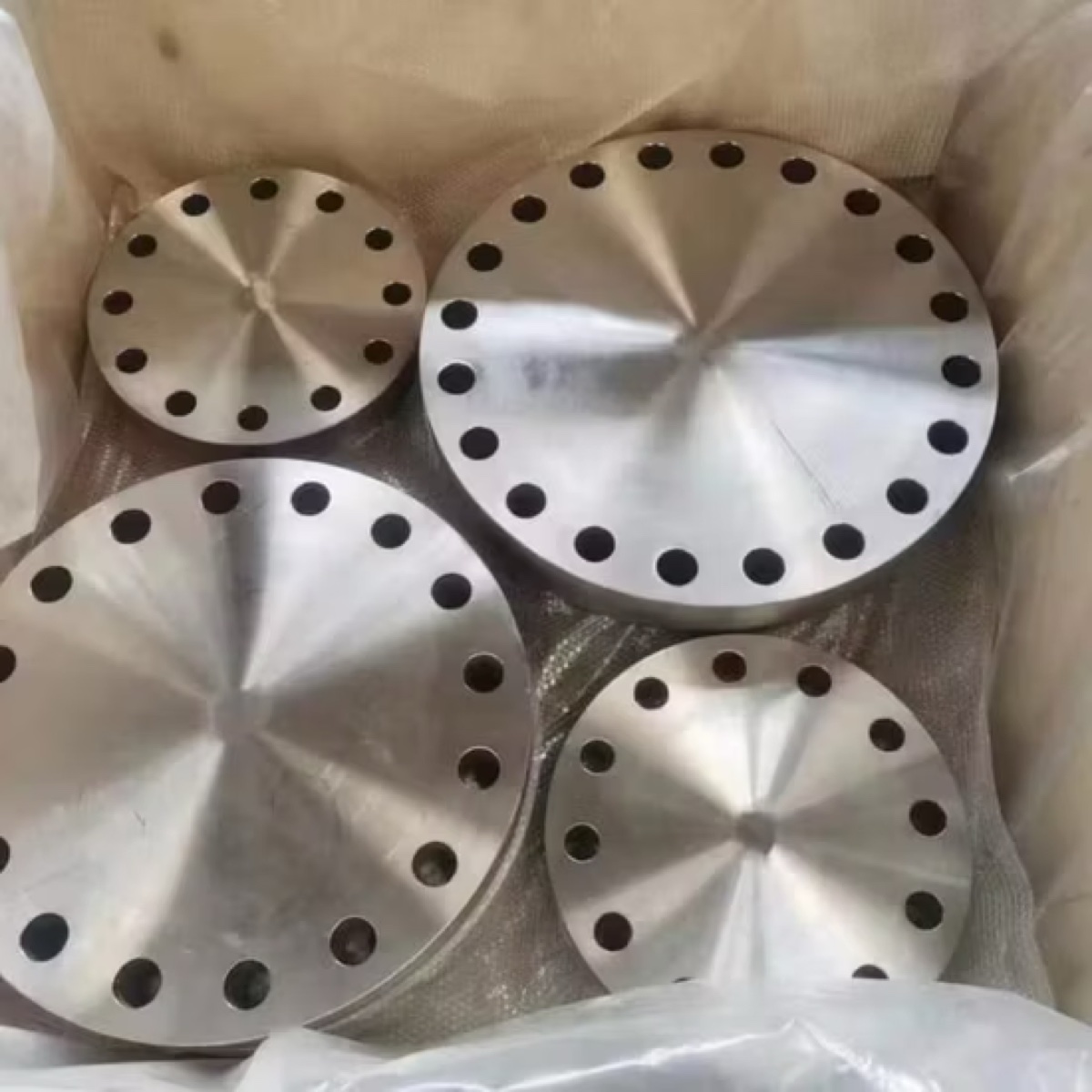
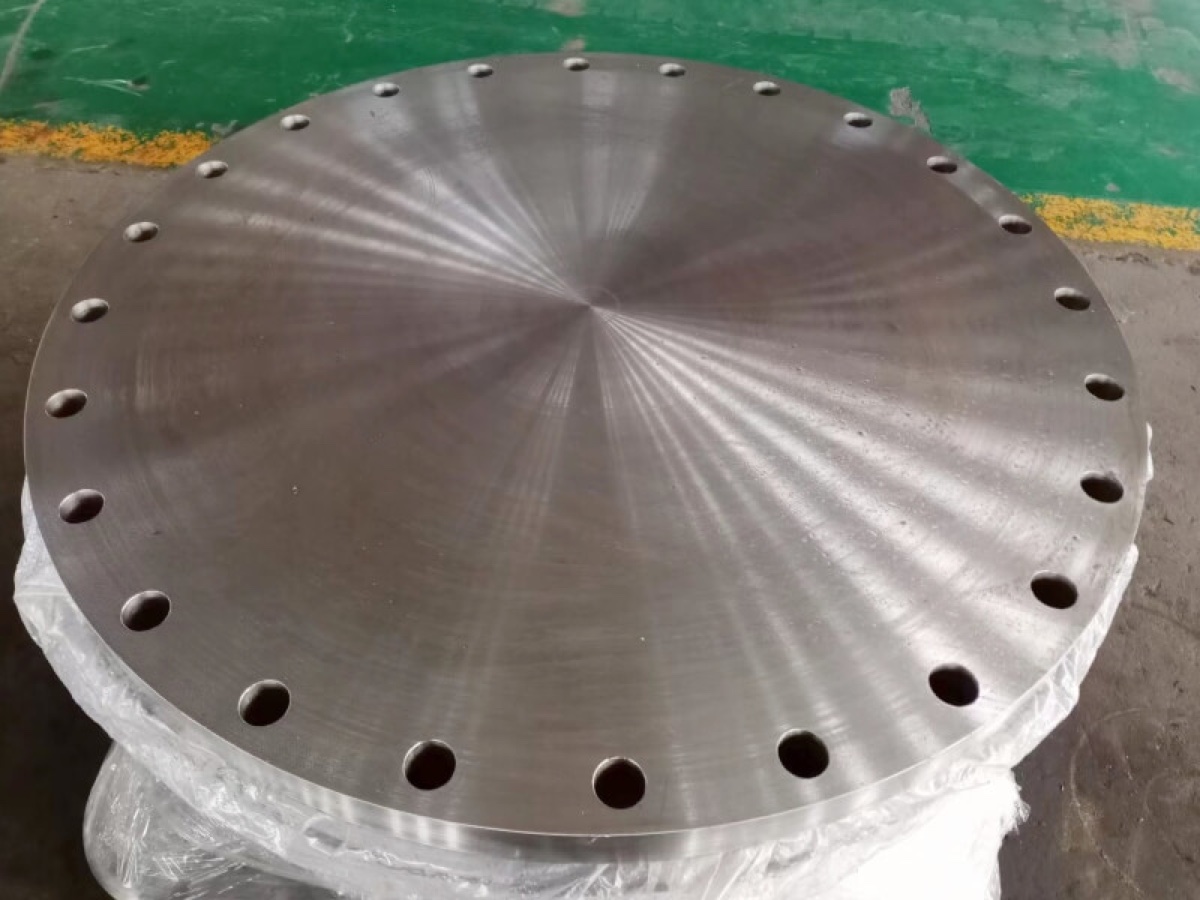
Forged Blind Flanges — Packed in Lined Export CrateLarge Machined Blind Flange — Bright Face Finish
F316 Blind Flange Dimensions
Blind dimensions are class-governed — identical across material grades. Full charts:
An ASTM A182 F316 blind flange is a solid forged disc of austenitic stainless steel — alloy 316, UNS S31600, the molybdenum-bearing upgrade of the 304 family — drilled to the standard bolt pattern with no bore, used to close pipes, valves and vessel nozzles in chloride-bearing duty: coastal and marine-adjacent plants, chemical processing, pharmaceutical systems and salt-bearing water. Dimensions follow ASME B16.5 from ½ inch to 24 inch and ASME B16.47 beyond, in raised face, flat face and ring joint facings.
What does the molybdenum in 316 do?
It defends the weak points of the passive film. Chlorides attack stainless locally — punching pits and creeping into crevices where the protective oxide struggles to heal — and molybdenum stabilises the film exactly there, roughly tripling its effectiveness point for point against chromium in the pitting index. The 2-3% addition is why 316 shrugs off the coastal atmospheres, salt-bearing waters and process chlorides that stain and pit 304 — and why '304 or 316?' is the most-asked materials question in the stainless world.
Why is 316's chromium lower than 304's?
A deliberate balancing act, not a downgrade. Molybdenum is a strong ferrite former, so adding it while keeping 304's 18-20% chromium would destabilise the austenite; the specification instead trims chromium to 16-18% and raises nickel to 10-14% to hold the structure. The corrosion arithmetic still wins decisively — molybdenum's contribution outweighs the two points of chromium several times over — which is why 316 outperforms 304 in chlorides despite the lower chromium on the certificate.
304 or 316 — how do I choose?
By chloride exposure. Fresh water, food and dairy, general chemistry, indoor and inland service: 304 does the job at lower cost. Coastal atmospheres, salt-bearing or brackish water, de-icing chemistry, many process chlorides: 316's molybdenum earns its premium — it is the single most common stainless upgrade decision. When chlorides get serious — warm seawater, brine — neither is the answer and the specification jumps to duplex. Our F304 blind flange page covers the economical default; this page covers the upgrade.
Is 316 seawater-proof?
No — and the honest answer saves real money. 316 handles marine atmospheres and brief seawater contact, but in continuous seawater service its crevice corrosion resistance runs out: under gaskets, deposits and barnacles, warm seawater pits it reliably, and hot chlorides can still crack it. Continuous seawater and brine belong to duplex F51/F60, hot seawater to super duplex F53/F55. Treat 316 as the chloride-resistant stainless, not the seawater stainless — our duplex blind flange pages cover the step up.
What is the difference between F316, F316L and F316H?
The same carbon logic as the 304 family, applied to the molybdenum grade. F316 (≤0.08% C) is the general-purpose form. F316L (≤0.030%) is the weld-safe corrosion-duty choice — and since chloride duty is usually welded corrosive duty, 316L is specified even more routinely than 304L. F316H (0.04-0.10%, minimum enforced) is the creep-rated hot variant, melted to order. Dual-certified F316/F316L forgings are the practical standard; our F316L blind flange page covers that designation.
What does F316/F316L dual certification mean?
One forging satisfying both specifications on one certificate — carbon low enough for L, strength high enough for standard 316. The dual-cert forging is weld-safe like an L grade and rateable like a standard grade, serving line classes written around either designation from one stock. Most of our austenitic production qualifies; state the requirement on the enquiry and the certificate reads accordingly.
What are the mechanical properties of F316 blind flanges?
Identical to F304: tensile strength 515 MPa (75 ksi) minimum, yield strength 205 MPa (30 ksi) minimum, elongation 30% minimum and reduction of area 50% minimum, solution annealed — A182 specifies no hardness limit. The molybdenum buys corrosion resistance, not strength; the modest yield is the austenitic trade-off throughout the family. The toughness is the quiet asset: ductile from cryogenic cold to red heat with no impact-test question.
What temperature range does an F316 blind flange cover?
The full austenitic span: cryogenic — LNG, liquid nitrogen — to roughly 800°C at the oxidation limit. The same two caveats as 304 apply: sustained 425-815°C service calls for the H grade (F316H, creep-rated), and welded corrosion duty calls for F316L. One molybdenum-specific note: 316 is often preferred over 304 even in cryogenic service where the cold system sees chloride-bearing environments at the flanged connections.
What facings are F316 blind flanges made with?
All three: raised face (BLRF) — the process-industry default — flat face (BLFF) for mating GRP and lined systems, and ring type joint (BLRTJ) for high-pressure duty, the ring chosen softer than the groove. Each facing has its own page on this site. The forging is common to all three; the mating flange governs the choice, and for RTJ the ring number follows from size and class.
Can F316 blind flanges be tapped for testing or instruments?
Yes — fill, vent, drain, gauge and injection taps are machined into the centre of the blind at the works and certified with the flange. Austenitic stainless work-hardens as it machines, so works tooling beats field drilling; the tap arrives ready to plug with the solution anneal undisturbed. State the NPT size on the enquiry.
Where are F316 blind flanges used?
Everywhere the chloride question has been asked and answered with molybdenum: coastal and marine-adjacent process plants, chemical and petrochemical duty with chloride-bearing streams, pharmaceutical and food systems that specify 316 by hygiene convention, water treatment with salt-bearing or softened water, and pulp and paper. F316 blinds serve the usual closure duties — isolations, future connections, tapped test blinds — with the pickled, paint-free finish those industries expect.
Which standards cover F316 blind flanges?
The material standard is ASTM A182 grade F316 (UNS S31600), with ASME SA-182 as its boiler-code twin and EN 1.4401 / X5CrNiMo17-12-2 as the European equivalent; dimensions follow ASME B16.5 for ½"-24" and ASME B16.47 for 26"-60". A complete specification reads: 'Blind Flange, RF, 4", ASME B16.5 Class 150, ASTM A182 F316 (or F316/F316L dual)' — and our EN 10204 certificates state it exactly that way, with heat number, heat treatment and test results.
When is 254 SMO or duplex needed instead of F316?
When the chloride ladder climbs past molybdenum's first rung. Continuous seawater, brine and hot chloride streams exceed 316's pitting and crevice margins; the next steps are duplex F51/F60 (strength plus chloride-SCC immunity, PREN ≥34), super duplex F53/F55 (PREN ≥40 for hot seawater), or the super austenitic 254 SMO where a fully austenitic PREN ≥42 grade suits the duty. The specification's PREN floor and service temperature decide — and each grade has its own page on this site.
Who manufactures ASTM A182 F316 blind flanges in India?
Tesco Steel & Engineering is an ISO 9001:2015 certified flange manufacturer based in Mumbai, India, forging ASTM A182 F316 / UNS S31600 stainless blind flanges from ½" to 24" NB per ASME B16.5 in Classes 150-2500 and to 60" per ASME B16.47 — solution annealed, pickled and passivated, PMI-verified, F316/F316L dual-certified where required, certified to EN 10204 3.1/3.2 on every lot — in raised face, flat face and ring joint facings, alongside F316L, F304/F304L/F304H, duplex and nickel-alloy blinds. Exported to more than 50 countries.