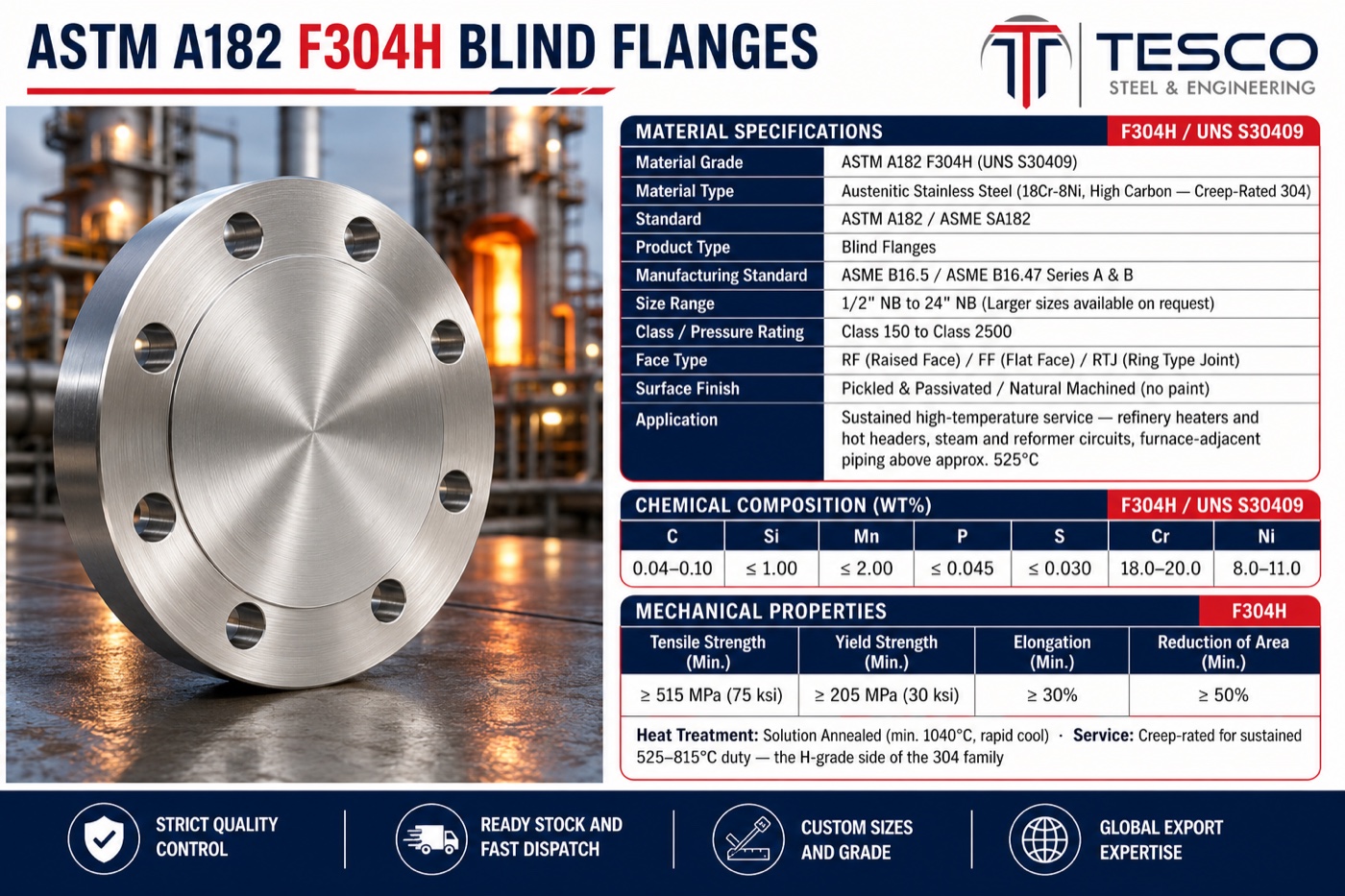
Tesco Steel & Engineering forges ASTM A182 F304H blind flanges — UNS S30409, the creep-rated member of the 304 family — to ASME B16.5 Class 150–2500 from ½″ to 24″ NB and to ASME B16.47 up to 60″. The H grade inverts the low-carbon logic: carbon is held at 0.04–0.10% with an enforced minimum, because in sustained hot service carbides are what pin the structure against creep — earning F304H its own allowable-stress lines above ~525 °C, where plain F304 thins out. Melted to order (it cannot dual-certify with F304L), solution annealed at minimum 1040 °C with rapid cooling — the closure of refinery heaters, hot headers, steam and reformer circuits. Facings: BLRF, BLFF or BLRTJ. Every lot with EN 10204 3.1/3.2 MTC. ISO 9001:2015, made in Mumbai, India — exported to 50+ countries.
ASTM A182 F304H · UNS S30409 · EN 1.4948High Carbon 0.04–0.10% · Minimum EnforcedCreep-Rated · Sustained 525–815 °CSolution Annealed min. 1040 °CASME B16.5 ½″–24″ · Class 150–2500RF · FF · RTJ FacingsEN 10204 3.1 / 3.2 · ISO 9001:2015
ASTM A182 F304H Blind Flange — Specifications at a Glance
What is an ASTM A182 F304H Blind Flange?
The hot-service 304. A solid forged disc of high-carbon austenitic stainless (UNS S30409) with no bore, closing pipes, valves and nozzles in sustained 525–815 °C duty — refinery heaters, hot headers, steam and reformer circuits. The defining feature is a carbon minimum: 0.04–0.10%, guaranteeing the carbides that resist creep and earning the grade its own allowable-stress lines in the codes. Room-temperature mechanicals match F304 (515/205 MPa); the difference shows at 650 °C. Melted to order, solution annealed min. 1040 °C. Dimensions per ASME B16.5 / B16.47 in RF, FF and RTJ facings; EN 10204 3.1 certified.
Also searched as: 304H blind flange, SS 304H blind, S30409 blind, SA-182 F304H blind (the ASME boiler-code twin), 1.4948 / X6CrNi18-10 blind (the EN counterpart) — all refer to the product on this page. See also the stainless steel hub, the F304H slip on flanges, siblings F304 / F304L / F316 blind flanges, and the facing pages BLRF / BLFF / BLRTJ.
The Carbon Inversion — Why H Means a Minimum
The 304 family manages one element three ways, and the H grade is the counter-intuitive corner: where L removes carbon to protect welds, H guarantees it — because at sustained heat, carbon changes sides:
Carbides Pin the Structure
At creep temperatures, finely distributed chromium carbides anchor grain boundaries against the slow sliding that is creep — the guaranteed 0.04% minimum is what keeps them coming for the design life.
Its Own Lines in the Tables
Above ~525 °C the codes give H grades separate, higher allowable stresses — strength plain 304 cannot legally claim, bought entirely by the enforced carbon and the high-temperature anneal.
One Mechanism, Two Reputations
The same precipitation that hot service exploits is called sensitization and condemned in aqueous corrosion duty — the H grade is that trade made deliberately, with the service kept hot where it pays.
Never with L — windows don't overlap; melted to order
The no-dual-cert rule matters at purchase. L caps carbon at 0.030%; H demands at least 0.04% — no melt satisfies both, so H-grade blinds are melted deliberately against the order, not pulled from dual-cert stock. If the line class says F304H, the certificate must say F304H: substituting standard 304 in a creep-rated joint is a specification break whose consequence arrives slowly, years into service.
F304H Chemical Composition (UNS S30409)
Element
C
Si
Mn
P
S
Cr
Ni
Weight %
0.04–0.10
≤1.00
≤2.00
≤0.045
≤0.030
18.0–20.0
8.0–11.0
One bold column tells the whole story: carbon with a floor. Everything else is standard 18-8 — and the mechanical table below reads identically to F304, because the H grade's advantage is invisible at room temperature.
Mechanical Properties & The Hot Band
Property
ASTM A182 F304H Requirement
Tensile Strength
≥ 515 MPa (75 ksi)
Yield Strength (0.2%)
≥ 205 MPa (30 ksi)
Elongation
≥ 30%
Reduction of Area
≥ 50%
Hardness
No A182 limit — typically soft as annealed
Condition
Solution annealed, minimum 1040 °C, rapid cool — mandatory
Home Band
Sustained 525–815 °C — separate H-grade allowables; ~800–815 °C oxidation ceiling
You buy F304H for what it holds at 650 °C, not what the tensile machine reads at 20 °C — below ~525 °C the grade works but buys nothing over F304.
Hot high-class refinery circuits — ring softer than groove
ASTM A182 F304H Blind Flange Specifications
ASTM A182 F304H Blind Flanges are available in the following specifications:
Material Grade
ASTM A182 F304H (UNS S30409); ASME SA-182 dual-certifiable; EN 1.4948 counterpart — melted to order
Heat Treatment
Solution annealed, minimum 1040 °C, rapid cool — mandatory; furnace record on certificate
Size
1/2"NB to 24"NB per ASME B16.5; 26"–60" per ASME B16.47; EN 1092-1 to order
Class
150#, 300#, 400#, 600#, 900#, 1500#, 2500#
Facings
Raised Face (BLRF), Flat Face (BLFF), Ring Type Joint (BLRTJ) with groove per B16.20
Service
Sustained 525–815 °C creep duty — separate H-grade allowable-stress lines in the codes
Surface Finish
Pickled & passivated or natural machined — no paint; segregated stainless handling throughout
Modifications
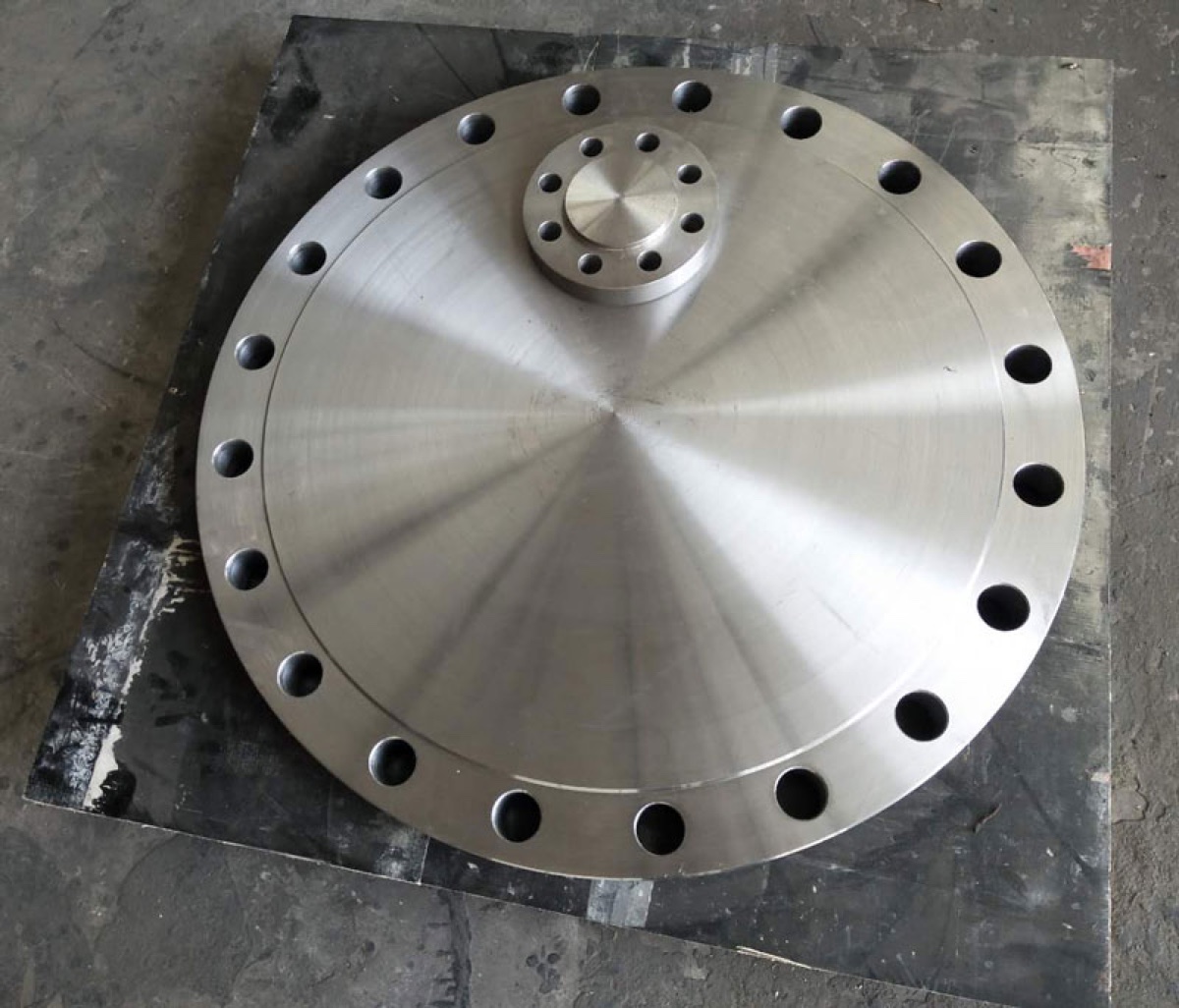
NPT-tapped centre (hydrotest / vent / drain / gauge), lifting provisions — machined & certified at the works
Testing
Tension & chemistry per heat — carbon reported explicitly; PMI routine; grain size where specified
Certification
EN 10204 3.1 (standard) / 3.2 witnessed
Why F304H Blind Flanges Are Specified
Creep Strength the Certificate Can Prove
The enforced carbon minimum is what separates a rated H-grade closure from a hopeful standard-304 one — and the difference is written in the code's own allowable-stress lines.
Austenitic Where Chrome-Moly Stops
Above the ferritic grades' comfort zone, the 18-8 austenite carries on — oxidation-resistant, weldable to its own kind, and free of the hardening dramas of 9Cr metallurgy.
The Matching-Metal Principle, Hot
A heater header in 304H deserves a closure on the same rating lines — blind in the line's own H grade keeps creep life and certificates uniform across the joint.
Works-Controlled Metallurgy
Deliberate melt, 1040 °C anneal, rapid cool, carbon on the certificate — the qualities creep service demands are exactly what the paperwork documents.
Know the Siblings
General duty: F304. Welded corrosion duty: F304L. Chlorides: F316. Stabilized hot grades: 321H/347H to order. Facings: BLRF / BLFF / BLRTJ.
Specification Notes — Getting the H Grade Right
Three details buyers miss.H means melted to order: no dual-cert stock can cover an F304H requirement — allow lead time for the deliberate melt, and insist the certificate reports carbon explicitly. Mind the boundaries of the trade: after long hot service the metal is sensitized by design — acid cleaning and corrosive idle chemistry need managing, and units that alternate hot with corrosive duty should consider stabilized 321H/347H. Below 525 °C it buys nothing: the H premium is for the creep band — general duty belongs to F304/F304L.
How Our F304H Blind Flanges Are Manufactured
1
Deliberate melt — the S30409 heat is ordered with the carbon window enforced; spectro verification confirms 0.04–0.10% before forging begins.
2
Forging — hot-forged into the solid disc blank with full heat traceability and segregated stainless handling.
3
Solution anneal — minimum 1040 °C with rapid cooling, dissolving the carbon for service to precipitate usefully; furnace charts retained against the heat number.
4
Machining & facing — faces, OD and drilling to ASME B16.5 / B16.47; RF serrations, flat face or RTJ groove gauged per B16.20; NPT taps machined where ordered.
5
Testing & marking — tension test and chemistry with carbon reported explicitly; PMI on every piece; grain-size determination where specified; permanent marking of standard, grade F304H, size, class and heat number.
6
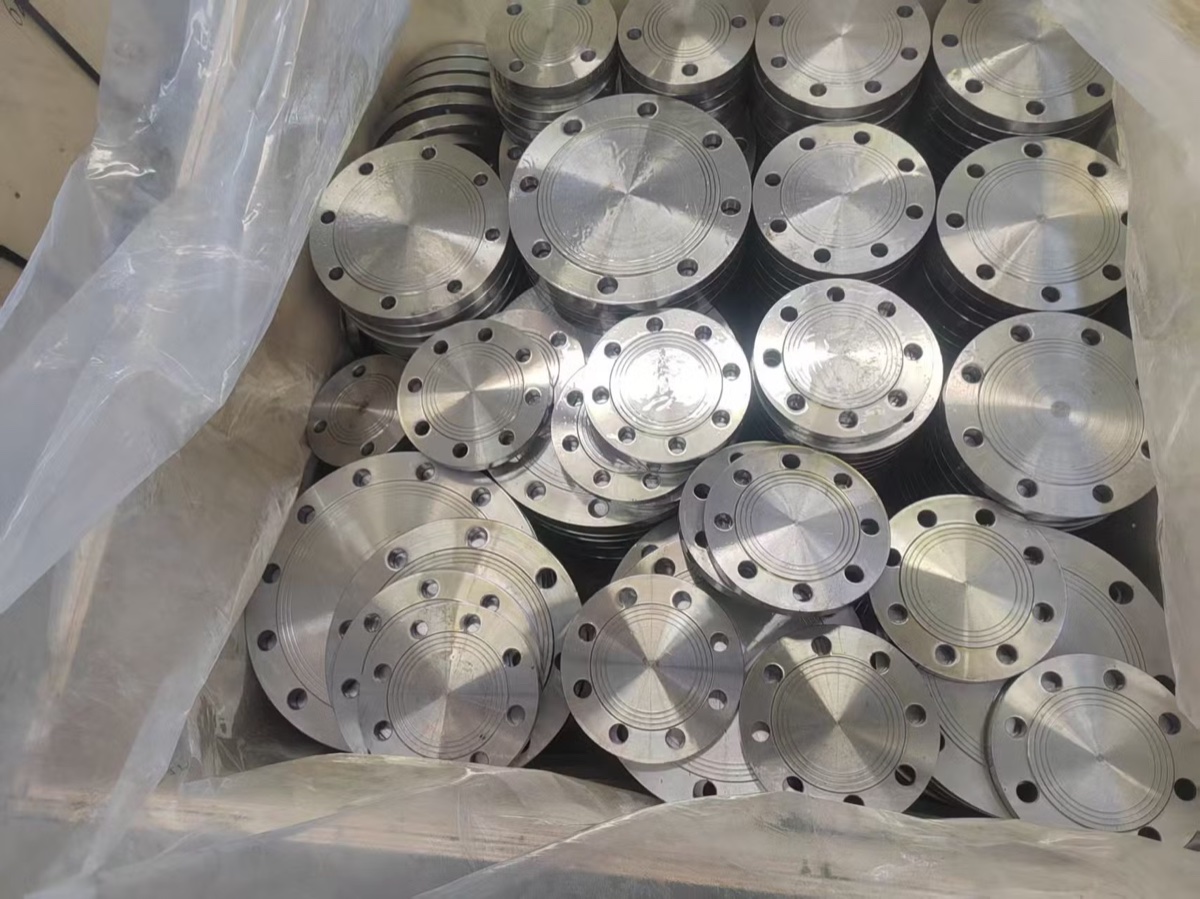
Certification & packing — EN 10204 3.1 MTC (3.2 witnessed on request); pickled and passivated, faces protected, palletised or crated sea-worthy.
Where F304H Blind Flanges Are Used
The permanently hot corners of process industry: refinery heater and furnace headers, hot-oil and transfer lines, steam and reformer circuits, FCC and flue-gas adjacent piping — wherever austenitic creep grades are specified. Production below:
Large Machined Blind with Auxiliary Nozzle ConnectionStainless Blind Flanges — Crated for Export
F304H Blind Flange Dimensions
Blind dimensions are class-governed — identical across material grades. Full charts:
An ASTM A182 F304H blind flange is a solid forged disc of high-carbon austenitic stainless steel — UNS S30409, the creep-rated member of the 304 family — drilled to the standard bolt pattern with no bore, used to close pipes, valves and vessel nozzles in sustained high-temperature service: refinery heaters and hot headers, steam and reformer circuits, furnace-adjacent piping above roughly 525°C. Dimensions follow ASME B16.5 from ½ inch to 24 inch and ASME B16.47 beyond, in raised face, flat face and ring joint facings.
What does the H in F304H mean?
High carbon, held deliberately: 0.04-0.10% with a minimum as well as a maximum — the inversion of the L grade's logic. In sustained hot service, carbon is the strengthening agent: it forms the carbides that resist creep, and a melt too lean in carbon quietly lacks the long-term strength the rating tables assume. The H designation guarantees the carbon is there, pairs it with a high-temperature solution anneal, and earns the grade its own allowable-stress lines in the codes above roughly 525°C.
How does carbon buy creep strength?
Through the same carbides that cause trouble elsewhere. At sustained high temperature, finely distributed chromium carbides pin grain boundaries and slow the microstructural sliding that is creep — the identical precipitation that, in aqueous corrosion service, would be called sensitization and condemned. The H grade is the deliberate side of that trade: carbon kept high for strength, service kept hot where intergranular corrosion has no electrolyte to exploit. One mechanism, two reputations — which side you are on is decided by the duty.
F304, F304L or F304H — which one?
By carbon, which is to say by duty. F304 (≤0.08%) is the general-purpose default. F304L (≤0.030%) is the welded-corrosion-duty choice — carbon removed so weld zones cannot sensitize. F304H (0.04-0.10%, minimum enforced) is the sustained-hot-service choice — carbon guaranteed for creep strength. The three share chemistry otherwise and even room-temperature mechanicals; they diverge exactly where the service does. Our F304 and F304L blind flange pages cover the other two corners.
Why can't F304H dual-certify with F304L?
Because their carbon windows do not overlap: L demands ≤0.030%, H demands ≥0.04%. A melt satisfies one or the other, never both — the opposite of the F304/F304L pair, which overlap comfortably. That is why H-grade material is melted deliberately against an order rather than pulled from dual-cert stock, and why an 'H' on the line class means the certificate must say H. Substituting standard 304 in a creep-rated joint is a specification break with a long, slow consequence.
What are the mechanical properties of F304H blind flanges?
At room temperature, identical to standard 304: tensile 515 MPa (75 ksi) minimum, yield 205 MPa (30 ksi) minimum, elongation 30%, reduction of area 50% — A182 sets no hardness limit. The difference lives in the code tables at temperature: above roughly 525°C the H grade carries its own, higher allowable-stress lines, because the guaranteed carbon and high-temperature anneal deliver creep strength standard 304 cannot claim. You buy F304H for what it holds at 650°C, not for what the tensile machine reads at 20°C.
What temperature range does an F304H blind flange cover?
Its home is sustained service between roughly 525 and 815°C — the band where creep governs design and where plain 304's rating lines stop or thin out. The oxidation limit of the 18-8 composition, around 800-815°C continuous, caps the top. Below 525°C the H grade works but buys nothing; the grade to stock there is F304 or F304L. And unlike its siblings it is rarely asked about cold duty — the cryogenic side of the family belongs to the low-carbon grades.
Does sensitization matter for F304H?
It is accepted by design while the flange lives hot — but it matters at the boundaries. After long service in the carbide-forming range, an H-grade component is sensitized metal, and if the duty later turns aqueous and corrosive (acid cleaning, idle periods with condensate) intergranular attack becomes possible. The management is operational: keep hot service hot, control shutdown chemistry, and where a unit alternates hot duty with corrosive exposure, consider the stabilized H grades. It is a known, managed characteristic — not a defect.
When are 321H or 347H chosen instead?
When the specification wants creep strength and stabilization together. 321H (titanium) and 347H (niobium) lock carbon into stable Ti and Nb carbides instead of chromium carbides — keeping the creep benefit while protecting grain-boundary chromium, useful where hot service alternates with corrosive exposure or where thermal cycling is severe. They are forged to order alongside F304H; the line class decides, and refinery heater specifications often name 321H or 347H by unit-licensor habit.
How is F304H heat treated?
A high-temperature solution anneal — minimum 1040°C with rapid cooling — is mandatory, dissolving the carbon so service can precipitate it usefully, and producing the somewhat coarser grain that benefits creep life. The furnace record travels on the certificate. As with every austenitic, the anneal is works business: field heating and improvisation have no place on a creep-rated component.
What facings are F304H blind flanges made with?
All three: raised face (BLRF) with graphite-filled spiral-wound gaskets typical of hot service, flat face (BLFF) for utility interfaces, and ring type joint (BLRTJ) for hot high-class refinery circuits, the ring chosen softer than the groove. Each facing has its own page on this site. The forging is common to all three; the mating flange governs the choice, and for RTJ the ring number follows from size and class.
Can F304H blind flanges be tapped for testing or instruments?
Yes — fill, vent, drain, gauge and injection taps are machined into the centre of the blind at the works and certified with the flange. Austenitic stainless work-hardens as it machines, and a creep-rated component deserves works tooling doubly; the tap arrives ready to plug with the anneal undisturbed. State the NPT size on the enquiry.
Where are F304H blind flanges used?
The permanently hot corners of process industry: refinery heater and furnace headers, hot-oil and transfer lines, steam and reformer circuits, FCC and flue-gas adjacent piping, and hot systems generally that specify austenitic creep grades. F304H blinds close those lines as isolations, future connections and tapped test blinds — in the line's own creep-rated grade, keeping the joint on the same allowable-stress lines as the pipe.
Which standards cover F304H blind flanges?
The material standard is ASTM A182 grade F304H (UNS S30409), with ASME SA-182 as its boiler-code twin and EN 1.4948 / X6CrNi18-10 as the European counterpart; dimensions follow ASME B16.5 for ½"-24" and ASME B16.47 for 26"-60", with the stainless rating tables carrying separate H-grade lines at high temperature. A complete specification reads: 'Blind Flange, RF, 6", ASME B16.5 Class 300, ASTM A182 F304H' — and our EN 10204 certificates state grade, heat treatment and carbon explicitly.
Who manufactures ASTM A182 F304H blind flanges in India?
Tesco Steel & Engineering is an ISO 9001:2015 certified flange manufacturer based in Mumbai, India, forging ASTM A182 F304H / UNS S30409 blind flanges from ½" to 24" NB per ASME B16.5 in Classes 150-2500 and to 60" per ASME B16.47 — melted to order with the carbon minimum enforced, solution annealed at minimum 1040°C with rapid cooling, PMI-verified and certified to EN 10204 3.1/3.2 on every lot — in raised face, flat face and ring joint facings, alongside F304/F304L, F316/F316L, duplex and nickel-alloy blinds. Exported to more than 50 countries.