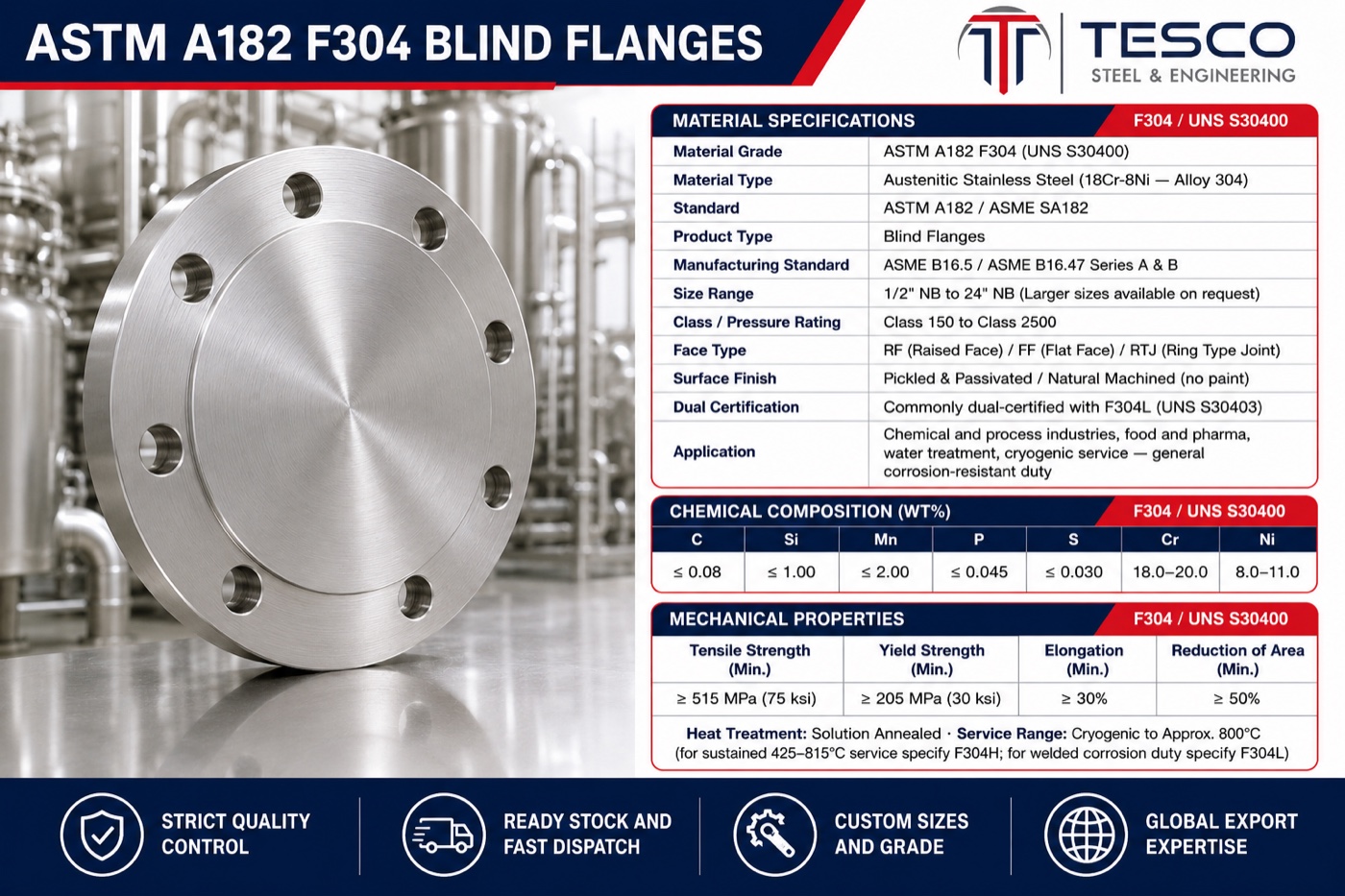
Tesco Steel & Engineering forges ASTM A182 F304 blind flanges — alloy 304, UNS S30400, the world's default stainless — to ASME B16.5 Class 150–2500 from ½″ to 24″ NB and to ASME B16.47 up to 60″. The 18-8 austenitic structure has no ductile-brittle transition: tough from LNG-cold to roughly 800 °C, the widest service span of any family on this site. Supplied solution annealed, pickled and passivated, and commonly F304/F304L dual-certified; chlorides step to F316/F316L, serious brine to duplex. Facings: BLRF, BLFF or BLRTJ. Every lot with EN 10204 3.1/3.2 MTC. ISO 9001:2015, made in Mumbai, India — exported to 50+ countries.
ASTM A182 F304 · UNS S30400 · EN 1.430118Cr-8Ni Austenitic · The Default StainlessCryogenic to ~800 °C · No DBTTF304/F304L Dual-CertificationASME B16.5 ½″–24″ · Class 150–2500RF · FF · RTJ FacingsEN 10204 3.1 / 3.2 · ISO 9001:2015
ASTM A182 F304 Blind Flange — Specifications at a Glance
What is an ASTM A182 F304 Blind Flange?
The default stainless closure. A solid forged disc of austenitic 304 (UNS S30400) with no bore, closing pipes, valves and nozzles wherever carbon steel would corrode: chemical plants, food and pharma, water treatment, cryogenic gas systems. The 18% Cr / 8–11% Ni austenite stays tough from cryogenic cold to ~800 °C — no ductile-brittle transition, no impact-test question. Tensile ≥515 MPa, yield ≥205 MPa, elongation ≥30%; solution annealed, pickled & passivated; commonly F304/F304L dual-certified. Dimensions per ASME B16.5 / B16.47 in RF, FF and RTJ facings; EN 10204 3.1 certified.
Also searched as: SS 304 blind flange, 304 stainless blind, S30400 blind, SA-182 F304 blind (the ASME boiler-code twin), 1.4301 / X5CrNi18-10 blind (the EN equivalent), F304/F304L dual-cert blind — all refer to the product on this page. See also the stainless steel hub, the F304 slip on flanges, siblings F304L / F316 / F316L blind flanges, and the facing pages BLRF / BLFF / BLRTJ.
The Austenitic Idea — Why 304 Runs the World
Chromium Makes It Stainless
18–20% chromium builds the self-healing passive film that shrugs off water, food acids, atmosphere and general chemistry — the property the whole family is named for.
Nickel Makes It Tough Everywhere
8–11% nickel locks the structure austenitic at all temperatures — no ductile-brittle transition, so the same grade serves LNG cold and red heat without an impact-test question.
The Trade-Off Is Honest
Yield sits at a modest 205 MPa and hot chlorides can pit and crack it — the two doors through which 316 and duplex enter the story.
The carbon story in one paragraph. Hold plain 304 between 425 and 815 °C — a weld zone, a slow cool — and its carbon precipitates as chromium carbides at grain boundaries, robbing the metal beside them of the chromium that makes it stainless: sensitization, and intergranular corrosion follows. A forged, solution-annealed blind arrives immune; the risk lives at field welds and hot excursions. The L grade removes the carbon (corrosion duty), the H grade manages it for creep (hot duty) — and dual-certified F304/F304L covers the everyday middle from one stock.
Where 304 Sits — The Stainless Ladder
Grade
Key Addition
Yield
Home Ground
F304 (this page)
— the 18-8 baseline
≥205 MPa
Fresh water, food, pharma, general chemistry, cryogenics
Note what is absent: no molybdenum (that is 316's addition), no nitrogen requirement, no micro-alloys — the simplicity is part of why 304 is the economical default of the stainless world.
Mechanical Properties & The Service Span
Property
ASTM A182 F304 Requirement
Tensile Strength
≥ 515 MPa (75 ksi)
Yield Strength (0.2%)
≥ 205 MPa (30 ksi)
Elongation
≥ 30%
Reduction of Area
≥ 50%
Hardness
No A182 limit for austenitics — typically soft, ~150–190 HB as annealed
Condition
Solution annealed — mandatory
Service Span
Cryogenic (LNG, LN2) to ~800 °C oxidation limit — F304H for sustained 425–815 °C, F304L for welded corrosion duty
The modest yield is the austenitic trade-off — stainless flange ratings sit below carbon steel's at moderate temperatures — but the ductility numbers (30% elongation, 50% reduction of area) describe a metal that bends and stretches long before it breaks, at any temperature piping sees.
ASTM A182 F304 Blind Flanges are available in the following specifications:
Material Grade
ASTM A182 F304 (UNS S30400); F304/F304L dual-certification standard where the melt qualifies; EN 1.4301 to order
Heat Treatment
Solution annealed — mandatory; condition stated on certificate
Size
1/2"NB to 24"NB per ASME B16.5; 26"–60" per ASME B16.47; EN 1092-1 to order
Class
150#, 300#, 400#, 600#, 900#, 1500#, 2500#
Facings
Raised Face (BLRF), Flat Face (BLFF), Ring Type Joint (BLRTJ) with groove per B16.20
Service Span
Cryogenic to ~800 °C — sustained 425–815 °C duty as F304H; welded corrosion duty as F304L
Surface Finish
Pickled & passivated or natural machined — no paint; segregated stainless handling throughout
Modifications
NPT-tapped centre (hydrotest / vent / drain / gauge), lifting provisions — machined & certified at the works
Testing
Tension & chemistry per heat; PMI routine; IGC (A262) and other corrosion tests where specified
Certification
EN 10204 3.1 (standard) / 3.2 witnessed — dual F304/F304L designation on request
Why F304 Blind Flanges Are Specified
The Economical Stainless Default
Where carbon steel corrodes and nothing exotic threatens, 304 is the answer the whole world reaches for first — and its blinds are the fastest-moving stainless closure we stock.
One Grade, Cryogenic to Red Heat
No ductile-brittle transition means no impact-test question — the same F304 blind closes an LNG-adjacent line and a hot process header.
Hygiene-Ready Finish
Pickled, passivated, paint-free — the surface food, dairy, brewery and pharma systems expect, straight from the works.
Dual-Cert Simplicity
F304/F304L on one certificate serves both paperwork worlds from one stock — the practical answer to the carbon-family question for everyday duty.
Three details buyers miss.Chlorides are the boundary: salt-bearing water pits 304 and warm chlorides can crack it — coastal and brine duty belongs to 316 or duplex, however clean the water looks on paper. The yield is modest: stainless ratings sit below carbon steel's at moderate temperatures — check the B16.5 stainless tables, not the carbon ones, when class-checking a joint. Say dual-cert if you need it: most melts qualify as F304/F304L, but the certificate only lists both if the order asks.
How Our F304 Blind Flanges Are Manufactured
1
Forging — cut billet of the spectro-verified S30400 heat is hot-forged into the solid disc blank with full heat traceability and segregated stainless handling.
2
Solution anneal — dissolving carbides and restoring the uniform austenite the grade's corrosion resistance depends on; furnace charts retained against the heat number.
3
Machining & facing — faces, OD and drilling to ASME B16.5 / B16.47; RF serrations, flat face or RTJ groove gauged per B16.20; NPT taps machined where ordered.
4
Testing — tension test and chemistry against the heat; PMI on every piece; intergranular-corrosion (ASTM A262) and other tests where specified.
5
Pickling & passivation — the restored chromium-oxide skin and hygienic finish, with marking of standard, grade (dual F304/F304L where certified), size, class and heat number.
6
Certification & packing — EN 10204 3.1 MTC (3.2 witnessed on request); faces protected, palletised or crated sea-worthy — no carbon-steel contact in transit.
Where F304 Blind Flanges Are Used
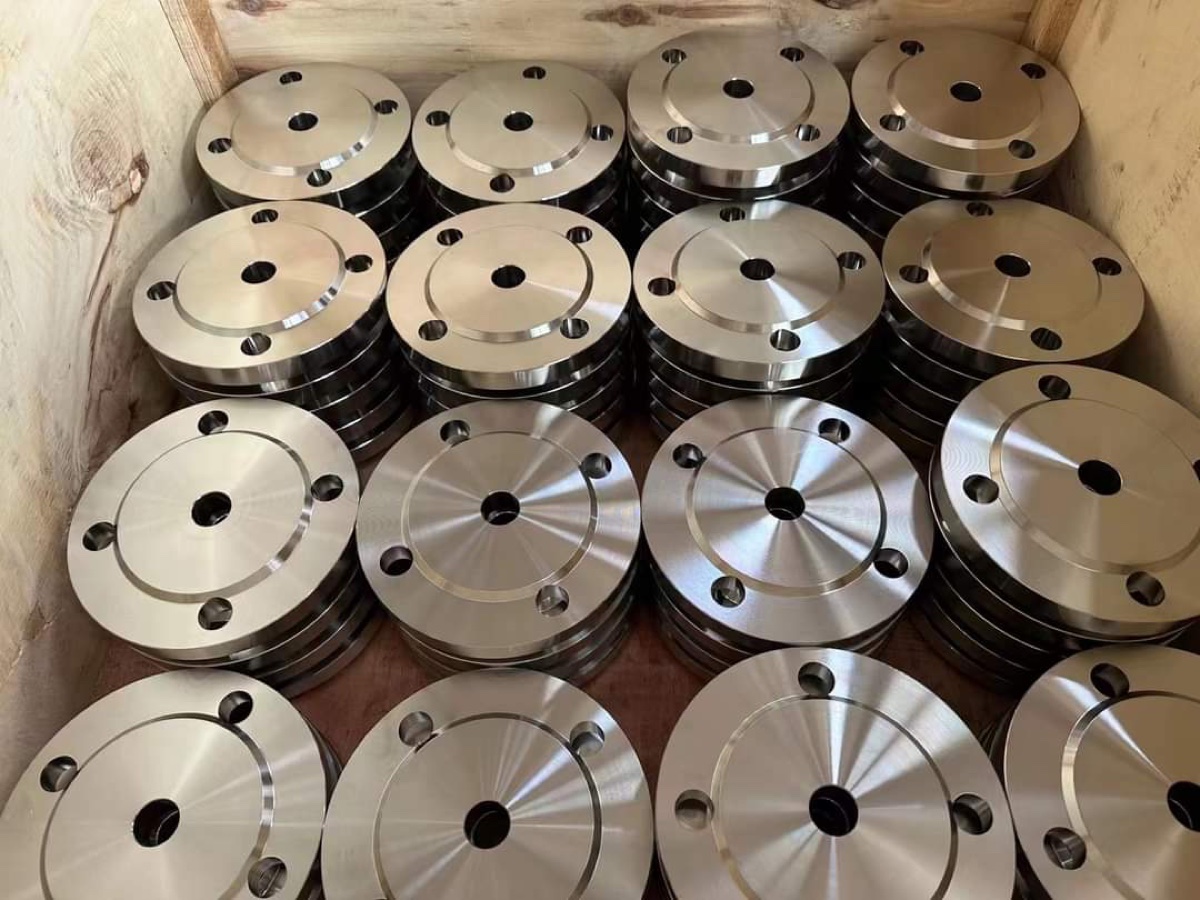
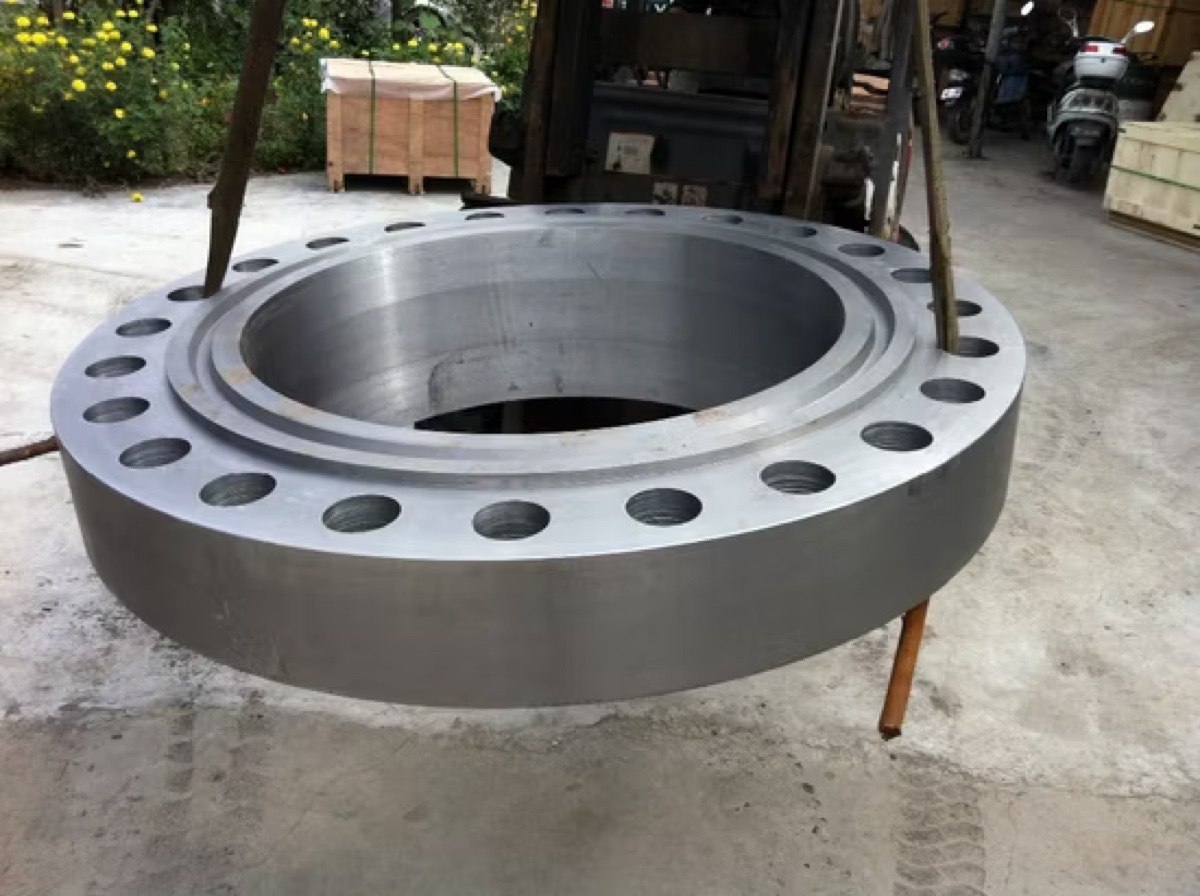
Everywhere general corrosion resistance earns its keep: chemical and process plants, food, dairy, brewery and pharmaceutical systems, water and wastewater treatment, pulp and paper, cryogenic gas plants, and utility piping generally. Production below:
Stainless Steel Flanges — Crated for DispatchLarge-Diameter Flange — Ring Groove Machined
F304 Blind Flange Dimensions
Blind dimensions are class-governed — identical across material grades. Full charts:
An ASTM A182 F304 blind flange is a solid forged disc of austenitic stainless steel — alloy 304, UNS S30400, the 18-chromium 8-nickel grade that is the world's default stainless — drilled to the standard bolt pattern with no bore, used to close pipes, valves and vessel nozzles wherever carbon steel would corrode: chemical and process plants, food and pharma, water treatment, and cryogenic systems. Dimensions follow ASME B16.5 from ½ inch to 24 inch and ASME B16.47 beyond, in raised face, flat face and ring joint facings.
What kind of steel is 304?
The founding austenitic stainless: roughly 18% chromium for the passive corrosion-resisting film and 8-11% nickel to hold the structure austenitic at all temperatures. That austenite is the grade's superpower — tough from cryogenic cold to red heat, ductile (30% elongation guaranteed), weldable and formable — at the price of modest yield strength and vulnerability to hot chlorides. F304 is the ASTM A182 forged-flange designation; EN calls the same steel 1.4301.
Why can F304 serve cryogenic duty?
Because austenite has no ductile-brittle transition. Ferritic steels — carbon, chrome-moly, even duplex — turn brittle below a transition temperature and need impact testing to prove a floor; austenitic stainless simply stays tough, to liquid-nitrogen temperatures and beyond. That is why LNG (-162°C), liquid oxygen and nitrogen systems run austenitic stainless as a matter of course, and why the cold end of the blind-flange world belongs to grades like F304 while the hot end belongs to chrome-moly.
What is the difference between F304, F304L and F304H?
Carbon. F304 caps it at 0.08% — the general-purpose grade. F304L holds it below 0.030%, sacrificing a little strength to prevent sensitization at welds — the corrosion-duty choice. F304H guarantees at least 0.04% carbon for creep strength in sustained hot service above roughly 525°C — the furnace-and-header choice, with its own rating lines. Most modern melts satisfy both F304 and F304L, so dual-certified F304/F304L forgings are the practical standard; F304H is melted deliberately when specified.
What is sensitization?
Heat plain 304 between roughly 425 and 815°C — a weld zone, a slow cool — and its carbon precipitates as chromium carbides along grain boundaries, robbing the neighbouring metal of the chromium that makes it stainless. The result is intergranular corrosion in service. A forged, solution-annealed blind arrives immune; the risk lives at field welds and hot excursions. The cures are the L grade (too little carbon to precipitate) for corrosion duty and the H grade (carbon managed for creep) for deliberate hot service — the reason the 304 family comes in three carbons.
When should F316 be used instead of F304?
When chlorides enter the picture. 316 adds 2-3% molybdenum, buying measurably better pitting and crevice resistance in salt-bearing water, coastal atmospheres and mild brine — the single most common stainless upgrade. 304 remains the economical default for fresh water, food, pharma and general chemistry. Our F316 and F316L blind flange pages cover that side; when chlorides get serious — warm seawater, brine — the answer jumps past both to duplex.
When is duplex the better choice than F304?
When strength or chloride stress-corrosion cracking governs. Austenitic 304 yields at 205 MPa and cracks in hot chlorides; duplex F51/F60 yields at 450 MPa and its ferrite blocks chloride SCC. The trade is duplex's narrow temperature band (-50 to +300°C) against austenitic's span from cryogenic to red heat. Fresh water and food duty stay 304; seawater and brine go duplex; the temperature extremes stay austenitic by default. Our duplex blind flange pages tell that story.
What are the mechanical properties of F304 blind flanges?
Tensile strength 515 MPa (75 ksi) minimum, yield strength 205 MPa (30 ksi) minimum, elongation 30% minimum and reduction of area 50% minimum, in the solution-annealed condition — A182 specifies no hardness limit for the grade. The modest yield is the austenitic trade-off, and it is why stainless flange ratings sit below carbon steel's at moderate temperatures. What the numbers do not show is the toughness: the grade bends and stretches long before it breaks, at any temperature piping sees.
What temperature range does an F304 blind flange cover?
The widest of any grade family on this site: cryogenic — LNG, liquid nitrogen — up to roughly 800°C where oxidation scaling becomes the limit. Two caveats shape real use: sustained service in the 425-815°C sensitization band calls for F304H (creep-rated, carbon-managed), and welded corrosion duty calls for F304L. The B16.5 pressure-temperature tables carry the grade far beyond carbon steel's 425°C ceiling — with allowable stresses reflecting the modest yield.
What facings are F304 blind flanges made with?
All three: raised face (BLRF) — the process-industry default — flat face (BLFF) for mating GRP and lined systems, and ring type joint (BLRTJ) for high-pressure duty, the ring chosen softer than the groove. Each facing has its own page on this site. The forging is common to all three; the mating flange governs the choice, and for RTJ the ring number follows from size and class.
Can F304 blind flanges be tapped for testing or instruments?
Yes — fill, vent, drain, gauge and injection taps are machined into the centre of the blind at the works and certified with the flange. Austenitic stainless work-hardens as it machines, so works tooling beats field drilling; the tap arrives ready to plug with the solution anneal undisturbed. State the NPT size on the enquiry.
Where are F304 blind flanges used?
Everywhere general corrosion resistance is worth paying for: chemical and process plants, food, dairy, brewery and pharmaceutical systems, water and wastewater treatment, pulp and paper, cryogenic gas plants, and utility piping generally. F304 blinds serve the usual closure duties — isolations, future connections, tapped test blinds — with the pickled, paint-free finish hygienic industries expect.
Which standards cover F304 blind flanges?
The material standard is ASTM A182 grade F304 (UNS S30400), with ASME SA-182 as its boiler-code twin and EN 1.4301 / X5CrNi18-10 as the European equivalent; dimensions follow ASME B16.5 for ½"-24" and ASME B16.47 for 26"-60". A complete specification reads: 'Blind Flange, RF, 4", ASME B16.5 Class 150, ASTM A182 F304 (or F304/F304L dual)' — and our EN 10204 certificates state it exactly that way, with heat number, heat treatment and test results.
What does F304/F304L dual certification mean?
One forging satisfying both specifications on one certificate. Modern melting comfortably holds carbon below 0.030% while meeting F304's strength, so the same heat certifies as F304 and F304L simultaneously — serving line classes written around either designation from one stock. Most of our austenitic production is dual-certifiable; state the requirement on the enquiry and the certificate reads accordingly.
Who manufactures ASTM A182 F304 blind flanges in India?
Tesco Steel & Engineering is an ISO 9001:2015 certified flange manufacturer based in Mumbai, India, forging ASTM A182 F304 / UNS S30400 stainless blind flanges from ½" to 24" NB per ASME B16.5 in Classes 150-2500 and to 60" per ASME B16.47 — solution annealed, pickled and passivated, PMI-verified, F304/F304L dual-certified where required, certified to EN 10204 3.1/3.2 on every lot — in raised face, flat face and ring joint facings, alongside F304L, F316/F316L, duplex and nickel-alloy blinds. Exported to more than 50 countries.