Hastelloy C22 Slip On Flanges — UNS N06022 Manufacturer
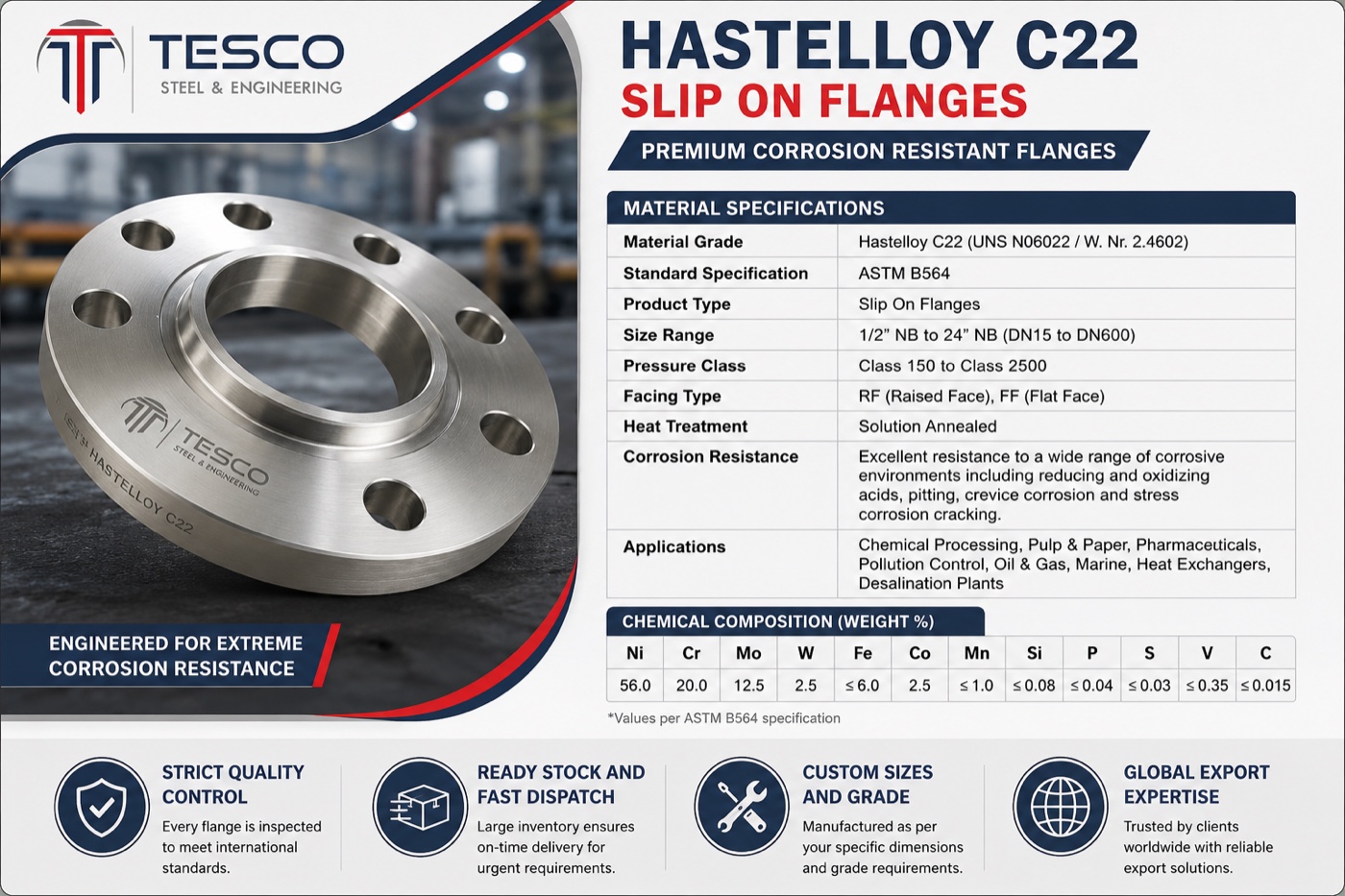
Tesco Steel & Engineering forges Hastelloy C-22 slip on flanges — the balanced nickel-chromium-molybdenum-tungsten alloy (UNS N06022, Werkstoff 2.4602, NiCr21Mo14W) — to ASTM B564 and ASME B16.5 Class 150–2500 from ½″ to 24″ NB, larger patterns to order. Where C-276 maximised molybdenum for reducing acids, C-22 rebalances: 22% chromium with 13% Mo and tungsten covers both sides of the electrochemical street — ferric and cupric chlorides, wet chlorine with oxidisers, mixed acids and multi-product duty — with among the highest pitting and crevice temperatures of any wrought alloy, and C 0.015 / Si 0.08 max for as-welded service. Supplied solution annealed, every lot with EN 10204 3.1/3.2 MTC. ISO 9001:2015, made in Mumbai, India — exported to 50+ countries.
Hastelloy C-22 · Alloy C22 · N06022ASTM B564 · 2.4602 · NiCr21Mo14WCr 20–22.5% · Mo 12.5–14.5% · W 2.5–3.5%NACE MR0175 Sour ServiceASME B16.5 Class 150–2500690 MPa TS / 310 MPa YS minEN 10204 3.1 / 3.2 · ISO 9001:2015
Hastelloy C22 Slip On Flange — Specifications at a Glance
What is a Hastelloy C22 Slip On Flange?
C-22 = the C-alloy that covers both sides of the street.22% Cr fights oxidising chlorides — ferric, cupric, wet chlorine with oxidants — while 13% Mo + 3% W hold the reducing side; the result posts among the highest pitting and crevice temperatures of any wrought alloy, exactly what a gasketed flange joint needs. C 0.015 / Si 0.08 max → as-welded service. The modern balanced choice beside the legacy default C-276. As a slip-on: two fillet welds with ERNiCrMo-10 filler, no preheat, no PWHT — forged to ASTM B564, not A182.
Also searched as: Alloy C22 slip on flange, Hastelloy C-22 SORF flange, ASTM B564 N06022 slip on flange, 2.4602 / NiCr21Mo14W slip on flange, pharma reactor flange — all refer to the product on this page. See also our Hastelloy C22 flanges overview and Hastelloy hub.
Rule of thumb: know your stream's electrochemistry — oxidising or mixed goes C-22, reducing goes C-276, pure concentrated HCl goes B-3 — and when the stream cannot be trusted, C-22's balance is the safest single answer.
Hastelloy C-22 (UNS N06022) Chemical Composition
Ni
Cr
Mo
W
Fe
Co
Mn
V
C
Si
S
Balance (~56)
20.0-22.5
12.5-14.5
2.5-3.5
2.0-6.0
2.5 max
0.50 max
0.35 max
0.015 max
0.08 max
0.02 max
Values in weight % for UNS N06022 per ASTM B564. Against C-276, read it as molybdenum traded for chromium — the armour rebalanced toward oxidising conditions — with the same ultra-low C and Si that keep welds serviceable as-welded.
Hastelloy C-22 Mechanical Properties
Tensile Strength, MPa (ksi)
Yield Strength 0.2%, Min, MPa (ksi)
Elongation % min (2")
Density
690 (100) min
310 (45) min
45
8.69 g/cm³
Per ASTM B564, solution annealed with rapid quench. Marginally stronger and even more ductile than C-276 (45% vs 40% elongation) — toughness from cryogenic temperatures upward. Values demonstrated per heat on the EN 10204 certificate.
Hastelloy C22 Slip On Flange Specifications
Hastelloy C22 Slip On Flanges are available in the following specifications:
Two fillet welds (hub + bore), pipe set back 1/8"; matching ERNiCrMo-10 filler, no preheat, no PWHT
Testing
PMI verification, ASTM G48-style pitting testing and NACE documentation where specified
Certification
EN 10204 3.1 (standard) / 3.2 witnessed
Equivalent Grades of Hastelloy C-22
Trade Names
ASTM Forging
UNS
Werkstoff Nr.
EN
Fittings
Hastelloy C-22 / Alloy C22 / Nicrofer 5621 hMoW
B564
N06022
2.4602
NiCr21Mo14W
B366 WPHC22
ASME SB-564 is the boiler-code twin. System partners: ASTM B574 rod & bar, ASTM B575 plate, sheet & strip, ASTM B622 seamless and B619 welded pipe. Not an A182 grade — nickel-alloy flanges are governed by the B-series standards. Reducing-side sibling: Hastelloy C-276 (N10276).
Why Hastelloy C22 Slip Ons Are Specified
Both Sides of the Street
22% Cr for oxidising chlorides, 13% Mo + W for reducing acids — the balanced armour that survives streams whose chemistry swings or cannot be trusted.
The Crevice Champion
Among the highest critical pitting and crevice temperatures of any wrought alloy — and a flange joint is a crevice by construction. Gasket faces stay passive where lesser alloys pit.
Multi-Product Insurance
Pharmaceutical and fine-chemical plants validate one alloy against every campaign — C-22's balance is why they standardise on it, reactor to flange.
As-Welded Into Service
C 0.015 / Si 0.08 max — no sensitised zones, no PWHT; ERNiCrMo-10 is also the cladding wire when C-22 surfaces protect carbon steel.
Balance has its own edges.Purely reducing hot HCl:C-276's extra molybdenum — or for concentrated HCl the Ni-Mo B-family — still edges it. Sustained heat: the 500–900 °C ageing window rules out furnace duty — that belongs to Inconel 600/601 and the Incoloy heat grades. The budget line: where 625, 825 or super duplex genuinely covers the stream, C-22 buys insurance the duty may not need — we quote the honest alternative when the enquiry allows.
How Our Hastelloy C22 Slip On Flanges Are Manufactured
1
Forging — cut billet of certified N06022 heat is hot-forged into the flange blank, keeping full heat traceability from raw material to despatch.
2
Solution annealing — ~1120 °C with rapid quench per ASTM B564, dissolving secondary phases and setting the corrosion resistance; furnace record retained.
3
Machining — hub, faces and bolt holes to ASME B16.5; the bore machined slightly over pipe OD per the slip-on tolerance.
4
Facing & finish — SORF raised face with serrated stock finish, flat face or RTJ groove.
5
Testing & marking — mechanical and chemical verification against the heat (PMI, G48-style pitting tests and NACE documentation where the order specifies), then permanent marking of standard, grade, size, class and heat number.
6
Certification & packing — EN 10204 3.1 MTC (3.2 witnessed on request), export-packed for sea or air freight.
Where Hastelloy C22 Slip On Flanges Are Used
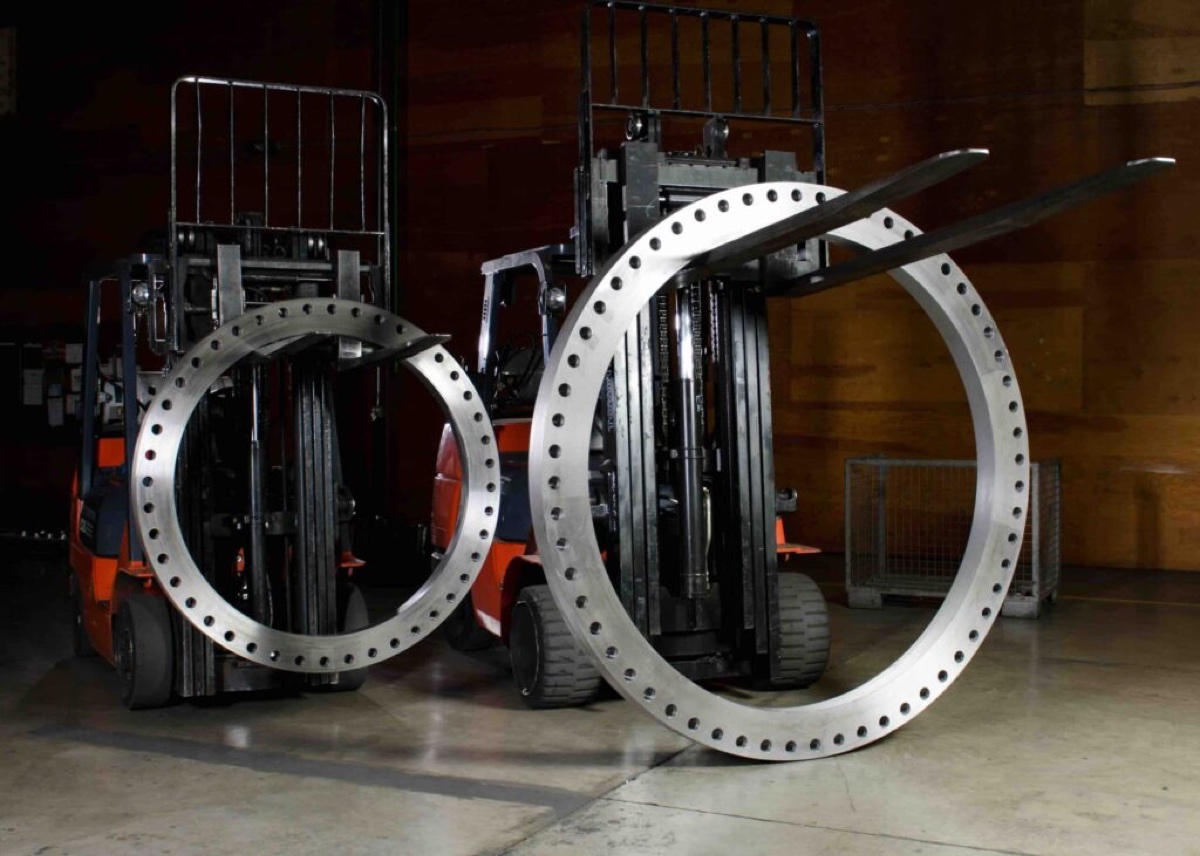
Multi-product and oxidising-chloride chemistry: pharmaceutical and fine-chemical reactor systems, flue-gas desulphurisation scrubbers, chlorine and hypochlorite service with oxidising contamination, pulp-and-paper bleach plants, waste incineration scrubbers, pickling and acid recovery, desalination brine sections and the severest sour gas processing. Slip-ons serve the moderate-pressure utility, transfer and scrubber connections; weld necks take the critical lines. Production scale below:
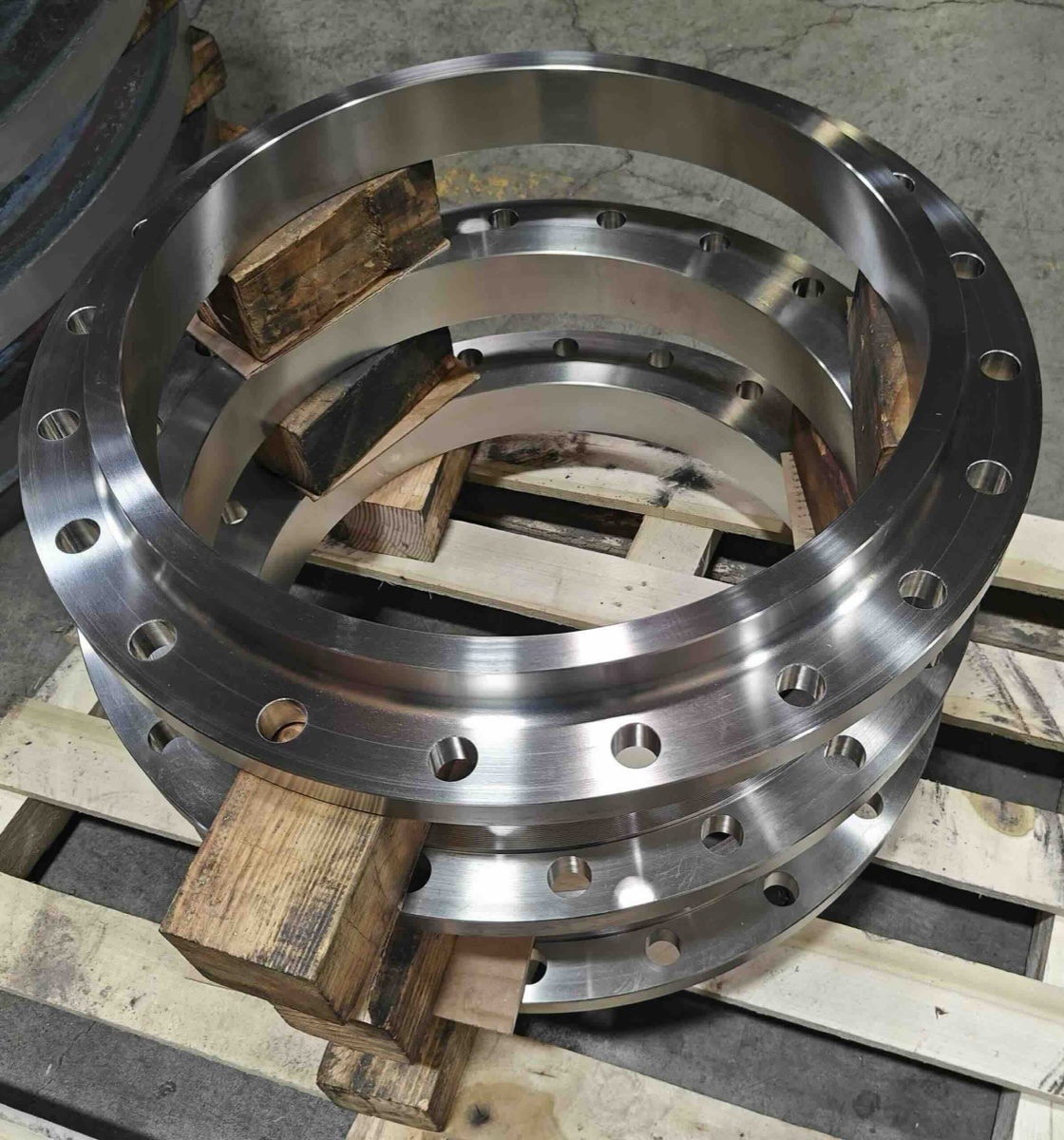
Large-Diameter Slip On Flanges — Palletised for DespatchGiant-Diameter Flanges — Forklift-Scale Production
Hastelloy C22 Slip On Flange Dimensions
Hastelloy C22 slip-on dimensions follow the ASME B16.5 slip-on tables — identical for every material. Full charts by class:
Example: “Slip On Flange, 4″ NB, ASME B16.5 Class 150, RF, Hastelloy C-22 / ASTM B564 (N06022), EN 10204 3.1 — 6 pcs.” Quotations normally within 24 hours with price, unit weight and delivery.
Hastelloy C22 Slip On Flanges — Frequently Asked Questions
What is a Hastelloy C22 slip on flange?
It is a slip-on flange forged from Hastelloy C-22 — the balanced nickel-chromium-molybdenum-tungsten alloy (UNS N06022, ASTM B564, Werkstoff 2.4602) — dimensioned to ASME B16.5. The flange slides over the pipe end and is secured with two fillet welds. With 22% chromium alongside 13% molybdenum and tungsten, C-22 covers oxidising and reducing chloride chemistry alike — ferric and cupric chlorides, wet chlorine, mixed acids — with ultra-low carbon and silicon letting welds enter that service as-welded.
What is Hastelloy C-22?
The balanced successor in the Hastelloy C family. C-276 solved reducing chloride chemistry with maximum molybdenum; C-22 rebalanced the recipe — chromium up to 22%, molybdenum eased to 13% — so one alloy handles both sides of the electrochemical street. The result outperforms C-276 in oxidising media while conceding little in reducing ones, which is why many new plants and the pharmaceutical industry standardise on it. Designations: UNS N06022, Werkstoff 2.4602, EN NiCr21Mo14W, often simply Alloy C22; forged flanges are governed by ASTM B564.
What is the chemical composition of Hastelloy C-22?
For UNS N06022: nickel balance (roughly 56%), chromium 20.0-22.5%, molybdenum 12.5-14.5%, tungsten 2.5-3.5%, iron 2.0-6.0%, cobalt 2.5% max, manganese 0.50% max, vanadium 0.35% max — and the fabrication-critical pair: carbon 0.015% max and silicon 0.08% max, low enough that welding cannot sensitise the heat-affected zone. Against C-276, read it as molybdenum traded for chromium: the armour rebalanced toward oxidising conditions.
What are the mechanical properties of Hastelloy C22 slip on flanges?
Per ASTM B564 in the solution annealed condition: tensile strength 690 MPa (100 ksi) minimum, 0.2% yield strength 310 MPa (45 ksi) minimum and elongation 45% minimum — marginally stronger and even more ductile than C-276. Density is 8.69 g/cm³. Supplied solution annealed with rapid quench, the condition that keeps the corrosion resistance intact; values are demonstrated per heat on the EN 10204 certificate.
What is the difference between Hastelloy C-22 and C-276?
Chromium balance. C-276 carries 16% Mo and 15% Cr — the reducing-acid specialist with the longest service record. C-22 raises chromium to 22% at 13% Mo, tilting the armour toward oxidising media: ferric and cupric chlorides, wet chlorine with oxidising contaminants, nitric-bearing mixtures — where it clearly outperforms C-276. In purely reducing hot HCl, C-276 still edges it. The practical split: C-276 is the legacy default and failure-history answer; C-22 is the modern balanced choice that new designs increasingly name outright. We forge both.
Why is C-22 better in oxidising chloride media?
Because oxidising attack is fought by chromium's passive film, and C-22 carries seven points more of it than C-276. Ferric and cupric chloride solutions — the classic accelerants of pitting, and the very chemicals used in ASTM G48 testing — meet a film that repairs itself faster than they can break it, while the still-substantial molybdenum and tungsten guard the reducing side. That double coverage gives C-22 among the highest critical pitting and crevice temperatures of any wrought alloy.
How does Hastelloy C-22 compare with Inconel 625?
Both are Ni-Cr-Mo alloys; the proportions tell the story. 625 (9% Mo) is the strong, economical all-rounder — seawater, sour service, double the strength. C-22 (13% Mo, 22% Cr, plus W) is the corrosion specialist: measurably higher pitting and crevice resistance, better in both oxidising and reducing acids, at a higher price and lower strength (310 vs 414 MPa yield). The enquiry moves from 625 to C-22 when localised chloride corrosion or aggressive mixed acids dominate the duty rather than load.
Why do pharmaceutical plants standardise on Hastelloy C-22?
Multi-product chemistry. A pharmaceutical or fine-chemical reactor sees different reagents every campaign — acids, brines, solvents, oxidants — and no single-purpose alloy can be validated against all of them. C-22's balanced resistance means the vessel, and the flanges serving it, survive whatever the next process brings, and its clean, low-carbon structure suits electropolishing and validation regimes. The same insurance logic drives its use in FGD and waste-incineration scrubbers, where flue chemistry is never twice the same.
How does Hastelloy C-22 perform in seawater and brine?
At the top of the wrought table. Its critical pitting and crevice corrosion temperatures sit above super duplex, 6-moly stainless and Alloy 625, so gasketed and creviced joints — exactly what a flange is — stay passive in hot, stagnant, chlorinated seawater that attacks lesser alloys. It is correspondingly specified in desalination brine sections and seawater-cooled process equipment where the cheaper ladder has a failure history. For routine seawater duty, though, super duplex or 254 SMO remain the economic answers.
Is Hastelloy C-22 acceptable for NACE MR0175 sour service?
Yes — UNS N06022 is listed in NACE MR0175 / ISO 15156-3 among the highest-rated wrought materials for severe sour environments, alongside C-276. Its oil-and-gas use concentrates where extreme H₂S, chloride and temperature combinations exhaust cheaper corrosion-resistant alloys. State the NACE requirement on the enquiry and the certification documents compliance.
What temperature range can Hastelloy C22 slip on flanges handle?
Its working world is wet corrosion from cryogenic temperatures through boiling-acid conditions, with ASME B16.5 ratings governing the joint. Like all C-family alloys it is not a furnace grade: prolonged exposure in roughly the 500-900 °C window precipitates intermetallic phases that degrade corrosion resistance, so hot-service enquiries belong with Inconel 600/601 or the Incoloy heat grades. Our supply arrives solution annealed with the corrosion resistance fully intact.
Which ASTM standard covers Hastelloy C22 slip on flanges?
ASTM B564 (ASME SB-564), the nickel-alloy forging specification — not A182, which covers stainless and alloy steels. System partners follow the same B-series logic: rod and bar to ASTM B574, plate, sheet and strip to ASTM B575, seamless pipe and tube to ASTM B622, welded pipe to ASTM B619, and welding fittings to ASTM B366 (WPHC22). Certificates state UNS N06022, the standard, the solution-annealed condition and the heat number together.
Where are Hastelloy C22 slip on flanges typically used?
Multi-product pharmaceutical and fine-chemical plants, flue-gas desulphurisation scrubbers, chlorine and hypochlorite systems with oxidising contamination, pulp-and-paper bleach chemistry, waste incineration scrubbers, pickling and acid-recovery service, desalination brine sections and the severest sour gas processing. Slip-ons serve the moderate-pressure utility, transfer and scrubber connections; weld necks take the critical lines — both forged from the same certified N06022 heats.
Where does Hastelloy C-22 not belong?
Three honest lines. Purely reducing hot hydrochloric acid: C-276 — or for concentrated HCl the nickel-molybdenum B-family — still edges it. Sustained heat: the 500-900 °C ageing window rules out furnace duty, which belongs to Inconel 600/601 and the Incoloy heat grades. And the budget line: where 625, 825 or super duplex genuinely covers the stream, C-22 buys insurance the duty may not need — we quote the honest alternative when the enquiry allows it.
Who manufactures Hastelloy C22 slip on flanges in India?
Tesco Steel & Engineering is an ISO 9001:2015 certified flange manufacturer based in Mumbai, India, forging Hastelloy C-22 / UNS N06022 slip on flanges from ½" to 24" NB per ASTM B564 and ASME B16.5 — alongside the full C22 range of weld neck, blind, socketweld, threaded, lapped joint and spectacle blind flanges, plus Hastelloy C-276, B2/B3 and the complete nickel-alloy acid ladder — with full heat traceability, NACE MR0175 documentation where specified, PMI on request, and EN 10204 3.1/3.2 certification on every lot. Exported to more than 50 countries.