Hastelloy C276 Slip On Flanges — UNS N10276 Manufacturer
Tesco Steel & Engineering forges Hastelloy C-276 slip on flanges — the nickel-molybdenum-chromium-tungsten alloy (UNS N10276, Werkstoff 2.4819, NiMo16Cr15W) — to ASTM B564 and ASME B16.5 Class 150–2500 from ½″ to 24″ NB, larger patterns to order. 16% molybdenum backed by tungsten makes it the last line of defence in wet corrosion: hot hydrochloric and sulphuric acid, wet chlorine, hypochlorite, FGD scrubber chemistry and mixed streams that swing between oxidising and reducing — with C 0.010% / Si 0.08% max so welds enter that service as-welded. The step above Inconel 625 on our acid ladder, beside its high-chromium sibling C22. Supplied solution annealed, every lot with EN 10204 3.1/3.2 MTC. ISO 9001:2015, made in Mumbai, India — exported to 50+ countries.
Hastelloy C-276 · Alloy C276 · N10276ASTM B564 · 2.4819 · NiMo16Cr15WMo 15–17% · W 3–4.5% · C 0.010% maxNACE MR0175 Sour ServiceASME B16.5 Class 150–2500690 MPa TS / 283 MPa YS minEN 10204 3.1 / 3.2 · ISO 9001:2015
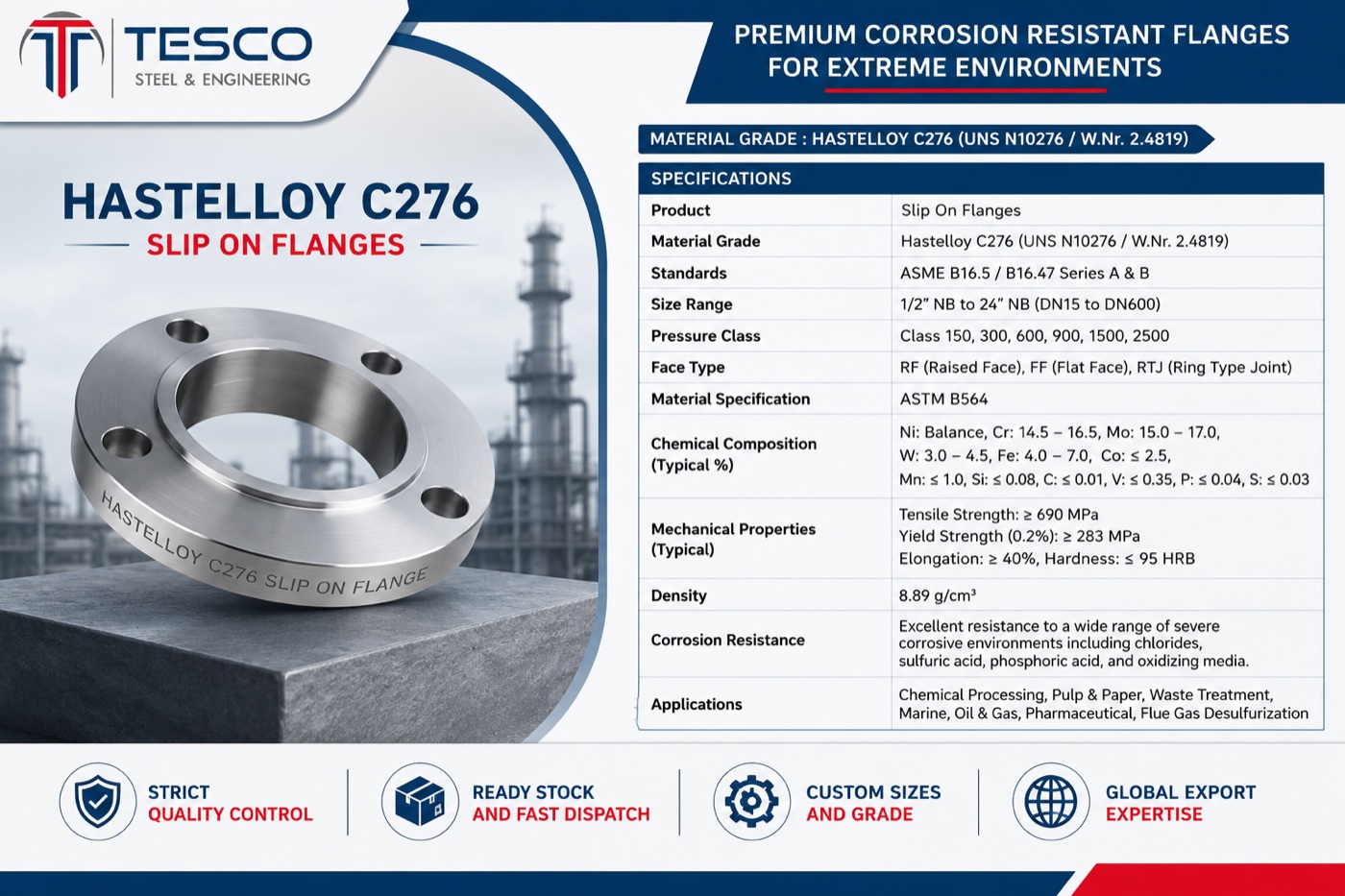
Hastelloy C276 Slip On Flange — Specifications at a Glance
What is a Hastelloy C276 Slip On Flange?
C-276 = the alloy specified after everything else has failed.16% Mo + 4% W shut down the pitting and crevice attack of hot HCl, wet chlorine and hypochlorite; 15% Cr keeps enough passive film for oxidising swings; C 0.010 / Si 0.08 max let welds enter that service as-welded — the refinement that made the grade famous. Chloride SCC immune, NACE-listed. As a slip-on: two fillet welds with ERNiCrMo-4 filler, no preheat, no PWHT — forged to ASTM B564, not A182.
Also searched as: Alloy C276 slip on flange, Hastelloy C-276 SORF flange, ASTM B564 N10276 slip on flange, 2.4819 / NiMo16Cr15W slip on flange, FGD scrubber flange — all refer to the product on this page. See also our Hastelloy C276 flanges overview and Hastelloy hub.
Rule of thumb: the ladder ends here for reducing chloride chemistry — beyond C-276 the conversation turns to titanium, tantalum or glass linings, not another steel.
Hastelloy C-276 (UNS N10276) Chemical Composition
Ni
Mo
Cr
W
Fe
Co
Mn
V
C
Si
S
Balance (~57)
15.0-17.0
14.5-16.5
3.0-4.5
4.0-7.0
2.5 max
1.0 max
0.35 max
0.010 max
0.08 max
0.03 max
Values in weight % for UNS N10276 per ASTM B564. The Mo + W pair is the armour against reducing acids and chloride attack; the ultra-low carbon and silicon are the fabrication story — held low enough that welding cannot precipitate damaging phases, the refinement that let C-276 replace the original Alloy C as-welded.
Hastelloy C-276 Mechanical Properties
Tensile Strength, MPa (ksi)
Yield Strength 0.2%, Min, MPa (ksi)
Elongation % min (2")
Density
690 (100) min
283 (41) min
40
8.89 g/cm³
Per ASTM B564, solution annealed (with rapid quench — the condition that keeps the corrosion resistance intact). Stronger than austenitic stainless with exceptional 40% ductility and toughness from cryogenic temperatures upward. Values demonstrated per heat on the EN 10204 certificate.
Hastelloy C276 Slip On Flange Specifications
Hastelloy C276 Slip On Flanges are available in the following specifications:
Two fillet welds (hub + bore), pipe set back 1/8"; matching ERNiCrMo-4 filler, no preheat, no PWHT
Testing
PMI verification and NACE documentation where specified
Certification
EN 10204 3.1 (standard) / 3.2 witnessed
Equivalent Grades of Hastelloy C-276
Trade Names
ASTM Forging
UNS
Werkstoff Nr.
EN
Fittings
Hastelloy C-276 / Alloy C276 / Nicrofer 5716 hMoW
B564
N10276
2.4819
NiMo16Cr15W
B366 WPHC276
ASME SB-564 is the boiler-code twin. System partners: ASTM B574 rod & bar, ASTM B575 plate, sheet & strip, ASTM B622 seamless and B619 welded pipe. Not an A182 grade — nickel-alloy flanges are governed by the B-series standards. High-chromium sibling: Hastelloy C22 (N06022).
Why Hastelloy C276 Slip Ons Are Specified
The Last Line of Defence
Hot HCl, wet chlorine, hypochlorite and FGD slurries — the streams that have already beaten stainless, 825 and 625 — are C-276's home ground. Its specification usually follows a failure history.
Survives the Swings
16% Mo for reducing conditions, 15% Cr for oxidising excursions — process upsets, contamination and concentration changes that kill single-purpose alloys leave it standing.
As-Welded Into the Worst Service
C 0.010 / Si 0.08 max — the ultra-low-residual refinement that made the grade famous: no sensitised zones, no PWHT, welds go straight into hot acid.
Sour to the Extreme
NACE MR0175 listed and among the highest-rated wrought materials in the severest H₂S-chloride-temperature combinations — where 825 and 925 run out of margin.
Even the last line has edges.Strongly oxidising acids: hot concentrated nitric favours high-chromium grades — C22, or for pure nitric even stainless outperforms it. Sustained heat: prolonged 500–900 °C exposure precipitates embrittling phases — furnace duty belongs to Inconel 600/601 and the Incoloy heat grades. The budget line: where 625 or 825 genuinely covers the stream, C-276 buys insurance the duty may not need — we quote the honest alternative when the enquiry allows.
How Our Hastelloy C276 Slip On Flanges Are Manufactured
1
Forging — cut billet of certified N10276 heat is hot-forged into the flange blank, keeping full heat traceability from raw material to despatch.
2
Solution annealing — ~1120 °C with rapid quench per ASTM B564, dissolving any secondary phases and setting the corrosion resistance; furnace record retained.
3
Machining — hub, faces and bolt holes to ASME B16.5; the bore machined slightly over pipe OD per the slip-on tolerance.
4
Facing & finish — SORF raised face with serrated stock finish, flat face or RTJ groove.
5
Testing & marking — mechanical and chemical verification against the heat (PMI and NACE documentation where the order specifies), then permanent marking of standard, grade, size, class and heat number.
6
Certification & packing — EN 10204 3.1 MTC (3.2 witnessed on request), export-packed for sea or air freight.
Where Hastelloy C276 Slip On Flanges Are Used
The hardest wet chemistry in industry: flue-gas desulphurisation scrubbers and ducting, chlorine and chlor-alkali plants, pulp-and-paper bleach systems, pharmaceutical and fine-chemical reactors, waste incineration scrubbers, pickling and acid-recovery plants, and the severest sour gas processing. Slip-ons serve the moderate-pressure utility, transfer and scrubber connections; weld necks take the critical lines. Production scale below:
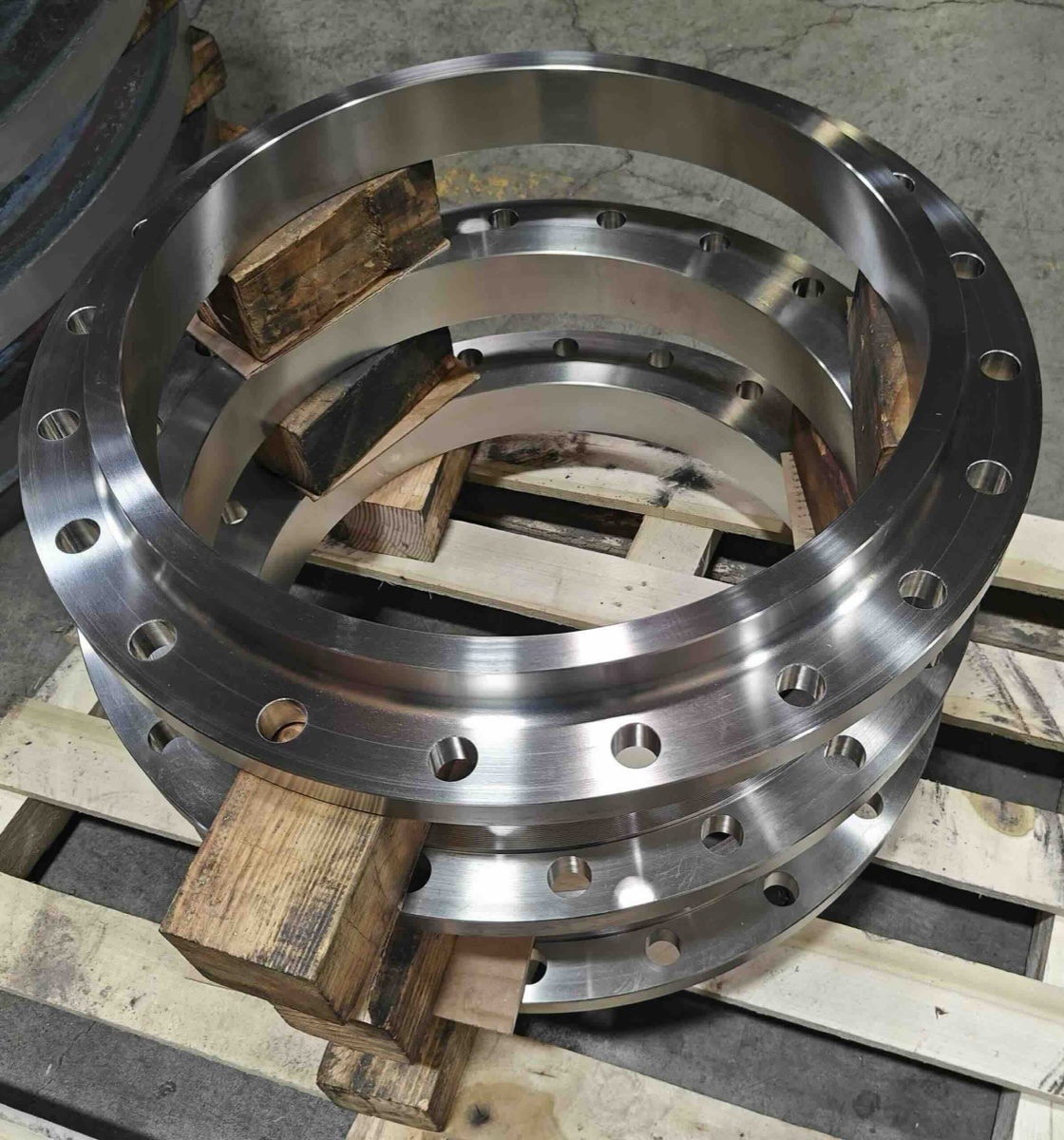
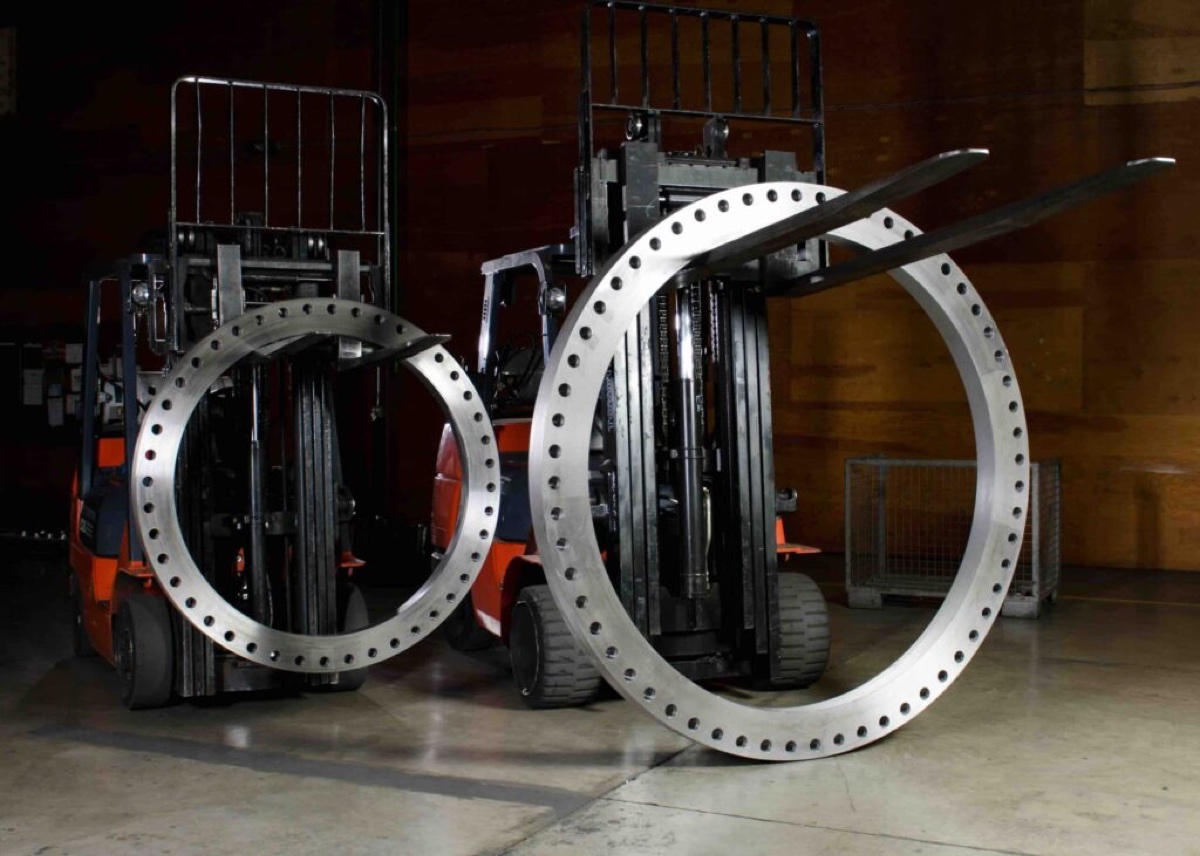
Large-Diameter Slip On Flanges — Palletised for DespatchGiant-Diameter Flanges — Forklift-Scale Production
Hastelloy C276 Slip On Flange Dimensions
Hastelloy C276 slip-on dimensions follow the ASME B16.5 slip-on tables — identical for every material. Full charts by class:
Example: “Slip On Flange, 4″ NB, ASME B16.5 Class 150, RF, Hastelloy C-276 / ASTM B564 (N10276), EN 10204 3.1 — 6 pcs.” Quotations normally within 24 hours with price, unit weight and delivery.
Hastelloy C276 Slip On Flanges — Frequently Asked Questions
What is a Hastelloy C276 slip on flange?
It is a slip-on flange forged from Hastelloy C-276 — the nickel-molybdenum-chromium-tungsten alloy (UNS N10276, ASTM B564, Werkstoff 2.4819) — dimensioned to ASME B16.5. The flange slides over the pipe end and is secured with two fillet welds. With 16% molybdenum backed by tungsten, C-276 is the alloy plants reach for when everything else has failed: hot hydrochloric and sulphuric acid, wet chlorine, hypochlorite and the worst mixed oxidising-reducing streams are its home ground, and its ultra-low carbon and silicon let welds enter that service as-welded.
What is Hastelloy C-276?
The most famous of the Hastelloy C family and the benchmark of severe wet-corrosion alloys. Its trick is balance: 16% molybdenum plus tungsten armour it against reducing acids and chloride pitting, while 15% chromium keeps enough passive-film capability for oxidising excursions — so streams that swing between the two, which destroy single-purpose alloys, leave it standing. Designations: UNS N10276, Werkstoff 2.4819, EN NiMo16Cr15W, often simply Alloy C276; forged flanges are governed by ASTM B564.
What is the chemical composition of Hastelloy C-276?
For UNS N10276: nickel balance (roughly 57%), molybdenum 15.0-17.0%, chromium 14.5-16.5%, tungsten 3.0-4.5%, iron 4.0-7.0%, cobalt 2.5% max, manganese 1.0% max, vanadium 0.35% max — and the fabrication-critical pair: carbon 0.010% max and silicon 0.08% max, held low enough that welding cannot precipitate damaging phases in the heat-affected zone. The molybdenum-tungsten combination gives a pitting resistance number far beyond any stainless.
What are the mechanical properties of Hastelloy C276 slip on flanges?
Per ASTM B564 in the solution annealed condition: tensile strength 690 MPa (100 ksi) minimum, 0.2% yield strength 283 MPa (41 ksi) minimum and elongation 40% minimum. Density is 8.89 g/cm³. Usefully stronger than austenitic stainless with exceptional ductility and toughness from cryogenic temperatures upward, supplied solution annealed with rapid quench — the condition that keeps the corrosion resistance intact. Values are demonstrated per heat on the EN 10204 certificate.
Why is Hastelloy C-276 called the last line of defence?
Because its specification usually follows a failure history. Plants try stainless, then 904L or Alloy 20, then 825 or 625 — and when the stream still wins, C-276 is the answer that holds: boiling hydrochloric fractions, hot contaminated sulphuric, wet chlorine and hypochlorite, FGD scrubber slurries. Its versatility across oxidising and reducing conditions means process upsets, contamination and concentration swings — the things that actually kill equipment — rarely surprise it. That insurance is what its price buys.
What is the difference between Hastelloy C-276 and Inconel 625?
Molybdenum, mostly. C-276 carries nearly twice 625's Mo (16 vs 9%) in a lower-iron base, making it decisively stronger in hot reducing acids — HCl above all — and wet chlorine chemistry. 625 counters with roughly double the strength (827 vs 690 MPa tensile minimum), better high-temperature capability, and lower cost. The working rule across our range: 625 is the default premium nickel alloy; the enquiry escalates to C-276 when hot HCl, wet chlorine or a failure history enters the conversation.
What is the difference between Hastelloy C-276 and C-22?
Chromium balance. C-22 (UNS N06022) raises chromium to 22% at slightly lower molybdenum, tilting the armour toward oxidising media — wet chlorine with oxidising contaminants, ferric and cupric chlorides, nitric-bearing mixtures — where it outperforms C-276; in purely reducing hot HCl the older alloy still edges it. C-276 remains the industry default with the longest service record and widest availability; C-22 is the specify-by-name choice for oxidising-chloride chemistry. We supply both — see our Hastelloy C22 slip on flanges.
How does Hastelloy C-276 compare with Alloy 20 or Incoloy 825?
They are the economic rungs below it on the acid ladder. Alloy 20 owns dedicated sulphuric duty and 825 owns standard sour and mixed-acid service — both at markedly lower cost, both covered on their own pages. C-276 takes over where those alloys' molybdenum runs out: hydrochloric acid at temperature, wet chlorine, severe crevice chemistry and streams whose composition cannot be trusted. Specifying C-276 where 825 suffices wastes money; specifying 825 where C-276 is needed wastes the plant. We quote honestly in both directions.
Why does C-276 handle wet chlorine and hot hydrochloric acid?
Chloride attack in these media is driven by acid reduction on the metal surface, and molybdenum — with tungsten reinforcing it — is the element that shuts that mechanism down. At 16% Mo plus 4% W, C-276's localised-corrosion resistance sits far beyond any stainless or lower-alloyed nickel grade, so the pitting and crevice attack that wet chlorine inflicts on lesser metals simply stalls. Meanwhile the nickel base is immune to chloride stress corrosion cracking. Hot HCl remains demanding — velocity, aeration and temperature still matter — but C-276 is the standard wrought answer.
Is Hastelloy C-276 acceptable for NACE MR0175 sour service?
Yes — UNS N10276 is listed in NACE MR0175 / ISO 15156-3, and in the most severe sour environments it is among the highest-rated wrought materials the standard recognises. In practice its oil-and-gas use concentrates in the extreme corners — high-H₂S, high-chloride, elevated-temperature wells and sour gas processing — where cheaper CRAs like 825 or 925 run out of margin. State the NACE requirement on the enquiry and the certification documents compliance.
What temperature range can Hastelloy C276 slip on flanges handle?
Its working world is wet corrosion from cryogenic temperatures up through boiling-acid conditions, with ASME B16.5 ratings governing the joint. Two honest notes: prolonged exposure in roughly the 500-900 °C window precipitates intermetallic phases that degrade corrosion resistance — C-276 is not a furnace alloy, and hot-service enquiries belong with Inconel 600/601 or the Incoloy heat grades — and any welding or hot work is finished with the solution-annealed condition intact, which our supply guarantees.
Which ASTM standard covers Hastelloy C276 slip on flanges?
ASTM B564 (ASME SB-564), the nickel-alloy forging specification — not A182, which covers stainless and alloy steels. System partners follow the same B-series logic: rod and bar to ASTM B574, plate, sheet and strip to ASTM B575, seamless pipe and tube to ASTM B622, welded pipe to ASTM B619, and welding fittings to ASTM B366 (WPHC276). Certificates state UNS N10276, the standard, the solution-annealed condition and the heat number together.
Where are Hastelloy C276 slip on flanges typically used?
The hardest wet chemistry in industry: flue-gas desulphurisation scrubbers and ducting, chlorine and chlor-alkali plants, pulp-and-paper bleach systems, pharmaceutical and fine-chemical reactors, waste incineration and scrubber systems, pickling and acid-recovery plants, and the severest sour gas processing. Slip-ons serve the moderate-pressure utility, transfer and scrubber connections; weld necks take the critical lines — both forged from the same certified N10276 heats.
Where does Hastelloy C-276 not belong?
Three honest lines. Strongly oxidising acids: hot concentrated nitric and similar chemistry favour high-chromium grades — C-22, or for pure nitric even stainless outperforms it. Sustained heat: the 500-900 °C ageing window rules out furnace duty, which belongs to Inconel 600/601 and the Incoloy heat grades. And the budget line: for duty that 625, 825 or Alloy 20 genuinely covers, C-276 buys insurance the stream may not need — we quote the honest alternative when the enquiry allows it.
Who manufactures Hastelloy C276 slip on flanges in India?
Tesco Steel & Engineering is an ISO 9001:2015 certified flange manufacturer based in Mumbai, India, forging Hastelloy C-276 / UNS N10276 slip on flanges from ½" to 24" NB per ASTM B564 and ASME B16.5 — alongside the full C-276 range of weld neck, blind, socketweld, threaded, lapped joint and spectacle blind flanges, plus Hastelloy C22, B2/B3 and the complete nickel-alloy acid ladder — with full heat traceability, NACE MR0175 documentation where specified, PMI on request, and EN 10204 3.1/3.2 certification on every lot. Exported to more than 50 countries.