Inconel 625 Slip On Flanges — UNS N06625 Manufacturer
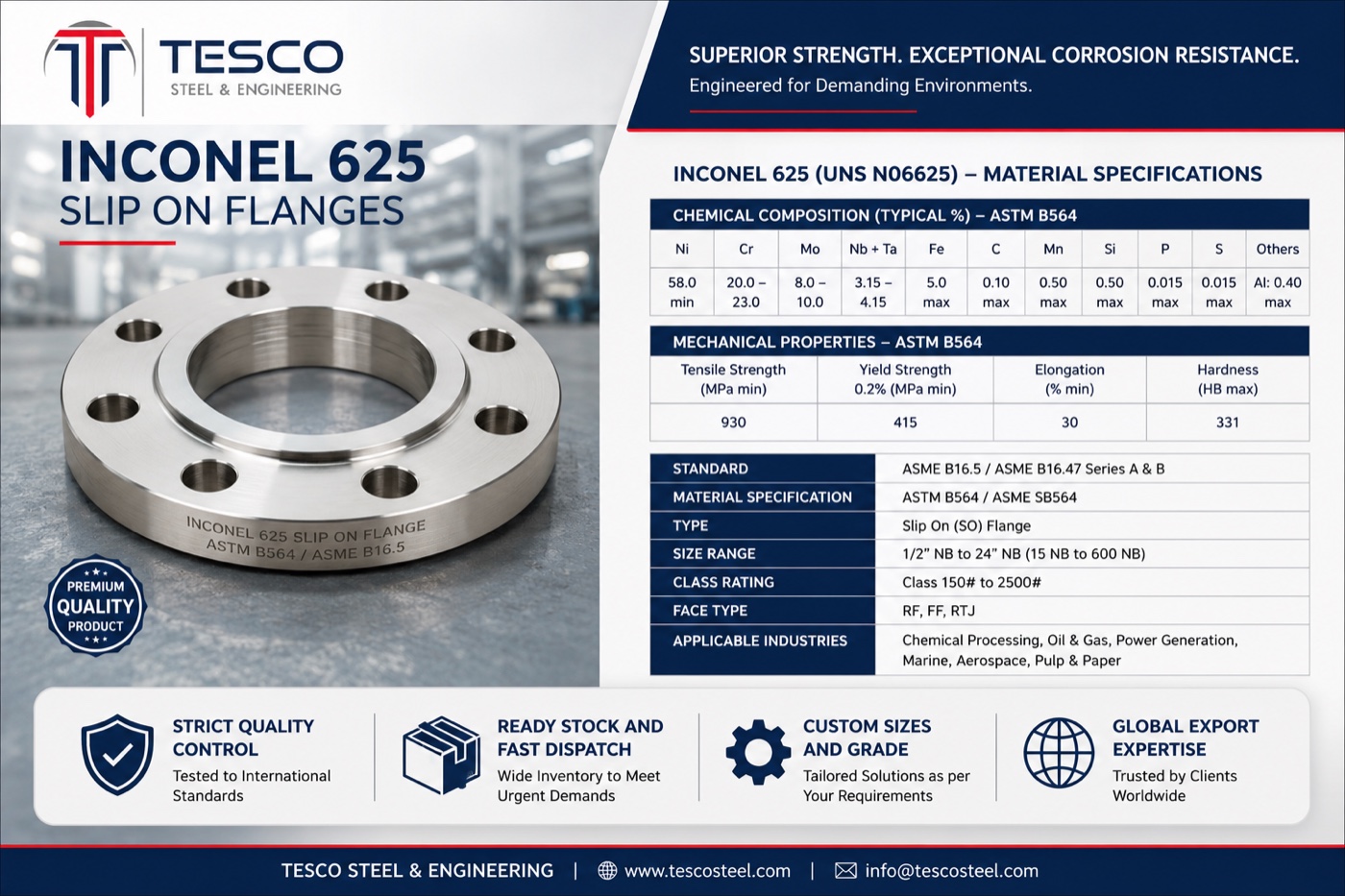
Tesco Steel & Engineering forges Inconel 625 slip on flanges — the nickel-chromium-molybdenum-niobium alloy (UNS N06625, Werkstoff 2.4856, NiCr22Mo9Nb) — to ASTM B564 and ASME B16.5 Class 150–2500 from ½″ to 24″ NB, B16.47 and larger patterns to order. The do-everything nickel alloy: 9% Mo + 3.5% Nb deliver seawater and crevice resistance, mixed-acid capability, NACE MR0175 sour-service acceptance and roughly double the strength of Alloy 600 — from cryogenic LNG duty to red heat. Supplied as Grade 1 (annealed), with Grade 2 for hot service; every lot with EN 10204 3.1/3.2 MTC. ISO 9001:2015, made in Mumbai, India — exported to 50+ countries.
Inconel 625 Slip On Flange — Material Specifications at a Glance
What is an Inconel 625 Slip On Flange?
Inconel 625 = the alloy specified when the project cannot afford a second thought.Ni-22Cr-9Mo-3.5Nb (2.4856): the molybdenum buys seawater, crevice and mixed-acid resistance, the niobium buys strength and weldability — 827/414 MPa, double Alloy 600 — with NACE MR0175 sour acceptance and toughness from cryogenic LNG to red heat. Its composition is also the nickel world's favourite filler, ERNiCrMo-3. As a slip-on: two fillet welds, matching filler, no preheat, no PWHT — forged to ASTM B564 Grade 1 or 2, not A182.
Also searched as: Alloy 625 slip on flange, Inconel 625 SORF flange, ASTM B564 N06625 slip on flange, 2.4856 / NiCr22Mo9Nb slip on flange, NACE MR0175 slip on flange — all refer to the product on this page. See also our Inconel 625 flanges overview and Inconel hub.
Rule of thumb: 625 is the default premium nickel alloy — the enquiry steps down to duplex or 6-moly when budget allows, and up to C-276 only when hot HCl or wet chlorine enters the stream.
Inconel 625 (UNS N06625) Chemical Composition
Ni
Cr
Mo
Nb+Ta
Fe
C
Mn
Si
Al
Ti
P
S
58.0 min
20.0-23.0
8.0-10.0
3.15-4.15
5.0 max
0.10 max
0.50 max
0.50 max
0.40 max
0.40 max
0.015 max
0.015 max
Values in weight % for UNS N06625 per ASTM B564. The molybdenum buys pitting and crevice resistance plus solid-solution strength; the niobium adds more strength and stabilises the welds — the same two elements that make the alloy's filler twin ERNiCrMo-3 the most-used wire in nickel fabrication.
Inconel 625 Mechanical Properties — Grade 1 vs Grade 2
Grade (per ASTM B564)
Tensile Strength, MPa (ksi)
Yield Strength 0.2%, Min, MPa (ksi)
Elongation % min
Intended Service
Grade 1 — annealed (standard supply)
827 (120) min
414 (60) min
30
Wet corrosion, marine, sour — up to ~593 °C
Grade 2 — solution annealed
690 (100) min
276 (40) min
30
Hot service above ~593 °C — creep stability
Density 8.44 g/cm³. Ordering the wrong grade is the classic 625 specification slip — state the service temperature and the certificate shows the correct grade and heat treatment. Values demonstrated per heat on the EN 10204 certificate.
Inconel 625 Slip On Flange Specifications
Inconel 625 Slip On Flanges are available in the following specifications:
1/2"NB to 24"NB per ASME B16.5; ASME B16.47 Series A & B and EN 1092-1 patterns to order
Class
150#, 300#, 400#, 600#, 900#, 1500#, 2500#
Facing
Raised Face (SORF) — default; Flat Face (SOFF) or RTJ where the piping class specifies
Heat Treatment
Grade 1 annealed (standard) or Grade 2 solution annealed for >593 °C service; thermal record retained
Service
Seawater incl. crevice conditions, mixed acids, NACE MR0175 sour service, cryogenic LNG to ~980 °C
Installation
Two fillet welds (hub + bore), pipe set back 1/8"; matching ERNiCrMo-3 filler, no preheat, no PWHT
Testing
PMI verification, hardness survey and NACE documentation where specified
Certification
EN 10204 3.1 (standard) / 3.2 witnessed
Equivalent Grades of Inconel 625
Trade Names
ASTM Forging
UNS
Werkstoff Nr.
EN
Inconel 625 / Alloy 625 / Nicrofer 6020 hMo
B564 Gr 1 / Gr 2
N06625
2.4856
NiCr22Mo9Nb
ASME SB-564 is the boiler-code twin. System partners follow the same B-series logic: ASTM B444 seamless pipe & tube, ASTM B443 plate, sheet & strip, ASTM B446 rod & bar and ASTM B366 welding fittings (WPNCMC). Not an A182 grade — nickel-alloy flanges are governed by the B-series standards.
Why Inconel 625 Slip Ons Are Specified
One Alloy, Every Front
Seawater with crevices, mixed acids, sour gas, cryogenic toughness and red-heat capability — 625 answers all of them at once, which is why critical projects standardise on it.
Double the Strength
827/414 MPa in Grade 1 — twice Alloy 600, three times an austenitic stainless — from solid-solution Mo and Nb, with no ageing treatment to manage at supply.
Sour-Service Passport
Listed in NACE MR0175 / ISO 15156-3 — wellheads, downhole hardware and sour piping specify N06625 by name, and our documentation follows.
The Filler-Metal Economy
Its own composition — ERNiCrMo-3 — is the universal nickel filler: one qualified procedure welds 625, clads steel and joins the 6-moly world. Fabricators price that in.
Fewer limits than almost any alloy — but three honest lines.Hot hydrochloric & wet chlorine:C-276's 16% molybdenum does better. The 650–980 °C window: long exposure precipitates embrittling phases — sustained hot service must be ordered as Grade 2, and pure cyclic-oxidation duty often suits 601 better. And the budget line: where super duplex or 6-moly genuinely covers the duty, 625 buys margin the project may not need — we quote the honest alternative when the enquiry allows.
How Our Inconel 625 Slip On Flanges Are Manufactured
1
Forging — cut billet of certified N06625 heat is hot-forged into the flange blank, keeping full heat traceability from raw material to despatch.
2
Heat treatment to grade — Grade 1 annealed for strength, or Grade 2 solution annealed for hot service; furnace record retained and grade stated on the certificate.
3
Machining — hub, faces and bolt holes to ASME B16.5; the bore machined slightly over pipe OD per the slip-on tolerance.
4
Facing & finish — SORF raised face with serrated stock finish, flat face or RTJ groove.
5
Testing & marking — mechanical and chemical verification against the heat (PMI, hardness and NACE documentation where the order specifies), then permanent marking of standard, grade, size, class and heat number.
6
Certification & packing — EN 10204 3.1 MTC (3.2 witnessed on request), export-packed for sea or air freight.
Where Inconel 625 Slip On Flanges Are Used
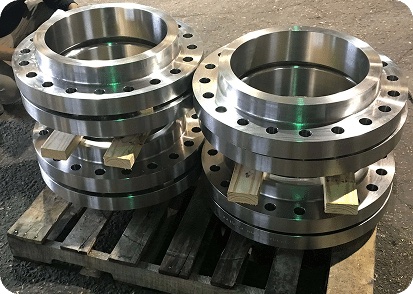
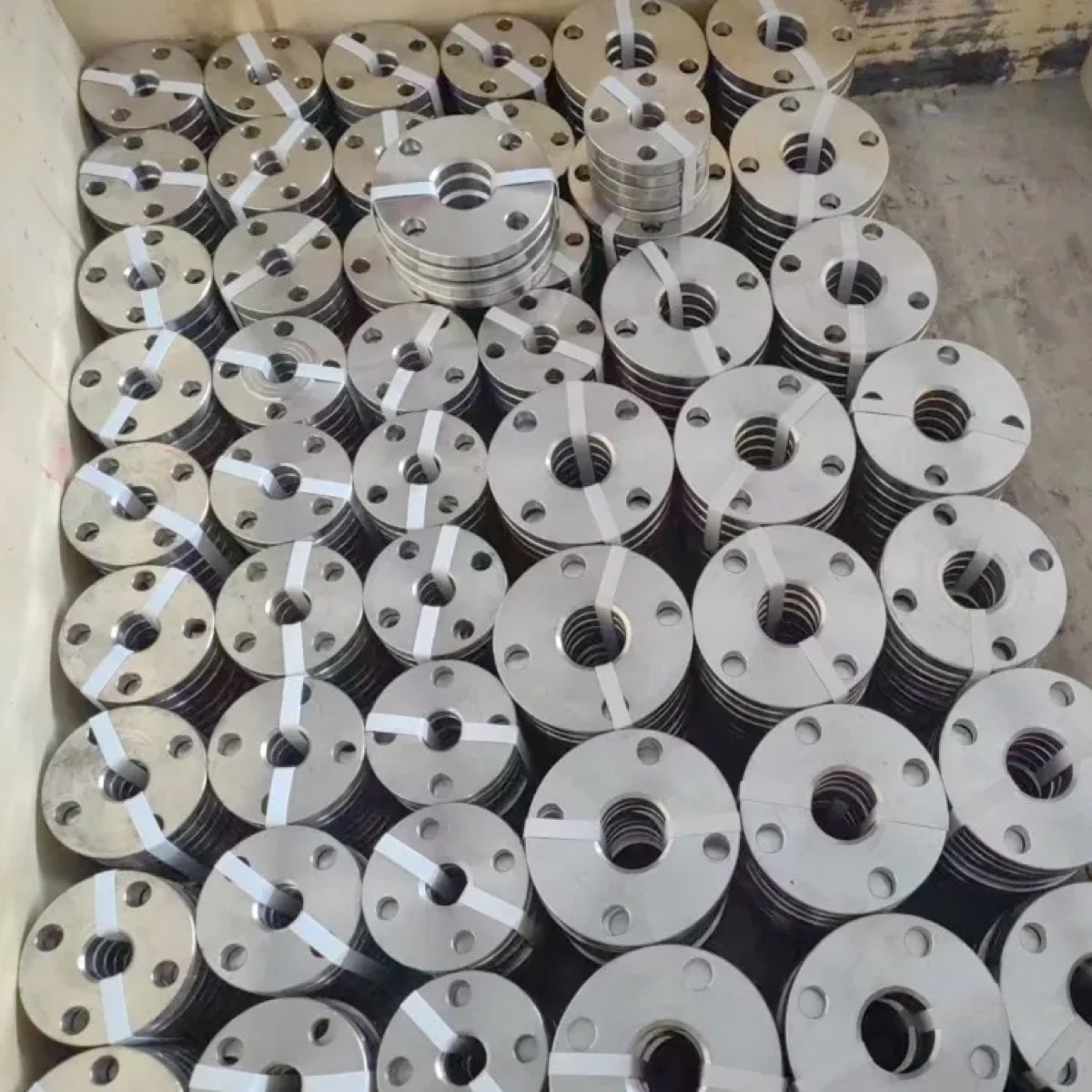
Offshore and subsea first — seawater, injection and riser hardware — then sour gas wellheads and piping to NACE MR0175, chemical plants running mixed acids, flue-gas desulphurisation, LNG and cryogenic terminals, aerospace and gas-turbine ducting, and flanges matching 625 weld-overlaid equipment. Slip-ons serve the moderate-pressure utility and transfer connections; weld necks take the critical lines. Production below:
Large Flanges — Stacked & Ready for DespatchEN 1092-1 Type 01 Plate / Slip On Flanges — Strapped Bundles
Inconel 625 Slip On Flange Dimensions
Inconel 625 slip-on dimensions follow the ASME B16.5 slip-on tables — identical for every material. Full charts by class:
Example: “Slip On Flange, 4″ NB, ASME B16.5 Class 300, RF, Inconel 625 / ASTM B564 Grade 1 (N06625), NACE MR0175, EN 10204 3.1 — 10 pcs.” Quotations normally within 24 hours with price, unit weight and delivery.
Inconel 625 Slip On Flanges — Frequently Asked Questions
What is an Inconel 625 slip on flange?
It is a slip-on flange forged from Inconel 625 — the nickel-chromium-molybdenum-niobium alloy (UNS N06625, ASTM B564, Werkstoff 2.4856) — dimensioned to ASME B16.5. The flange slides over the pipe end and is secured with two fillet welds. The 9% molybdenum and 3.5% niobium set it apart from the rest of the Inconel family: seawater and crevice-corrosion resistance, mixed-acid capability, NACE MR0175 sour-service acceptance and roughly twice the strength of Alloy 600, from cryogenic temperatures to red heat.
What is Inconel 625?
The closest thing the nickel world has to a do-everything alloy. Developed in the 1960s for steam-line strength, its Ni-22Cr-9Mo-3.5Nb chemistry turned out to solve wet corrosion, heat, strength and fabrication in one material — which is why it appears in seawater systems, sour gas fields, chemical plants, aerospace exhausts and LNG terminals alike, and why its composition doubles as the most-used welding filler in nickel-alloy fabrication. Designations: UNS N06625, Werkstoff 2.4856, EN NiCr22Mo9Nb, often simply Alloy 625; forged flanges are governed by ASTM B564.
What is the chemical composition of Inconel 625?
For UNS N06625: nickel 58.0% minimum, chromium 20.0-23.0%, molybdenum 8.0-10.0%, niobium plus tantalum 3.15-4.15%, iron 5.0% max, carbon 0.10% max, manganese 0.50% max, silicon 0.50% max, aluminium 0.40% max, titanium 0.40% max, phosphorus and sulphur 0.015% max each. The molybdenum buys pitting and crevice resistance and solid-solution strength; the niobium adds more strength and stabilises the welds — the same two elements that make the alloy's filler-metal twin ERNiCrMo-3 so trusted.
What are the mechanical properties of Inconel 625 slip on flanges?
Per ASTM B564, Grade 1 (annealed — the standard supply): tensile strength 827 MPa (120 ksi) minimum, 0.2% yield strength 414 MPa (60 ksi) minimum and elongation 30% minimum — roughly double Alloy 600 and far beyond any stainless flange. Grade 2 (solution annealed, specified for service above about 593 °C) trades strength for creep resistance and thermal stability: 690 MPa (100 ksi) tensile, 276 MPa (40 ksi) yield minimum. Density is 8.44 g/cm³; values are demonstrated per heat on the EN 10204 certificate.
What is the difference between Inconel 625 Grade 1 and Grade 2?
Heat treatment, matched to service temperature. Grade 1 is annealed at a lower temperature, keeping a fine grain and maximum strength — the correct supply for wet-corrosion, marine and sour duty up to roughly 593 °C. Grade 2 is solution annealed at a higher temperature, coarsening the grain for creep resistance and structural stability in hot service above 593 °C, at lower specified strength. Ordering the wrong grade is a classic 625 specification slip — state the service temperature on the enquiry and the certificate will show the correct grade and heat treatment.
What is the difference between Inconel 625 and Inconel 600 or 601?
Molybdenum and niobium — the wet-duty and strength elements. 600 and 601 are heat specialists: furnace atmospheres, halogens, cyclic oxidation, with no molybdenum and moderate strength. 625 brings 9% Mo and 3.5% Nb, which buy pitting and crevice resistance in seawater and acids plus roughly double the strength — at more cost, and with a metallurgical caveat in the 650-980 °C window where long exposure embrittles it. In short: hot, dry and chemical stays 600/601; wet, hard, strong and sour goes 625.
How does Inconel 625 compare with Hastelloy C-276?
C-276 carries nearly twice the molybdenum (16% vs 9%) in an iron-lean nickel base, making it the stronger answer in the worst reducing acids — hot hydrochloric, wet chlorine, aggressive mixed streams. 625 counters with higher strength, better high-temperature capability, wider stock availability and lower cost, while still covering seawater, sour gas and most acid chemistry. The practical rule: 625 is the default premium nickel alloy; the enquiry escalates to C-276 when hot HCl or wet chlorine enters the process description.
How does Inconel 625 compare with super duplex or 254 SMO in seawater?
All three handle seawater including crevice conditions; the ladder is cost against margin. Super duplex F53/F55 delivers 550 MPa yield at stainless-family prices but carries a ~250 °C ceiling and fabrication discipline; 254 SMO adds austenitic toughness with no temperature ceiling at higher cost. 625 sits above both: immune to chloride SCC, strong from cryogenic to red heat, sour-service accepted and effortless to weld — the choice when the project cannot afford a second thought, which is why subsea hardware and offshore risers standardise on it.
Is Inconel 625 acceptable for NACE MR0175 sour service?
Yes — UNS N06625 is listed in NACE MR0175 / ISO 15156-3 for sour (H₂S-bearing) oil and gas service in the annealed condition, where its high nickel and molybdenum resist both sulphide stress cracking and chloride-assisted mechanisms. This is one of the alloy's defining markets: wellhead and christmas-tree components, downhole hardware, sour gas piping and the cladding of carbon-steel equipment. State the NACE requirement on the enquiry and the certification will document compliance.
What temperature range can Inconel 625 slip on flanges handle?
From genuine cryogenic service — the alloy stays tough at liquefied-gas temperatures, earning it LNG duty — up to roughly 980 °C in oxidation terms. One honest window to respect: long exposure between about 650 and 980 °C slowly precipitates intermetallic phases that reduce ductility, so sustained hot service is ordered as Grade 2 and the hottest cyclic-oxidation duty often suits Inconel 601 better. Bolted-joint ratings follow the ASME B16.5 tables as always.
Why is ERNiCrMo-3 called the universal nickel filler?
ERNiCrMo-3 is Inconel 625 in wire form — and its over-alloyed, niobium-stabilised chemistry welds far more than its parent. It joins 625 to itself, nickel alloys to steels, clads carbon steel with a corrosion-resistant layer, and is the specified filler for welding 6-moly stainless like 254 SMO and super austenitics, because its molybdenum overwhelms weld-metal segregation. For a fabricator, one qualified 625 procedure covers a remarkable share of the nickel-alloy world — a quiet economy built into every 625 flange.
Which ASTM standard covers Inconel 625 slip on flanges?
ASTM B564 (ASME SB-564), the nickel-alloy forging specification, in Grade 1 or Grade 2 — not A182, which covers stainless and alloy steels. System partners follow the same B-series logic: seamless pipe and tube to ASTM B444, plate, sheet and strip to ASTM B443, rod and bar to ASTM B446, and welding fittings to ASTM B366 (WPNCMC). Certificates state UNS N06625, the standard, the grade and heat treatment, and the heat number together.
Where are Inconel 625 slip on flanges typically used?
Offshore and subsea systems — seawater, injection and riser hardware — sour gas wellheads and piping to NACE MR0175, chemical and petrochemical plants running mixed acids, flue-gas desulphurisation, LNG and cryogenic terminals, aerospace and gas-turbine ducting, and as the flange matching 625 weld-overlaid equipment. On these plants the slip-on serves moderate-pressure utility and transfer connections, with weld necks specified for the critical lines — both forged from the same certified heats.
Where does Inconel 625 not belong?
Fewer places than almost any alloy — but three honest lines. Hot hydrochloric acid and wet chlorine: C-276's 16% molybdenum does better. Sustained 650-980 °C exposure: ageing embrittlement makes Grade 2 mandatory and 601 often wiser for pure cyclic heat. And the budget line: where super duplex or 6-moly stainless genuinely covers the duty, 625 is money spent on margin the project may not need — we quote the honest alternative when the enquiry allows it.
Who manufactures Inconel 625 slip on flanges in India?
Tesco Steel & Engineering is an ISO 9001:2015 certified flange manufacturer based in Mumbai, India, forging Inconel 625 / UNS N06625 slip on flanges from ½" to 24" NB per ASTM B564 (Grade 1 and Grade 2) and ASME B16.5 — alongside the full Inconel 625 range of weld neck, blind, socketweld, threaded, lapped joint and spectacle blind flanges, plus Inconel 600 and 601 — with full heat traceability, NACE MR0175 documentation where specified, PMI on request, and EN 10204 3.1/3.2 certification on every lot. Exported to more than 50 countries.