Titanium UNS R56400 Slip On Flanges — Ti-6Al-4V Grade 5
Tesco Steel & Engineering forges titanium Grade 5 slip on flanges — the Ti-6Al-4V aerospace alloy (UNS R56400, Werkstoff 3.7165) — to ASTM B381 grade F-5 and ASME B16.5 Class 150–2500 from ½″ to 24″ NB, larger patterns to order. The world's most-used titanium alloy: 6% aluminium and 4% vanadium deliver 895/828 MPa — alloy-steel strength at 4.43 g/cm³, 56% of the weight — the best strength-to-weight of any common engineering metal, while keeping titanium's self-healing oxide film in seawater and oxidising chloride duty. Chemistry-led duty stays with Grade 2; load-led duty is this page. Every lot with EN 10204 3.1/3.2 MTC, hydrogen reported. ISO 9001:2015, made in Mumbai, India — exported to 50+ countries.
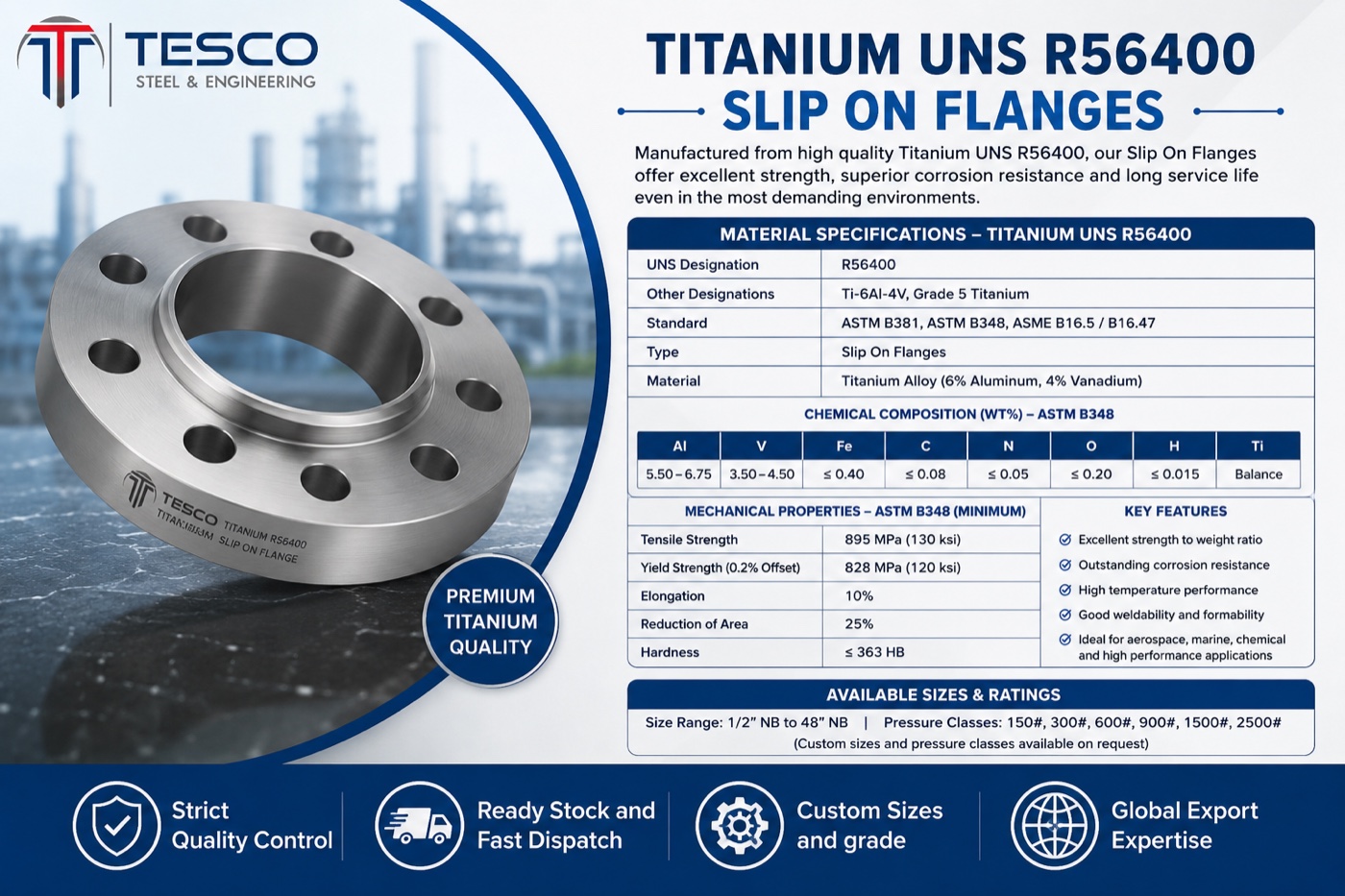
Titanium Gr 5 · Ti-6Al-4V · R56400ASTM B381 F-5 · 3.7165Al 5.5–6.75% · V 3.5–4.5%895 MPa TS / 828 MPa YS minDensity 4.43 — 56% of SteelASME B16.5 Class 150–2500EN 10204 3.1 / 3.2 · ISO 9001:2015
Titanium UNS R56400 Slip On Flange — Specifications at a Glance
What is a Titanium UNS R56400 Slip On Flange?
Grade 5 = titanium with the strength problem solved.6% Al + 4% V lift the metal to 895/828 MPa — alloy-steel numbers at 4.43 g/cm³, giving the best strength-to-weight ratio of any common engineering metal — while the self-healing TiO₂ film keeps seawater and oxidising-chloride duty on home ground. Half the world's titanium output is this one alloy. As a slip-on: two fillet welds, GTAW with ERTi-5 under full argon discipline, no preheat, no PWHT — forged to ASTM B381 F-5, not A182.
Also searched as: Ti-6Al-4V slip on flange, Titanium Grade 5 SORF flange, Ti64 flange, ASTM B381 F-5 slip on flange, 3.7165 slip on flange — all refer to the product on this page. See also our Titanium Gr 5 flanges overview, Grade 2 slip on flanges and Titanium hub.
Rule of thumb: when the specification is written per kilogram — flight, subsea handling, transport limits, inertia — Grade 5 wins before the corrosion column is even read.
Titanium Grade 5 (UNS R56400) Chemical Composition
Ti
Al
V
Fe
O
C
N
H
Balance
5.50-6.75
3.50-4.50
0.40 max
0.20 max
0.08 max
0.05 max
0.015 max
Values in weight % for UNS R56400 per ASTM B381. Aluminium stabilises the alpha phase, vanadium the beta — the two-phase structure that makes the alloy strong and tunable — while the interstitials are held low for toughness and hydrogen capped hardest (embrittlement), reported on every certificate.
Titanium Grade 5 Mechanical Properties
Grade
Tensile Strength, MPa (ksi)
Yield Strength 0.2%, Min, MPa (ksi)
Elongation % min
Density
Titanium Gr 5 (this page, annealed)
895 (130) min
828 (120) min
10
4.43 g/cm³
Titanium Gr 2 — for comparison
345 (50) min
275 (40) min
20
4.51 g/cm³
Per ASTM B381 grade F-5 (reduction of area 25% min). Three times Grade 2's yield and stronger per kilogram than any alloy steel or aged nickel grade — the arithmetic aerospace runs on. Tough at cryogenic temperatures; values demonstrated per heat on the EN 10204 certificate.
Titanium UNS R56400 Slip On Flange Specifications
Titanium Grade 5 Slip On Flanges are available in the following specifications:
1/2"NB to 24"NB per ASME B16.5; EN 1092-1 and larger patterns to order
Class
150#, 300#, 400#, 600#, 900#, 1500#, 2500#
Facing
Raised Face (SORF) — default; Flat Face (SOFF) or RTJ where the piping class specifies
Heat Treatment
Annealed per ASTM B381, thermal record retained; stress relief where the design specifies
Service
Load-governed titanium duty: aerospace, subsea, offshore hydraulics, high-performance marine & chemical — cryogenic to ~350–400 °C
Installation
Two fillet welds (hub + bore), pipe set back 1/8"; GTAW with ERTi-5 (ERTi-23 where toughness governs) under full argon coverage, colour-inspected
Testing
Full interstitial analysis incl. hydrogen reported per heat; PMI on request
Certification
EN 10204 3.1 (standard) / 3.2 witnessed
Equivalent Grades of Titanium Grade 5
Trade Names
ASTM Forging
UNS
Werkstoff Nr.
Fittings
ELI Variant
Titanium Grade 5 / Ti-6Al-4V / Ti64
B381 F-5
R56400
3.7165
B363 WPT5
Grade 23 ELI (R56401)
ASME SB-381 is the boiler-code twin. System partners: ASTM B348 bar, B265 plate, B861/B862 pipe. Not an A182 grade and not the nickel B-series — titanium carries its own ASTM family. Grade neighbours: Gr 2 (the corrosion standard), Gr 7 Pd (hot reducing acids).
Why Titanium Grade 5 Slip Ons Are Specified
The Strength-to-Weight King
828 MPa yield at 4.43 g/cm³ — 187 MPa per unit density, where alloy steel manages ~60 and aged nickel ~126. When mass is money, nothing common competes.
Titanium's Chemistry, Kept
The same self-healing oxide film: seawater, brine, wet chlorine and oxidising chlorides remain home ground — corrosion resistance without chromium, at three times Grade 2's strength.
Fatigue & Cryogenic Pedigree
The alloy airframes and rocket stages trust: superb fatigue life, full toughness below zero, and an ELI variant that is a cryogenic standard.
Half the World's Titanium
Ti-6Al-4V is ~50% of global titanium output — the best-characterised, best-stocked, most-qualified titanium alloy there is. Data, filler and experience all exist.
All of titanium's rules apply, plus two of its own. The family lines: HF acid (Monel's domain), dry chlorine (fire risk — nickel alloys), hot reducing acids (Gr 7 or Hastelloy), hydrogen (embrittlement) and galvanic nobility against bare steel. Grade 5's own: where duty is chemistry-led, Grade 2 does it cheaper and its hot-chloride crevice margin runs a shade below CP titanium; and above ~400 °C the strength advantage fades — the nickel world takes over. State load, stream and temperature; we confirm the grade honestly.
How Our Titanium Grade 5 Slip On Flanges Are Manufactured
1
Forging — cut billet of certified R56400 heat is hot-forged in the alpha-beta window, keeping full heat traceability from raw material to despatch.
2
Annealing — per ASTM B381; furnace record retained, interstitial pickup controlled.
3
Machining — hub, faces and bolt holes to ASME B16.5 with titanium-dedicated tooling and controlled speeds; the bore machined slightly over pipe OD per the slip-on tolerance.
4
Facing & finish — SORF raised face with serrated stock finish, flat face or RTJ groove; iron-contamination-free handling throughout.
5
Testing & marking — tensile and full interstitial verification against the heat, hydrogen reported (PMI where the order specifies), then permanent marking of standard, grade, size, class and heat number.
6
Certification & packing — EN 10204 3.1 MTC (3.2 witnessed on request), export-packed for sea or air freight.
Where Titanium Grade 5 Slip On Flanges Are Used
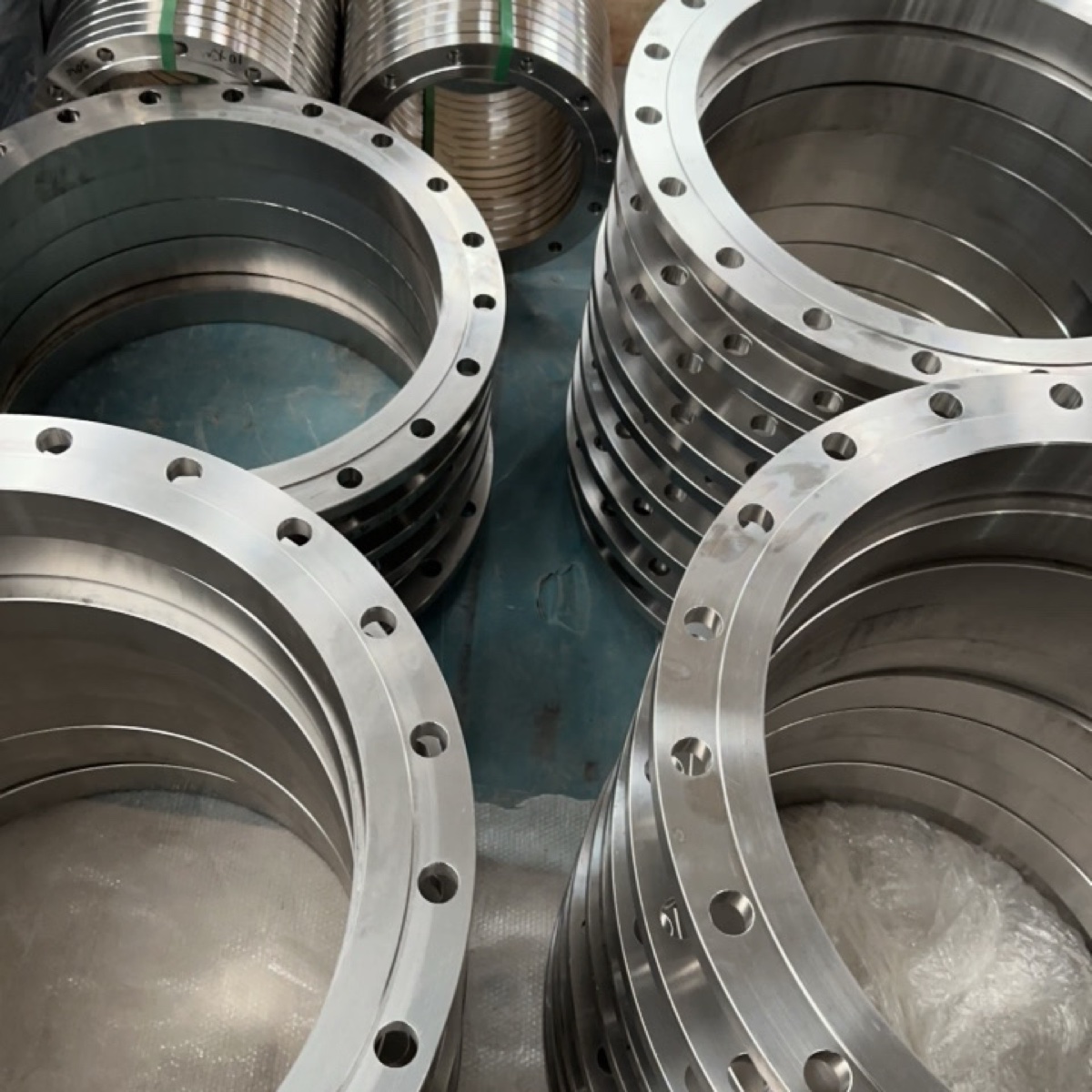
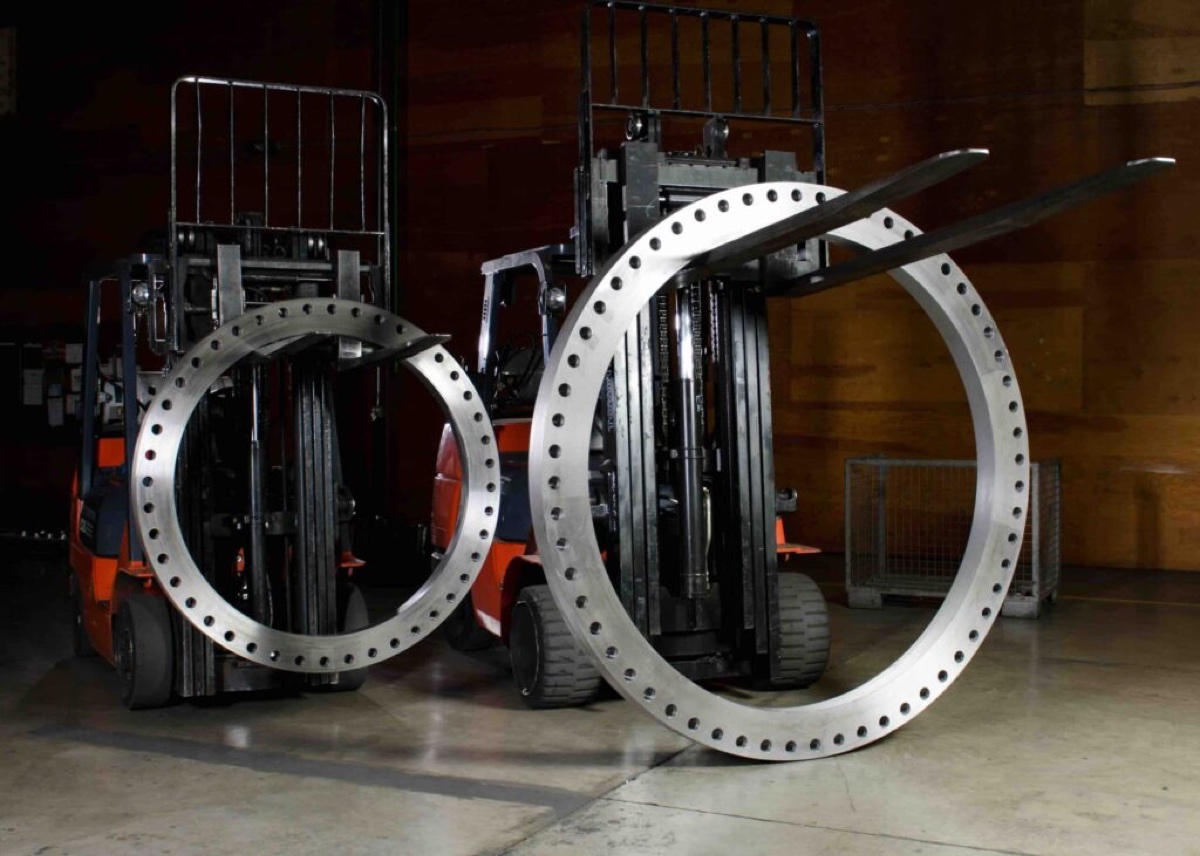
Wherever titanium's chemistry meets serious load: aerospace and defence fluid systems, subsea and ROV-handled hardware, offshore hydraulic and injection systems where weight is costed per tonne, high-speed and high-pressure marine equipment, desalination and chemical duty beyond Grade 2's pressure comfort, and flanges matching Ti-6Al-4V vessels and machinery. Slip-ons serve the moderate-pressure connections; weld necks take the extreme envelope. Production scale below:
Large-Diameter Slip On Flanges — EN 1092-1 Patterns to OrderGiant-Diameter Flanges — Forklift-Scale Production
Titanium UNS R56400 Slip On Flange Dimensions
Titanium Grade 5 slip-on dimensions follow the ASME B16.5 slip-on tables — identical for every material (the 56%-of-steel weight is where Grade 5 differs). Full charts by class:
How to Specify & Order a Titanium Grade 5 Slip On Flange
Five elements — no bore schedule, since the slip-on bore suits the pipe OD:
1
Size & standard — e.g. 4″ NB ASME B16.5.
2
Pressure class & facing — Class 150–2500, SORF (default), flat face or RTJ where specified.
3
Grade & duty — Titanium Gr 5 / UNS R56400 — ASTM B381 F-5 (3.7165); state load, stream and temperature so we can confirm Gr 5 against Gr 2, Gr 7 or Gr 23 ELI.
4
Certification & testing — EN 10204 3.1 (standard) or 3.2 witnessed; hydrogen reported as standard, PMI where the project specifies.
Example: “Slip On Flange, 4″ NB, ASME B16.5 Class 300, RF, Titanium Gr 5 / ASTM B381 F-5 (R56400), EN 10204 3.1 — 6 pcs.” Quotations normally within 24 hours with price, unit weight and delivery.
Titanium UNS R56400 Slip On Flanges — Frequently Asked Questions
What is a titanium UNS R56400 slip on flange?
It is a slip-on flange forged from titanium Grade 5 — the Ti-6Al-4V alloy (UNS R56400, ASTM B381 grade F-5, Werkstoff 3.7165) — dimensioned to ASME B16.5. The flange slides over the pipe end and is secured with two fillet welds. Grade 5 is titanium with the strength problem solved: 6% aluminium and 4% vanadium raise it to 895/828 MPa — alloy-steel numbers at 4.43 g/cm³, 56% of steel's weight — while the element's self-healing oxide film keeps its seawater and oxidising-chloride corrosion resistance.
What is titanium Grade 5 / Ti-6Al-4V?
The most-used titanium alloy on earth — roughly half of all titanium produced. Aluminium stabilises the alpha phase and vanadium the beta, giving a two-phase alloy that heat treatment and working can tune from tough to very strong. Aerospace adopted it in the 1950s and never left; subsea, medical and high-performance industry followed. Designations: UNS R56400, Werkstoff 3.7165, Ti64, Grade 5; forged flanges are governed by ASTM B381 as grade F-5.
What is the chemical composition of titanium Grade 5?
For UNS R56400: titanium balance, aluminium 5.5-6.75%, vanadium 3.5-4.5%, with interstitial limits of oxygen 0.20% max, iron 0.40% max, carbon 0.08% max, nitrogen 0.05% max and hydrogen 0.015% max. The aluminium-vanadium pair does the strengthening; the interstitials are held low for toughness, and hydrogen is capped hardest because absorbed hydrogen embrittles titanium — our certificates report it on every heat.
What are the mechanical properties of titanium Grade 5 slip on flanges?
Per ASTM B381 grade F-5, annealed: tensile strength 895 MPa (130 ksi) minimum, 0.2% yield strength 828 MPa (120 ksi) minimum, elongation 10% minimum and reduction of area 25% minimum — at 4.43 g/cm³. That combination gives the best strength-to-weight ratio of any common engineering metal: stronger than most alloy steels and age-hardened nickel grades per kilogram, which is the entire reason aerospace runs on it. Values are demonstrated per heat on the EN 10204 certificate.
Why is Ti-6Al-4V the aerospace workhorse?
Because flight is priced per kilogram. Grade 5 delivers alloy-steel strength at 56% of the weight, keeps that strength to around 350-400 °C, resists fatigue superbly, and cannot rust — so airframes, engine components, fasteners and hydraulic systems standardised on it decades ago. The same logic transfers to earthbound weight-critical work: offshore topsides, subsea hardware, high-speed machinery and transport-limited packages, which is where Grade 5 flanges most often appear.
What is the difference between titanium Grade 5 and Grade 2?
Strength against serenity. Grade 2 is commercially pure: 345/275 MPa, maximum corrosion margin, effortless welding — the piping and flange standard, covered on our Grade 2 slip-on page. Grade 5 trades some of that ease for three times the yield strength: its corrosion resistance remains excellent but its crevice margin in hot chlorides sits a shade below CP titanium, and its welding demands more discipline. The clean split: chemistry-led duty specifies Grade 2; load-led duty specifies Grade 5. We forge both.
How does titanium Grade 5 compare with Inconel 718 or other age-hardened alloys?
On absolute numbers, 718 wins — around 1035 MPa yield against 828. On specific strength, Grade 5 wins decisively: at 4.43 g/cm³ against 718's 8.19, each kilogram of Ti-6Al-4V carries roughly 1.7 times the load. 718 counters with higher temperature capability and sour-service listings; Grade 5 counters with corrosion resistance that needs no chromium and half the freight. Aerospace and subsea buy both, each where its economics rule — and we quote to whichever the specification names.
Does Grade 5 keep titanium's corrosion resistance?
Substantially, yes — the same self-healing TiO₂ film protects it, so seawater, brine, wet chlorine and oxidising chloride chemistry remain home ground. Two honest nuances: its crevice-corrosion threshold in hot chlorides runs somewhat below CP Grade 2's ~75-80 °C, and every titanium rule carries over unchanged — wet chlorine yes, dry chlorine never (fire risk), no hydrofluoric acid, care with hot reducing acids and hydrogen. Where Grade 5's strength is wanted with more corrosion margin, Grade 29 (Ti-6Al-4V ELI plus ruthenium) is the specialist answer.
What is titanium Grade 23 (Ti-6Al-4V ELI)?
The extra-low-interstitial version of the same alloy — oxygen capped at 0.13% instead of 0.20% — which trades a little strength for measurably better fracture toughness and ductility, especially at cryogenic temperatures. It is the medical-implant and critical-fracture-control grade (UNS R56401). For flanges it appears where a project's fracture-mechanics or low-temperature requirements name it; commercially, standard Grade 5 covers the great majority of duty. State the governing specification and we supply accordingly.
How is a titanium Grade 5 slip on flange welded to pipe?
With two fillet welds — hub outside, bore inside, pipe set back 1/8" (3 mm) — by GTAW with matching ERTi-5 filler (ERTi-23 ELI filler where toughness governs), under the full titanium discipline: total argon coverage of pool, cooling bead and back side, colour-judged acceptance, scrupulous cleanliness. Grade 5 demands more care than CP titanium — its alpha-beta structure is sensitive to heat input, and interstitial pickup costs toughness — so qualified titanium welders and procedures are non-negotiable. No preheat, no PWHT; stress relief only where the design specifies.
Which ASTM standard covers titanium UNS R56400 slip on flanges?
ASTM B381 (ASME SB-381), the titanium forging specification, where Grade 5 forgings are designated F-5 — not A182 and not the nickel B-series. System partners follow titanium's own family: bar to ASTM B348, plate to B265, seamless pipe to B861, welded pipe to B862 and welding fittings to ASTM B363 (WPT5). Certificates state UNS R56400, the standard, the annealed condition, the full interstitial analysis including hydrogen, and the heat number together.
Where are titanium Grade 5 slip on flanges typically used?
Wherever titanium's chemistry meets serious load: aerospace and defence fluid systems, subsea and ROV-handled hardware, offshore hydraulic and injection systems where weight is costed, high-speed and high-pressure marine equipment, desalination and chemical duty at pressures beyond Grade 2's comfort, and flanges matching Ti-6Al-4V vessels and machinery. Slip-ons serve the moderate-pressure connections; weld necks and integral hubs take the extreme envelope — both forged from the same certified heats.
What temperature range can titanium Grade 5 slip on flanges handle?
From cryogenic service — Grade 5 stays tough well below zero, and its ELI variant is a cryogenic standard — up to roughly 350-400 °C, where creep and oxidation begin to erode its advantage; that ceiling comfortably exceeds CP titanium's practical range. Bolted-joint design follows the ASME B16.5 tables as always. Above titanium's band, hot strength belongs to the nickel world — Inconel 718 for load, the Incoloy and Inconel heat grades for furnace duty.
Where does titanium Grade 5 not belong?
All of titanium's honest lines apply: hydrofluoric acid (Monel's domain), dry chlorine (fire risk — nickel alloys), hot uninhibited reducing acids (Grade 7 or Hastelloy), hydrogen-rich conditions and cathodic over-protection (embrittlement), and galvanic nobility against bare steel. Two Grade-5-specific additions: where the duty is chemistry-led rather than load-led, Grade 2 does it cheaper and welds easier; and above ~400 °C its strength advantage fades — the nickel alloys take over. State load, stream and temperature and we confirm the grade honestly.
Who manufactures titanium UNS R56400 slip on flanges in India?
Tesco Steel & Engineering is an ISO 9001:2015 certified flange manufacturer based in Mumbai, India, forging titanium Grade 5 / Ti-6Al-4V / UNS R56400 slip on flanges from ½" to 24" NB per ASTM B381 and ASME B16.5 — alongside the full R56400 range of weld neck, blind and socketweld flanges and titanium Grades 1, 2 and 7 — with full heat traceability, hydrogen reported on every certificate, PMI on request, and EN 10204 3.1/3.2 certification on every lot. Exported to more than 50 countries.