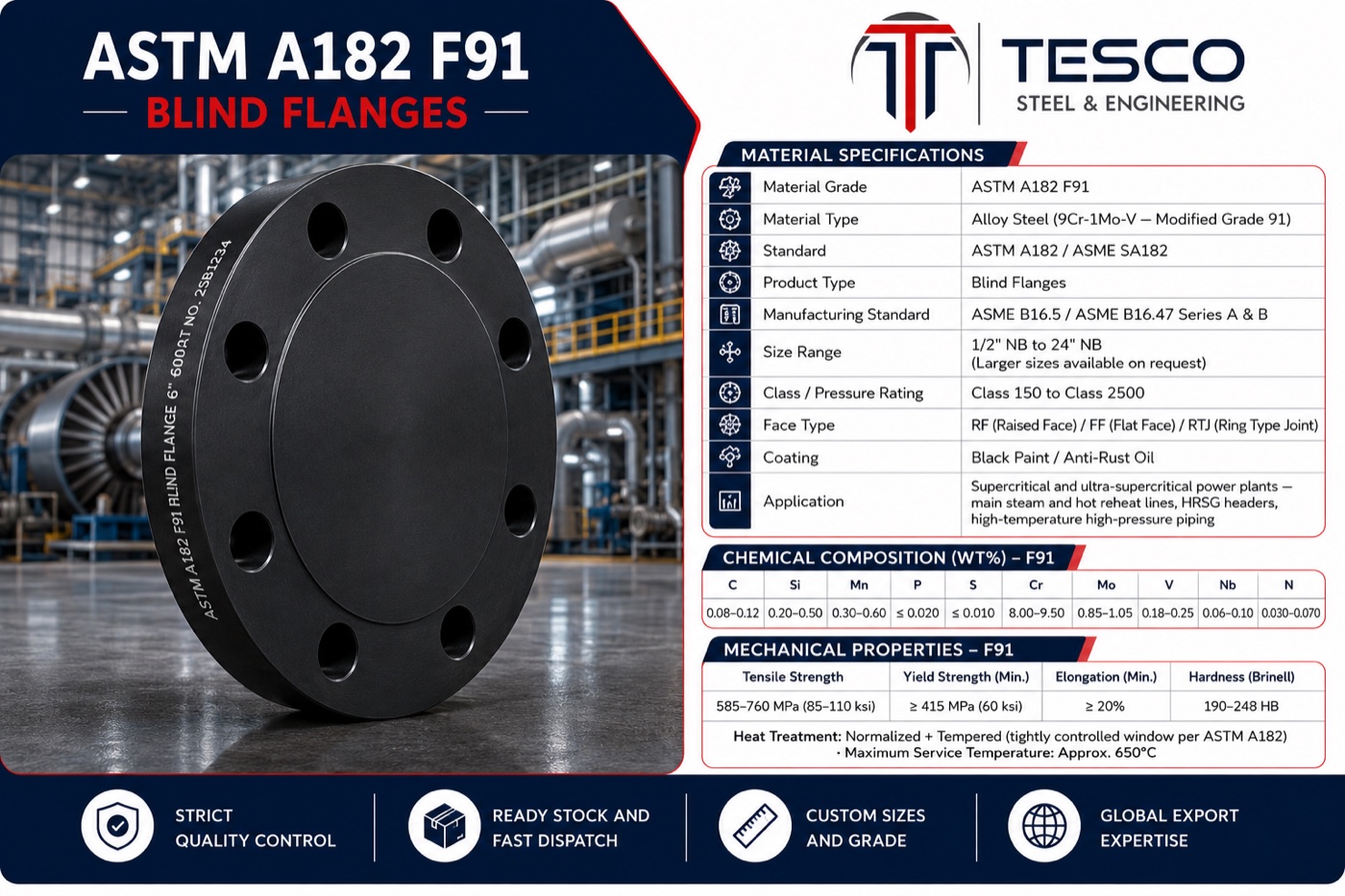
Tesco Steel & Engineering forges ASTM A182 F91 blind flanges — Grade 91, the creep-strength-enhanced ferritic that made supercritical power possible — to ASME B16.5 Class 150–2500 from ½″ to 24″ NB and to ASME B16.47 up to 60″. Vanadium, niobium and nitrogen pin the microstructure against creep, delivering roughly double the allowable stress of classic chrome-moly at 600 °C — the closure of main steam, hot reheat and HRSG headers. Everything depends on the normalize-and-temper window, which is why every blind ships hardness-verified to 190–248 HB. Not to be confused with plain F9; the classic-creep side lives on F22. Facings: BLRF, BLFF or BLRTJ. Every lot with EN 10204 3.1/3.2 MTC. ISO 9001:2015, made in Mumbai, India — exported to 50+ countries.
ASTM A182 F91 · Grade 91 · ASME SA-1829Cr-1Mo-V-Nb-N · CSEFSupercritical Main Steam & Hot ReheatHardness-Verified 190–248 HBASME B16.5 ½″–24″ · Class 150–2500RF · FF · RTJ FacingsEN 10204 3.1 / 3.2 · ISO 9001:2015
ASTM A182 F91 Blind Flange — Specifications at a Glance
What is an ASTM A182 F91 Blind Flange?
The supercritical closure. A solid forged disc of modified 9Cr-1Mo-V steel — Grade 91 — with no bore, closing the hottest, highest-stress piping ferritic steel serves: power-plant main steam and hot reheat. Micro-alloyed V-Nb-N precipitates pin the structure against creep, giving roughly double the 600 °C allowable stress of classic chrome-moly. Tensile 585–760 MPa (min and max), hardness 190–248 HB, normalized & tempered in controlled windows. Dimensions per ASME B16.5 / B16.47 in RF, FF and RTJ facings; EN 10204 3.1 certified.
Also searched as: Grade 91 blind flange, F91 blind, SA-182 F91 blind (the ASME boiler-code twin), P91 flange (the pipe family), 9Cr-1Mo-V blind, X10CrMoVNb9-1 / 1.4903 blind (the EN equivalent) — all refer to the product on this page. See also the alloy steel hub, the F91 slip on flanges, siblings F9 / F22 / F11 / F12 blind flanges, and the facing pages BLRF / BLFF / BLRTJ.
The CSEF Story — Strength Engineered Into the Microstructure
Classic chrome-moly holds strength at temperature by solid-solution molybdenum. Grade 91 goes further — it is a creep-strength-enhanced ferritic (CSEF) steel, and the enhancement is deliberate microstructural engineering:
V-Nb-N Precipitates Do the Work
Vanadium and niobium carbo-nitrides form a fine, stable dispersion through the tempered martensite — pinning it against creep at temperatures where plain 9Cr-1Mo has already softened. Result: roughly double the allowable stress at 600 °C.
The Heat Treatment Is the Product
Normalize and temper inside tight windows, or the precipitates never form correctly — the steel looks fine and fails early. This is why F91 chemistry, P/S limits and processing are all boxed harder than any classic grade.
Hardness Is the Health Check
190–248 HB signals a correct structure; soft readings signal deleted creep strength. Every blind we ship is hardness-verified with the value on the certificate — treat it as part of the specification, because it is.
F91 Chemical Composition
Element
C
Si
Mn
P
S
Cr
Mo
V
Nb
N
Weight %
0.08–0.12
0.20–0.50
0.30–0.60
≤0.020
≤0.010
8.0–9.5
0.85–1.05
0.18–0.25
0.06–0.10
0.030–0.070
Note what makes this table different from every classic chrome-moly: vanadium, niobium and nitrogen are required, carbon sits in a narrow box rather than under a cap, and phosphorus and sulphur are held to 0.020/0.010% — half or less of the classic limits. Plain F9 shares the 9% chromium and none of the micro-alloys; the two certificates are not interchangeable in either direction.
Why the tensile maximum? Over-hard F91 signals a botched temper, not a bonus — strength in this grade is engineered, not accumulated. The 760 MPa cap and the 248 HB ceiling are the specification policing its own microstructure.
Highest-class applications — ring softer than groove
ASTM A182 F91 Blind Flange Specifications
ASTM A182 F91 Blind Flanges are available in the following specifications:
Material Grade
ASTM A182 F91 (Grade 91, CSEF); ASME SA-182 dual-certifiable; EN X10CrMoVNb9-1 / 1.4903 to order
Heat Treatment
Normalized + tempered in tightly controlled windows — mandatory; furnace record on certificate
Hardness
190–248 HB verified on every lot — the CSEF health check
Size
1/2"NB to 24"NB per ASME B16.5; 26"–60" per ASME B16.47
Class
150#, 300#, 400#, 600#, 900#, 1500#, 2500#
Facings
Raised Face (BLRF), Flat Face (BLFF), Ring Type Joint (BLRTJ) with groove per B16.20
Service
Supercritical/USC main steam & hot reheat; useful allowable stresses to ~650 °C
Modifications
NPT-tapped centre (hydrotest / vent / drain / gauge), lifting provisions — machined & certified at the works
Testing
Tension, full micro-alloy chemistry & hardness per heat; PMI routine; UT / MPI where specified
Certification
EN 10204 3.1 (standard) / 3.2 witnessed
Why F91 Blind Flanges Are Specified
Double the Allowable Stress at 600 °C
The V-Nb-N dispersion halves wall thickness on main steam piping versus classic chrome-moly — and the closures inherit the same rating, in the same grade, certificate-matched to the line.
The Supercritical Standard
Grade 91 is what supercritical and ultra-supercritical specifications name for main steam and hot reheat — the blind that closes those lines is F91 by definition, not by choice.
No Weld, No Type IV
Grade 91's notorious weakness is the softened heat-affected zone of its welds — a bolted blind has no weld, no HAZ and no Type IV location. The metallurgy arrives correct and cannot be undone on site.
Discipline You Can Audit
Boxed chemistry, controlled furnace windows, hardness on every lot, PMI on every piece — the qualities CSEF service demands are exactly what the certificate documents.
Three details buyers miss.F91 ≠ F9: shared chromium, different everything else — micro-alloys, hardness windows, purpose; check which the line class actually names. Respect the hardness window: a soft F91 blind is a failed F91 blind even if it machines and fits perfectly — insist on the 190–248 HB value on the certificate and verify on receipt for critical lines. No field modifications, ever: flame-cutting, welding or drilling site-side destroys the engineered microstructure locally — taps and any machining belong at the works, heat-treatment intact, certified with the flange.
How Our F91 Blind Flanges Are Manufactured
1
Forging — cut billet of the spectro-verified F91 heat — full micro-alloy analysis including V, Nb and N — is hot-forged into the solid disc blank with complete heat traceability.
2
Normalize & temper — inside the tightly controlled windows the grade demands; furnace charts retained and referenced on the certificate. This step is the product.
3
Hardness verification — every lot checked into the 190–248 HB window; out-of-window material does not ship.
4
Machining & facing — faces, OD and drilling to ASME B16.5 / B16.47; RF serrations, flat face or RTJ groove gauged per B16.20; NPT taps machined where ordered.
5
Testing & marking — tension test and chemistry against the heat; PMI on every piece; UT and MPI where specified; permanent marking of standard, grade F91, size, class and heat number.
6
Certification & packing — EN 10204 3.1 MTC (3.2 witnessed on request) stating heat treatment, hardness and full chemistry; faces protected, palletised or crated sea-worthy.
Where F91 Blind Flanges Are Used
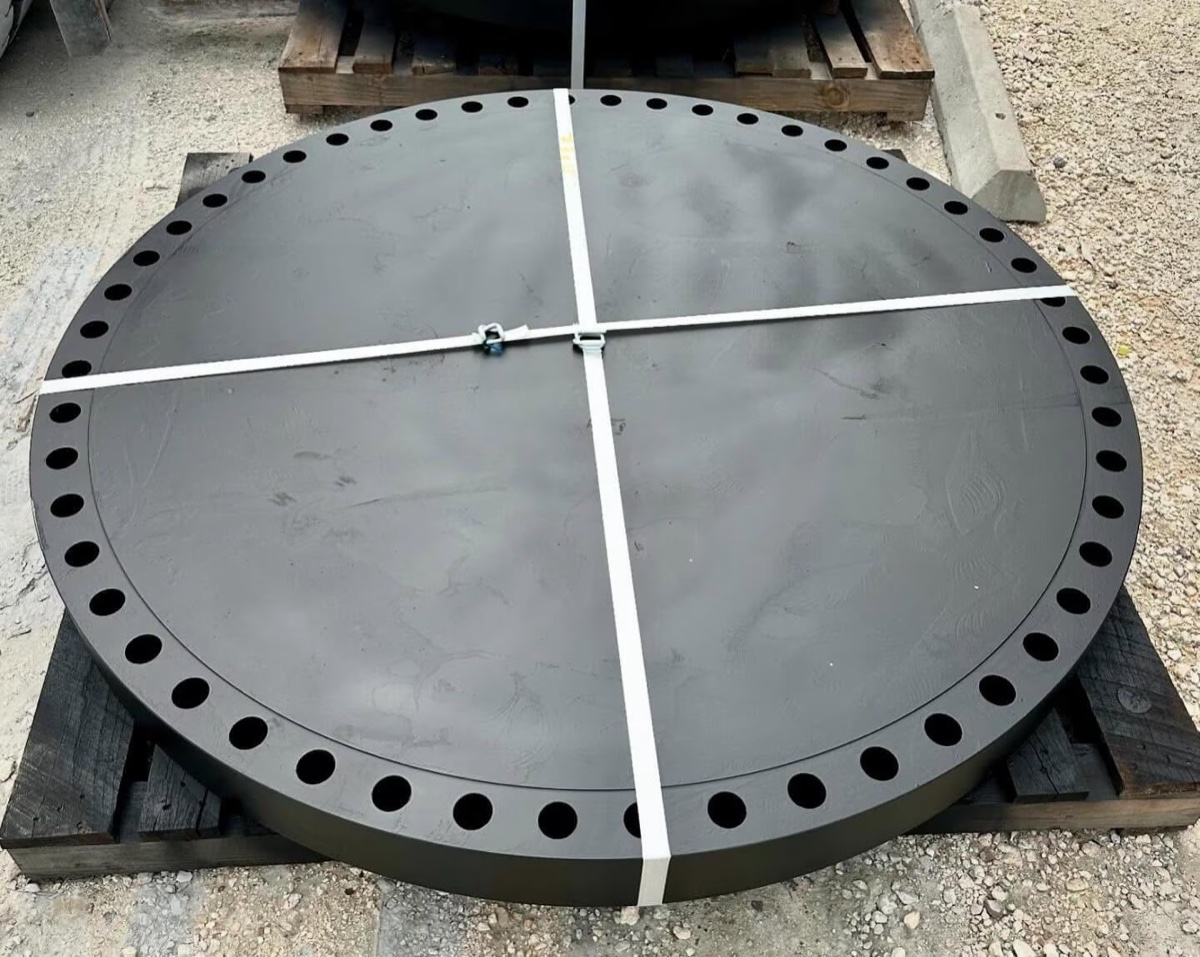
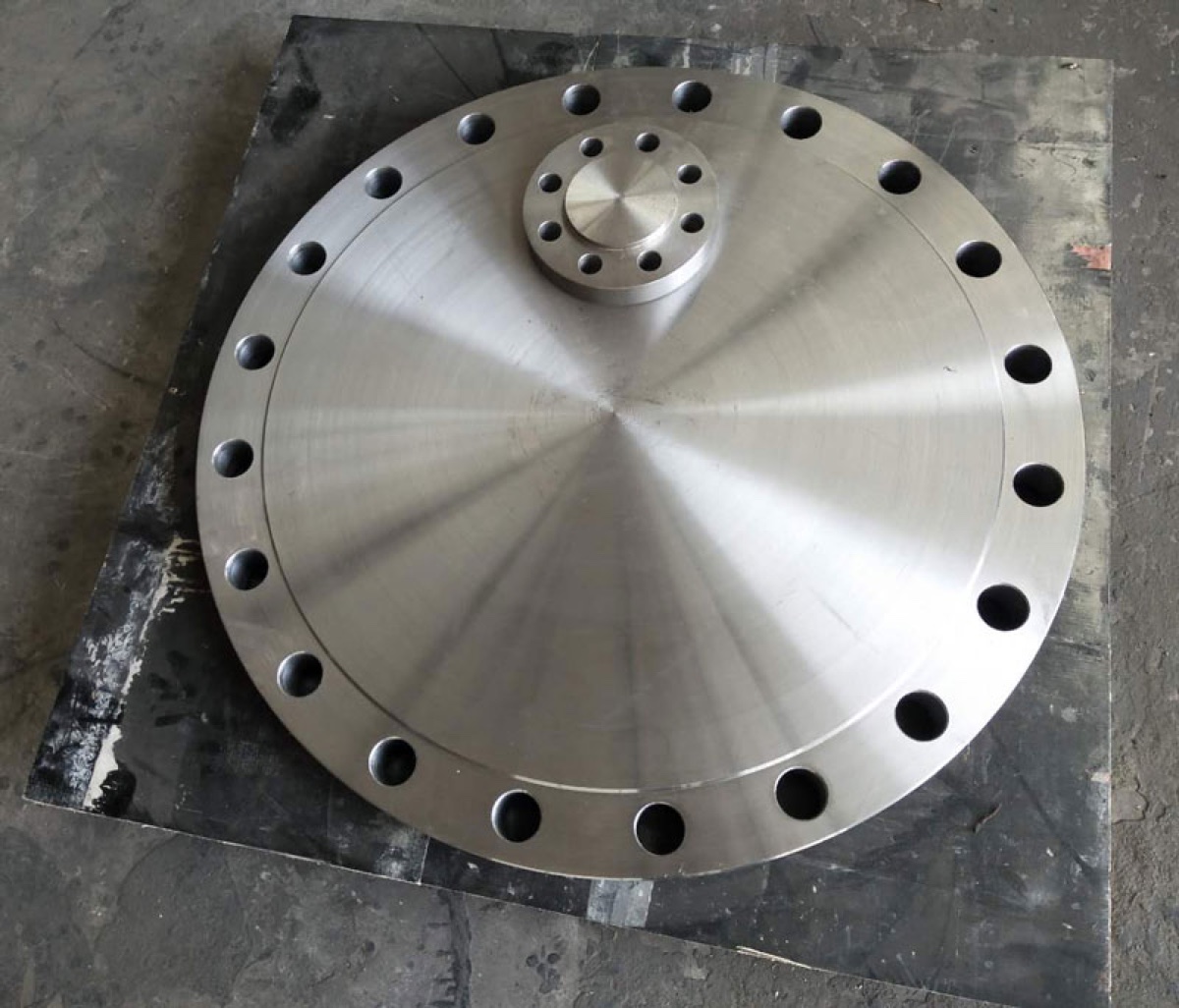
The supercritical world: main steam and hot reheat lines, boiler outlet headers and turbine-adjacent piping of supercritical and ultra-supercritical power stations, HRSG high-temperature sections behind large gas turbines, and process duties that borrow power-plant metallurgy. Production below:
Large-Diameter Blind Flange — Palletised in the Dispatch YardLarge Machined Blind with Auxiliary Nozzle Connection
F91 Blind Flange Dimensions
Blind dimensions are class-governed — identical across material grades. Full charts:
Five elements — and let the certificate requirements carry the CSEF discipline:
1
Size & standard — e.g. 8″ NB ASME B16.5, or the B16.47 series for 26″ and above.
2
Pressure class & facing — Class 150–2500; RF, FF or RTJ (with ring number) to match the mating flange.
3
Grade — ASTM A182 F91; if the drawing says F9 or P91 pipe is not in the line, double-check before ordering the CSEF grade.
4
Modifications & certification — NPT tap size if a test blind; hardness report, PMI, UT or 3.2 witnessing as the specification demands; EN 10204 3.1 standard.
An ASTM A182 F91 blind flange is a solid forged disc of modified 9Cr-1Mo-V alloy steel, drilled to the standard bolt pattern with no bore, used to close pipes, valves and vessel nozzles in the hottest, highest-stress piping ordinary alloy steel can serve — power-plant main steam and hot reheat above all. F91 is a creep-strength-enhanced ferritic steel: vanadium, niobium and nitrogen micro-alloying gives it roughly twice the high-temperature allowable stress of the classic chrome-molys. Dimensions follow ASME B16.5 from ½ inch to 24 inch and ASME B16.47 beyond, in raised face, flat face and ring joint facings.
What kind of steel is A182 F91?
Modified 9Cr-1Mo — 'Grade 91', the defining member of the creep-strength-enhanced ferritic (CSEF) family. Chemistry is tightly boxed: carbon 0.08-0.12%, chromium 8.0-9.5%, molybdenum 0.85-1.05%, plus the modifications that make the grade — vanadium 0.18-0.25%, niobium 0.06-0.10% and nitrogen 0.030-0.070% — with phosphorus and sulphur capped at 0.020/0.010%. Supplied normalized and tempered in a tightly controlled window, hardness 190-248 HB. Everything about F91 is more controlled than classic chrome-moly, because everything about its strength depends on that control.
What do the vanadium, niobium and nitrogen do?
They form a fine, stable dispersion of vanadium and niobium carbo-nitrides through the tempered martensitic structure — precipitates that pin the microstructure against creep at temperatures where plain 9Cr-1Mo has already softened. That dispersion is the entire trick: it roughly doubles the allowable stress at 600°C compared with the classic grades, which is why supercritical power plants could be built at all. It is also why the heat treatment matters so much — the wrong cycle dissolves or coarsens the precipitates and quietly deletes the strength the certificate promises.
How much stronger is F91 than classic chrome-moly?
At room temperature: noticeably — tensile 585-760 MPa against F22's 515 minimum, yield 415 against 310. At service temperature: transformationally — in the creep range around 600°C, Grade 91's allowable stresses run roughly double those of F22 or F9, which halves wall thickness on main steam piping and lightens the closures with it. Note the tensile maximum: F91 is capped at 760 MPa because over-hard material signals a botched temper, not a bonus — strength in this grade is engineered, not accumulated.
What is the difference between F91 and F9?
They share the 9% chromium and little else that matters on a certificate. F9 is the plain 9Cr-1Mo corrosion grade — high silicon, no micro-alloys — specified for hot sulphur refinery service. F91 is the creep grade: V-Nb-N micro-alloyed, tightly heat treated, built for stress at 600°C in power plant. Their chemistry windows, hardness limits and purposes all differ, and neither certificate substitutes for the other. Our F9 blind flange page covers that grade; if your line class says F91, it means this page's product.
When should F91 be used instead of F22?
When temperature and stress outrun 2¼Cr-1Mo — in practice, main steam and hot reheat around 565°C and above, where F22 walls become impractically thick and its creep life impractically short. Supercritical and ultra-supercritical plants specify Grade 91 as a matter of course; HRSG high-temperature headers follow. Below that band F22 remains the economical answer — F91's price and process discipline buy nothing you need at 500°C. The line class decides; our F22 blind flange page covers the other side.
Why is the heat treatment so critical on F91?
Because the strength lives in the microstructure, not the chemistry alone. F91 must be normalized and tempered inside a tight window; cool it wrongly or temper it wrongly and the vanadium-niobium precipitates that carry the creep strength never form correctly — the steel looks fine, machines fine, and fails early at temperature. Hardness is the field health-check: 190-248 HB signals a correct structure, soft readings signal trouble. Every F91 blind we ship is furnace-documented and hardness-verified, with both on the certificate.
What are the mechanical properties of F91 blind flanges?
Tensile strength 585-760 MPa (85-110 ksi) — both a minimum and a maximum — yield strength 415 MPa (60 ksi) minimum, elongation 20% minimum, hardness 190-248 HB, in the mandatory normalized-and-tempered condition. Every heat is tension-tested, chemistry-verified across the full micro-alloy set and hardness-checked, with results and the heat-treatment record on the EN 10204 3.1 certificate.
What temperature range does an F91 blind flange cover?
The hottest territory ferritic steel serves: useful allowable stresses run to roughly 650°C in the ASME tables, with real-world main-steam practice concentrated at 565-610°C. It is not a cold-service grade — below about -29°C ferritic steels need impact testing, and cold closures belong to LTCS or stainless. Between those bounds F91 is the closure of the supercritical world, holding pressure where classic chrome-moly would need double the wall.
What facings are F91 blind flanges made with?
All three: raised face (BLRF) with graphite-filled spiral-wound gaskets — the staple of high-energy steam joints — flat face (BLFF) for utility interfaces, and ring type joint (BLRTJ) for the highest-class applications, the ring chosen softer than the groove. Each facing has its own page on this site. The forging is common to all three; the mating flange governs the choice, and for RTJ the ring number follows from size and class.
Does welding affect F91 blind flanges?
Welding is Grade 91's known weakness — the heat-affected zone softens locally and creep failures concentrate there (the Type IV cracking problem that has dominated CSEF research for decades), which is why welded F91 demands qualified procedures, tight preheat and PWHT, and hardness surveys. A bolted blind sidesteps the entire subject: no weld, no heat-affected zone, no Type IV location. The flange arrives normalized, tempered and hardness-verified, and nothing on site can undo it. Field modifications remain off the table — taps belong at the works.
Can F91 blind flanges be tapped for testing or instruments?
Yes — fill, vent, drain, gauge and injection taps are machined into the centre of the blind at the works, before final inspection, and certified with the flange. On main-steam and reheat circuits the hydrotest closures see severe pressure, and matching them to the line's creep grade is standard practice. Field-drilling a CSEF blind is precisely the improvisation to avoid; state the NPT size on the enquiry and the tap arrives ready to plug.
Where are F91 blind flanges used?
Supercritical and ultra-supercritical power plants — main steam and hot reheat lines, boiler outlet headers, turbine-adjacent piping — HRSG high-temperature sections behind large gas turbines, and high-temperature high-pressure process duties that borrow power-plant metallurgy. On those lines F91 blinds serve the usual closure duties — isolations, future connections, tapped hydrotest blinds — in the line's own grade, keeping creep life and certificates uniform across the joint.
Which standards cover F91 blind flanges?
The material standard is ASTM A182 grade F91, with ASME SA-182 as its boiler-code twin; dimensions follow ASME B16.5 for ½"-24" and ASME B16.47 for 26"-60". The European equivalent is X10CrMoVNb9-1 (1.4903), the EN incarnation of Grade 91, and EN 1092-1 blinds in that grade are produced to order. A complete specification reads: 'Blind Flange, RF, 8", ASME B16.5 Class 600, ASTM A182 F91' — and our EN 10204 certificates state dimension standard, grade, heat-treatment record and test results together.
Who manufactures ASTM A182 F91 blind flanges in India?
Tesco Steel & Engineering is an ISO 9001:2015 certified flange manufacturer based in Mumbai, India, forging ASTM A182 F91 blind flanges from ½" to 24" NB per ASME B16.5 in Classes 150-2500 and to 60" per ASME B16.47 — normalized and tempered in controlled windows, hardness-verified to 190-248 HB, PMI-verified and certified to EN 10204 3.1/3.2 on every lot — in raised face, flat face and ring joint facings, with NPT-tapped test blinds to order, alongside F11, F12, F22, F5 and F9 chrome-moly, carbon steel, LTCS, stainless and nickel-alloy blinds. Exported to more than 50 countries.